Key takeaways
- Find the best stackable dog kennel crates for home dog care setups, with vertical tiers, wheels, trays, dividers, and feeding bowls for daily multi-dog care.
A home dog care setup is different from a single crate in a living room. It is a working area: dogs are fed, rested, groomed, and checked on in a regular routine, often several times a day, and the person doing the care needs to reach every dog without moving heavy furniture or disturbing the others. When several dogs live in one home, that routine can take over a whole room unless the crates are arranged to use vertical space well.
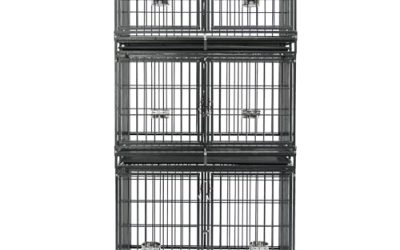
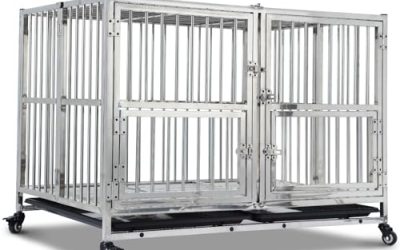
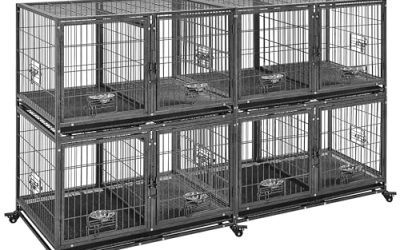
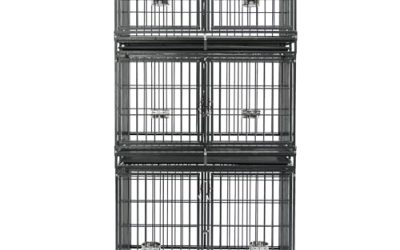
Stackable kennel crates are made for this situation. Two or more units lock together in a vertical bank, so several dogs can have their own compartment in the floor space of a single crate. Each tier has its own doors, tray, and feeding bowls, and the whole bank can often be moved on lockable wheels. For a home that cares for multiple dogs every day — a multi-dog family, a foster home, or a small home-based care setup — that vertical arrangement keeps feeding, cleaning, and rest in one organised place.
Disclosure: As an Amazon Associate, we earn from qualifying purchases.
How to Choose Stackable Dog Kennel Crates for Home Dog Care Setups
Planning the Crate Bank
Start with the room, not the crate. Measure the floor area, the ceiling height, and the doorway the crates must pass through. A two-tier bank roughly doubles the height of a single crate, and a three-tier bank can reach well over six feet, so ceiling height and the ability to reach the top tier safely matter. You need enough headroom above the bank to open the top doors fully, and enough space in front of it to open every door without hitting furniture. Plan the bank for the number of dogs you care for on a busy day, not just on a quiet one.
Stability and Stacking Safety
A stackable crate is only safe if the tiers lock together firmly. Look for a design where the upper tier sits in a frame or is fixed with screws or brackets, rather than simply resting on top of the lower tier. The frame should be steel tube or heavy-gauge metal, with a powder-coated finish to resist rust, and the base tier should have lockable wheels so the bank can be moved and then held still. Check the weight guidance for each tier. The lower tiers carry the weight of the tiers above them as well as the dog inside, so heavier dogs belong in the lower tiers, where the bank is most stable and lifting the dog in and out is easier. Lighter dogs, puppies, and small breeds are better suited to the upper tiers.
Access, Trays, and Cleaning
Daily care means reaching into every compartment often. Look for crates with an open top, side doors, and a front door on each tier, so you can lift a dog out from above, feed from the side, and check on the dog from the front without moving the whole bank. Feeding bowls that attach to the door or sit in a holder are useful, because they can be removed for washing without opening the main door. The open top lets you place a puppy into the crate from above, check a wound or bandage, or lift out a small dog that is reluctant to walk out through a door.
Our Top Picks
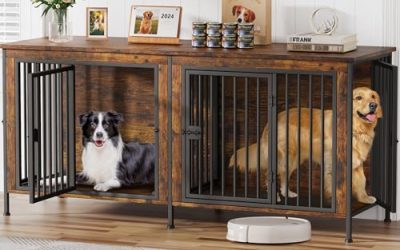
These three stackable crates suit different home care setups: a compact unit that can be stacked, a large two-tier unit with a divider, and a versatile unit that can be used as a single crate or as part of a taller bank.
Homey Pet 37-Inch Stackable Heavy Duty Dog Crate

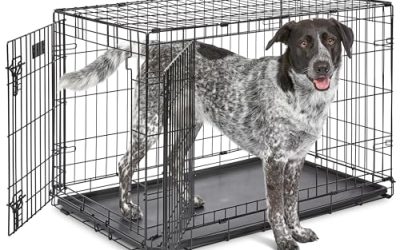
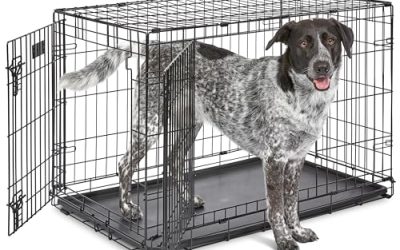
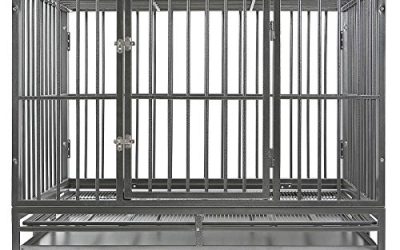
The Homey Pet 37-inch crate measures 37 by 22.5 by 31 inches and is designed to be stacked to save floor space in homes with multiple pets. It has a steel tube frame and wire panel design, double doors, lockable wheels, a removable tray, and a metal floor grid. The listing also includes two steel feeding bowls, a safe lock, and a tray. This size suits medium and small dogs such as French Bulldogs, Beagles, Corgis, and Dachshunds. In a home care setup, it works as a single tier that can be stacked with a second identical unit, or as a standalone crate for a smaller dog while larger dogs use a bigger bank nearby.
Best for: A home care setup for small to medium dogs, where a 37-inch stackable tier can be used alone or stacked with a matching unit.
Pros: Stackable design saves floor space; steel tube frame with an escape-resistant lock; lockable wheels; removable tray and metal floor grid; feeding bowls and divider included.
Cons: 37-inch length is too small for large breeds; stacking a second unit adds height that needs a safe lifting routine; heavy, so moving it with a dog inside is not advisable.
Yaheetech Stackable Dog Crate, 42-Inch, Heavy Duty

The Yaheetech 42-inch stackable crate can be used as a single crate or stacked with a second unit to create up to four separate compartments. It has a removable middle divider, so the interior can be split into two smaller compartments of about 20.5 by 27.6 by 21.7 inches each, or left open as one spacious area for a medium-sized dog. The top opens fully for inspection and cleaning, and the crate has four rolling wheels, double doors, and stainless-steel bowls with small feeding doors. The metal wire frame has a water-resistant powder coating, and the bar spacing is about 1.2 inches.
Best for: A home care setup that needs flexible compartments, with two small dogs in one tier or one medium dog in a larger space.
Pros: Removable divider creates two compartments or one large space; open top allows easy inspection and cleaning; stacking two units can create up to four compartments; rolling wheels; feeding doors give access to bowls without opening the main door.
Cons: A stacked pair is tall and heavy, so upper tiers suit smaller, lighter dogs; divider compartments are best for small dogs rather than medium breeds; assembly is required, so allow time before first use.
aboxoo 42/48-Inch Heavy Duty Metal Dog Crate, Stackable, with Wheels

The aboxoo stackable crate is available in 42-inch and 48-inch sizes, and it is designed for two dogs or one large dog, with an open top, a divider, a floor grid, a tray, and a feeding bowl. The all-metal frame has double doors, wheels, and a removable tray, and the stackable design allows a second unit to be placed on top to create a taller bank. The 48-inch option gives a large dog more length, while the 42-inch option suits medium dogs and fits more easily into a smaller care room. In a home care routine, this crate works well as the base tier of a bank, where a larger or heavier dog can be housed at ground level, with a smaller crate stacked above it.
Best for: A home care setup that needs a larger base tier for a medium or large dog, with the option to stack a second unit above it.
Pros: Available in 42-inch and 48-inch sizes; open top and double doors give flexible access for care; divider allows two dogs or one large dog in a single tier; wheels and removable tray support daily cleaning; stackable design allows a taller bank over time.
Cons: A stacked pair needs careful checking for stability before use; larger size is heavy and needs two people to move safely; upper tiers are best for smaller dogs, so plan the bank by weight.
Home Dog Care Setup Considerations
Build the setup around a daily routine. Feed dogs in the same order each day, in their own tiers, remove bowls after meals, and keep a simple log for a foster or multi-dog home: which dog is in which tier, when it was fed, when it went out, and any health notes. Wipe trays and bowls daily, wash bedding regularly, and check the frame, wheels, and latches weekly. Stackable crates are for rest, feeding, and short periods of care, not for keeping a dog confined all day, so build in time outside the crate for exercise, play, and social time.
Frequently Asked Questions
How many dogs can a stackable crate bank hold in a home care setup?
It depends on the number of tiers and the size of each tier. A two-tier bank holds two dogs, one per tier, or more if a tier is divided into two compartments for small dogs. A three-tier bank holds three dogs, one per tier. Always match each dog to a tier that is large enough for it to stand, turn, and lie flat, and place heavier dogs in the lower tiers.
Is it safe to stack dog crates in a home?
Stacking is safe when the crates are designed for it, the tiers are fixed together as the manufacturer instructs, and the bank sits on a level floor with the wheels locked. Place heavier dogs low, lighter dogs high, and check the fixings regularly. Do not stack crates that are not designed to be stacked, and do not place heavy items on top of a bank.
How do I clean a stackable crate bank without taking it apart?
Remove the tray from each tier and wash it separately, wipe the wire and frame with a pet-safe cleaner, and wash bowls and bedding regularly. The open top and side doors on most stackable crates allow you to reach inside without dismantling the bank. For a deeper clean, take the bank apart tier by tier, clean each unit, and reassemble it with the fixings checked.
Conclusion
Stackable kennel crates turn a multi-dog home care routine into an organised system. A vertical bank gives each dog its own tier, with its own doors, tray, and bowls, in the floor space of a single crate. Choose a bank that fits the room and the dogs, place heavier dogs low and lighter dogs high, and build feeding and cleaning into a daily routine. With the right stack and a steady pattern of care, the crates support the dogs’ rest and health instead of taking over the home.
More from Amazon
Programs that pair well with the guide above. Offers and eligibility are set by Amazon and may change.
Set up recurring deliveries of everyday items on eligible products. Terms and savings are set by Amazon.
Explore Subscribe & SaveFree shipping on eligible items, Prime Video and more. Eligible new members can start with a free trial.
Start a Prime free trialAudiobooks and podcasts to listen to on the go. Eligible new members can start with a free trial.
Try Audible freeRead from a large library of eBooks and audiobooks on any device. Check Amazon for current plans.
Explore Kindle UnlimitedAs an Amazon Associate we earn from qualifying purchases.