Key takeaways
- The best cat litter mat for most households is a 35″ x 23″ EVA honeycomb mat sized to extend at least 6 inches past every edge of the litter box, since that overhang catches the bulk of scatter before it…
The best cat litter mat for most households is a 35″ x 23″ EVA honeycomb mat sized to extend at least 6 inches past every edge of the litter box, since that overhang catches the bulk of scatter before it hits bare floor. Beyond that baseline, the right pick depends on your flooring, your cat’s digging habits, and how much weekly cleanup you’re willing to do.
As an Amazon Associate we earn from qualifying purchases at no extra cost to you.


What Actually Determines How Much Litter a Mat Traps
Litter tracking happens in two stages: scatter (litter kicked out during digging) and transfer (litter stuck to paws that falls off as a cat walks away). A mat’s trapping performance comes down to three variables: surface texture depth, mat size relative to the box, and how often it gets shaken out or vacuumed. Mats with deeper honeycomb cells or longer microfiber loops hold more litter against paw pressure, but they also need more frequent cleaning or the trapped litter just gets kicked free again on the next pass.
Based on typical litter weight data for clay and clumping litters (roughly 2.5 to 3 lbs per cup), a well-sized honeycomb mat under a single-cat household can trap anywhere from 4 to 9 ounces of litter per week, mostly concentrated in the first 12 inches off the box. A mat that’s undersized for the box or placed with less than 4 inches of clearance on any side will trap closer to 2 ounces per week, with the rest ending up on the floor beyond it.
Matching Mat Size to Box Footprint
Most standard litter boxes measure between 18″ x 15″ and 24″ x 18″, while jumbo and corner boxes can run up to 28″ x 22″. The mat needs to extend past the box on the sides your cat actually exits from, which for most cats is every side since they rotate before digging.
| Box Type | Typical Box Size | Recommended Mat Size | Overhang per Side |
|---|---|---|---|
| Small/kitten box | 16″ x 12″ | 24″ x 17″ | ~3.5″ |
| Standard box | 20″ x 16″ | 30″ x 23″ | ~4.5″ |
| Jumbo/high-sided box | 24″ x 18″ | 35″ x 23″ | ~5.5″ |
| Corner or enclosed box | 28″ x 22″ | 40″ x 28″ (or two overlapping mats) | ~5–6″ |
If your mat and box sizes don’t fit neatly into these ranges, round up rather than down. An oversized mat with excess overhang on one side costs you nothing; an undersized mat loses most of its trapping ability on the short side.
EVA Honeycomb vs. Rubber-Backed Microfiber vs. Silicone
These three materials dominate the litter mat category in 2026, and each has a different failure point.
- EVA honeycomb:
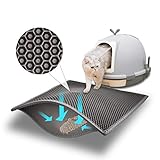
EVA honeycomb mats use a double layer with holes that let litter fall through the top layer and stay trapped in the bottom tray. They trap the most litter by weight because the holes act as a one-way filter, but the edges are the weak point: EVA foam curls upward at the corners within a few months of regular folding or washing, especially in dry indoor air. Vacuuming is easy since the holes let a vacuum nozzle pull litter straight out without lifting the mat.
Rubber-backed microfiber mats trap litter in dense fiber loops rather than holes. They’re the quietest underfoot and grip hardwood floors better than EVA honeycomb because the rubber backing has real friction, not just weight. The trade-off is cleaning: litter buried in the fibers doesn’t vacuum out easily, and these mats generally need shaking out or a once-a-week machine wash to stay effective. The rubber backing is also the first thing to wear out, typically cracking or peeling at the 12-18 month mark with daily use.
Silicone mats are the newest mainstream option and behave like a flexible, slightly tacky sheet with shallow ridges. They don’t trap as much litter by weight as honeycomb or microfiber, but what they do trap stays visible on the surface, which makes a quick wipe-down or shake-out fully effective. Silicone resists curling far better than EVA and tends to lie flatter over its lifespan, but it has the weakest grip on carpet, where it can bunch or slide if the carpet pile is thick.
Side-by-Side Comparison
| Material | Weekly Litter Trapped (avg. single-cat home) | Edge Curling Over Time | Vacuum-Friendly | Hardwood Grip | Carpet Grip |
|---|---|---|---|---|---|
| EVA honeycomb | 6–9 oz | Moderate to high after 3-4 months | Yes, holes pull clean | Fair (needs non-slip pad) | Good |
| Rubber-backed microfiber | 5–7 oz | Low (fabric doesn’t curl, but backing can crack) | Poor, fibers hold litter | Very good | Fair (can shift on low-pile) |
| Silicone | 3–5 oz | Very low | Not needed, wipes clean | Good | Poor to fair |
Hardwood vs. Carpet: Why the Same Mat Behaves Differently
On hardwood, friction is the whole game. A mat that doesn’t have rubberized nubs or a non-slip backing will slide every time a cat jumps off it, which over months leaves scratch marks and eventually pushes the mat out from under the box entirely. Rubber-backed microfiber performs best here because the backing material is designed for grip, not just weight.
On carpet, the opposite problem shows up. Mats with thick rubber backing or deep silicone ridges can bunch against carpet fibers, creating a lip at the edge that cats either refuse to cross or that catches a paw. Thin, flexible EVA honeycomb mats tend to sit flatter on carpet and are less likely to shift, since the carpet pile itself provides enough friction to anchor a lightweight mat.
If you have mixed flooring, such as a hardwood-floored bathroom with a carpeted hallway leading to it, place the mat fully on the hardwood section if possible. A mat straddling a transition strip almost always curls or slides at that seam.
Decision Guide: Picking by Situation
| Your Situation | Best Pick | Why |
|---|---|---|
| Multi-cat household, heavy digger(s) | EVA honeycomb, largest size that fits your space | Highest litter-trapping capacity and easiest to vacuum daily |
| Hardwood floors, mat keeps sliding | Rubber-backed microfiber | Best grip of the three materials on smooth surfaces |
| Want minimal maintenance, light tracker | Silicone | Wipes clean in seconds, no shaking or vacuuming needed |
| Carpeted room | Thin EVA honeycomb or low-profile microfiber | Avoids bunching and edge-catching that thicker mats cause on pile |
| Senior cat or kitten with mobility concerns | Silicone or thin microfiber, no raised honeycomb lip | Flat, low-profile surface is easier and safer to step across |
| Budget-conscious, replacing frequently | Basic EVA honeycomb | Lowest cost per mat even though it has the shortest lifespan |
Ownership Realities: What Wears Out First
Regardless of material, the most common failure isn’t the mat tearing, it’s the edges losing their flat shape. EVA honeycomb curls because the foam dries out and loses flexibility, especially if it’s washed and air-dried without being laid fully flat. Rubber backing on microfiber mats cracks when it’s repeatedly rolled or folded for storage or washing. Silicone holds its shape longest but can develop a slightly tacky residue over 6-12 months that attracts dust, which just needs a wipe with mild soap and water rather than replacement.
A few habits extend any mat’s useful life: shake mats outdoors rather than inside to avoid redistributing litter onto nearby flooring, lay them flat to dry after washing instead of hanging them, and rotate the mat 180 degrees every few weeks so the heaviest-traffic edge (usually the exit side) doesn’t bear all the wear.
FAQ
Do bigger mats actually reduce tracking, or just hide it?
Bigger mats genuinely reduce tracking because litter has to travel farther to clear the mat. Once a cat’s paws have taken 2-3 steps on a textured surface, most loose litter has already dropped off. A mat under 24 inches long often doesn’t give a cat enough steps before reaching bare floor.
How often should a litter mat be cleaned?
Honeycomb mats benefit from a quick vacuum every 2-3 days since litter sits visibly in the lower tray. Microfiber mats need a full shake-out or wash weekly, since litter embeds in the fibers and isn’t visible until it’s tracked further. Silicone mats can be wiped as needed, often daily in multi-cat homes, since there’s no absorption to deal with.