Key takeaways
- You have a large cat or a long-bodied cat: Start with a wheel near 40–48 inches. Watch for a relaxed back and an even stride when your cat walks on the track. If the cat has to crouch or shorten each step, a smaller wheel is a poor fit regardless of its price or portability.
- You live in a small apartment: Measure the floor area before ordering. Include space for the base, a clear approach, and room to step around the wheel. A compact wheel may make sense for a smaller cat, but do not trade away comfortable posture just to save a few inches.
- Your floors are hard or your home is noise-sensitive: Look for smooth-running bearings, secure track connections, and a stable base. Place the wheel on a dense, non-slip mat that does not obstruct the mechanism. A mat can reduce floor vibration; it will not silence claws striking the track or a squeaky bearing.
- Your cat is cautious or new to wheels: Favor a steady, grippy running surface and a wheel that can be moved or temporarily secured during early sessions. Avoid forcing the wheel to spin under the cat. Let curiosity and treats build familiarity at the cat’s pace.
- You want the easiest cleaning routine: Check whether the running surface can be removed or wiped down. Carpet-style tracks can feel secure underfoot but collect fur and may take longer to clean than a smooth, textured surface.
Best Cat Exercise Wheels for Indoor Energy and Play
The best cat exercise wheels are large enough for your cat to run with a relaxed back, grippy enough to prevent slipping, quiet enough for your home, and small enough to fit without blocking a walkway. For most households, a wheel around 40 inches in diameter is a practical starting point; choose a larger model for a long-bodied cat or a compact wheel only if your cat can use it without hunching.
Among recognizable options, the One Fast Cat Exercise Wheel is a modular choice with a roughly 48-inch outside diameter, while the Penn-Plax Spin Kitty is a smaller, roughly 31-inch wheel. Their size difference matters more than a long feature list: a compact wheel is easier to place, but gives a cat less room to lengthen its stride. Always confirm the current dimensions and assembly requirements with the manufacturer before buying; model details can change.
Our top picks
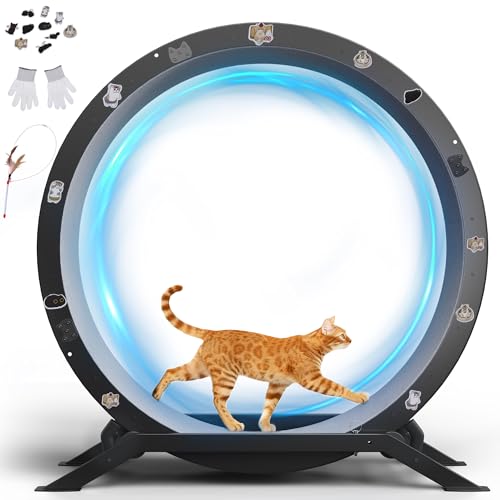


As an Amazon Associate we earn from qualifying purchases at no extra cost to you. Ratings are shown as listed on Amazon.
At a glance: size, surface, sound, and space
| Option | Approx. wheel diameter | Running surface | Space and sound considerations | Best suited to |
|---|---|---|---|---|
| One Fast Cat Exercise Wheel | About 48 in (122 cm) | Modular track with a carpet-style running surface | Large floor footprint; wheel rotation and cat claws can be audible, especially on a hard floor | Homes with enough open floor space and cats that need a longer running arc |
| Penn-Plax Spin Kitty | About 31 in (79 cm) | Textured running track | More compact, though a smaller wheel may be less comfortable for long-striding cats; check how the base moves on your flooring | Small spaces and cats that fit the running curve comfortably |
| Large, 40–48 in wheel category | 40–48 in (102–122 cm) | Carpet, textured plastic, or a replaceable grip strip, depending on model | Needs clear space around the wheel; bearings, track joins, and floor contact affect noise | Owners who prioritize a natural stride and can dedicate a corner |
| Compact, 30–36 in wheel category | 30–36 in (76–91 cm) | Usually a molded or textured track | Smaller footprint, but the tighter curve may encourage a hunched posture in larger cats | Small cats or homes where a full-size wheel will not fit |
Dimensions above are approximate product-category guidance, not a guarantee of usable running width. A wheel’s outside diameter does not tell you how broad the track is, how high its sidewalls are, or how stable its base feels. Check the assembled dimensions and the manufacturer’s cat-size guidance, then compare them with your cat’s body length and stance.
Choose by your room and your cat—not by diameter alone
- You have a large cat or a long-bodied cat: Start with a wheel near 40–48 inches. Watch for a relaxed back and an even stride when your cat walks on the track. If the cat has to crouch or shorten each step, a smaller wheel is a poor fit regardless of its price or portability.
- You live in a small apartment: Measure the floor area before ordering. Include space for the base, a clear approach, and room to step around the wheel. A compact wheel may make sense for a smaller cat, but do not trade away comfortable posture just to save a few inches.
- Your floors are hard or your home is noise-sensitive: Look for smooth-running bearings, secure track connections, and a stable base. Place the wheel on a dense, non-slip mat that does not obstruct the mechanism. A mat can reduce floor vibration; it will not silence claws striking the track or a squeaky bearing.
- Your cat is cautious or new to wheels: Favor a steady, grippy running surface and a wheel that can be moved or temporarily secured during early sessions. Avoid forcing the wheel to spin under the cat. Let curiosity and treats build familiarity at the cat’s pace.
- You want the easiest cleaning routine: Check whether the running surface can be removed or wiped down. Carpet-style tracks can feel secure underfoot but collect fur and may take longer to clean than a smooth, textured surface.
Head-to-head: One Fast Cat vs. Penn-Plax Spin Kitty
One Fast Cat: more room to stretch, more room required
At roughly 48 inches in outside diameter, the One Fast Cat wheel is the more compelling starting point for owners prioritizing a longer running curve. Its modular construction can help with transport and assembly, and its carpet-style track provides a different feel from bare plastic. The trade-offs are a substantial footprint and a surface that needs regular fur removal. Track sections and fasteners should also be checked periodically, since looseness can create rattling or uneven running.
Measure the assembled wheel, not just the circular track. A large wheel needs clear space around its base, and a tight corner may make it difficult to access for cleaning or adjustment. It may also be conspicuous in a shared room.
Penn-Plax Spin Kitty: a smaller footprint with a sizing caveat
The Spin Kitty’s roughly 31-inch diameter can be appealing where floor space is limited. Its smaller size is not automatically a better fit, though: the tight curve may not suit a large cat or one that prefers a long stride. Before choosing it, check the maker’s current size guidance and, if possible, observe whether your cat can stand and walk on the track without visibly rounding its back.
As with any compact wheel, stability and sound depend on the assembled unit, floor, and running surface. Check for wobble and track movement before encouraging a faster run. If it shifts when pushed by hand, reposition or stabilize it according to the instructions rather than letting a cat discover the problem at speed.
What to check before you buy
Fit: measure the clear footprint
Use the product’s assembled width and depth to mark a rectangle on the floor with painter’s tape. Then add a practical clearance zone for entry, exit, and cleaning. For a circular wheel, measuring diameter alone is insufficient: the base can extend beyond the track, and a nearby wall can interfere with mounting or access.
Grip: balance traction and cleanability
A track should offer enough grip for controlled steps without creating an abrasive or difficult-to-clean surface. Carpet can hold fur and debris; molded tracks are simpler to wipe but vary in texture. Inspect whether the surface is replaceable, how it attaches, and whether seams or raised edges could catch claws. Keep the track dry and clear of litter, which can reduce traction.
Noise: separate wheel noise from floor noise
Rumbling often comes from the base vibrating against the floor; clicking may come from a loose track connection; squeaking can point to a bearing that needs attention under the maker’s maintenance instructions. Listen to the unloaded wheel first, then check again at a slow walking pace. Tighten only the parts the instructions identify, and do not apply oils or lubricants unless the manufacturer permits them.
Setup and ownership: the details that affect daily use
- Assemble on a level surface. A tilted or uneven base can make the wheel wobble and increase noise.
- Inspect every join and fastener. Track seams, bolts, and the base are common places for movement to develop. Recheck them after initial use and at routine intervals.
- Introduce the wheel while stationary. Let your cat sniff and step onto it before encouraging any movement. Reward voluntary exploration; do not place the cat on a spinning wheel.
- Start with brief, supervised sessions. Keep the wheel stable and the area clear. Stop if your cat seems frightened or the wheel shifts, catches, or makes a new noise.
- Clean according to the surface type. Remove loose fur regularly. Wipe washable tracks as directed and let them dry fully before use. Replace worn or peeling grip material rather than covering it with an improvised surface that could snag.
The track surface and moving parts are the main ownership concerns. Carpet-style material can mat or hold hair; textured plastic can become slippery if dirty; bearings and joints may need inspection. A quick weekly check for fur buildup, loose hardware, and wobble is more useful than waiting for a noise to become obvious.
Bottom line
For a cat that needs room to lengthen its stride and a home with dedicated floor space, a large wheel such as the One Fast Cat is the stronger starting point. For a smaller cat and a genuinely tight room, the Penn-Plax Spin Kitty may be worth considering—but only after checking posture and current fit guidance. If neither size fits comfortably, skip the wheel rather than choosing an awkward one: a secure climbing structure, interactive play, and food puzzles can offer indoor activity without forcing a poor fit.
A wheel is an enrichment option, not a substitute for veterinary care or a guaranteed exercise solution. If your cat has mobility concerns, pain, or a health condition, ask a veterinarian whether running-wheel activity is appropriate.