Key takeaways
- Fleece and plush: warm and soft, but they can trap hair and take longer to dry.
- Microfiber or short polyester fabric: usually easier to vacuum and less likely to snag than long faux fur.
- Canvas and woven cotton: cooler and more resistant to claw contact, though less luxurious.
- Memory foam: supportive and slow to flatten, but it should have a removable cover because the foam core itself is rarely machine washable.
- Polyester fiberfill: affordable and lightweight, but it can compress into uneven lumps if washed or dried too aggressively.
- Rubberized or non-slip bottoms: useful on smooth floors, although the dots or coating may crack after repeated hot washing.
The best cat beds are the ones that match your cat’s sleeping posture, fit the space they already choose, and have removable, washable covers with enough support for repeated use.
Quick picks by sleeping style and home layout
| Cat or space | Best bed type | Useful target specifications | Why it works |
|---|---|---|---|
| Cat who curls into a tight ball | Round bolster bed | 16–20 inches wide; 3–5-inch raised rim | Creates a contained nest without taking much floor space |
| Cat who stretches out | Flat mat or low-profile sofa bed | 24–30 inches long; at least 1.5 inches of resilient filling | Allows full-body extension and easy entry |
| Senior, stiff, or cautious cat | Low-entry orthopedic bed | 2–4-inch supportive foam; entry lip under 3 inches | Reduces climbing effort while keeping the sleeping surface stable |
| Cat who seeks warmth | Self-warming bed or covered cave | Reflective insulating layer or removable fleece; 16–20-inch opening | Holds body heat without requiring an electrical cord |
| Small apartment or shelf | Window perch or compact mat | 15–20-inch platform; load rating above the cat’s weight | Uses vertical or existing furniture space instead of floor area |
| Messy household or frequent washing | Simple bolster with removable cover | Two washable covers; polyester or microfiber outer fabric | Shortens drying downtime and limits odor retention |
What to compare before buying
Dimensions: measure the cat’s sleeping shape, not just its body
Measure from the cat’s nose to the base of the tail while the cat is lying in its usual position, then add 4–6 inches. For a cat that sleeps curled, measure the diameter of the curl and add about 3 inches. A bed that is too large may feel exposed to a cat that prefers a nest, while one that is too small forces a long sleeper to keep its paws or tail on the floor.
Our top picks


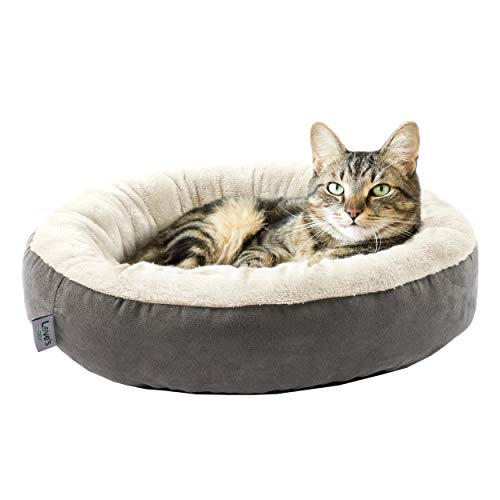
As an Amazon Associate we earn from qualifying purchases at no extra cost to you. Ratings are shown as listed on Amazon.
Also measure the usable interior rather than the advertised outside dimensions. A 20-inch round bed with a 4-inch bolster may offer only about 12 inches of flat sleeping area. This distinction matters particularly for beds with thick walls, cave entrances, or deep cushioning.
Materials: comfort is only half the decision
- Fleece and plush: warm and soft, but they can trap hair and take longer to dry.
- Microfiber or short polyester fabric: usually easier to vacuum and less likely to snag than long faux fur.
- Canvas and woven cotton: cooler and more resistant to claw contact, though less luxurious.
- Memory foam: supportive and slow to flatten, but it should have a removable cover because the foam core itself is rarely machine washable.
- Polyester fiberfill: affordable and lightweight, but it can compress into uneven lumps if washed or dried too aggressively.
- Rubberized or non-slip bottoms: useful on smooth floors, although the dots or coating may crack after repeated hot washing.
For most homes, a short-pile, removable polyester cover over a separate foam or fiber insert is the best balance of comfort and maintenance. A fully stuffed one-piece bed is simpler to buy but harder to wash thoroughly and replace when the filling collapses.
Washability: look beyond “machine washable”
Check whether the cover unzips completely, whether the cushion fits in your washing machine, and whether the care label permits low-heat drying. “Machine washable” may refer only to the cover. If the entire bed must be washed, a large bolster can overload a compact machine and remain damp inside for many hours.
The most practical setup is two covers for one insert. Wash one cover while the other is in use, and place a washable blanket over the bed during shedding season. Avoid fabric softener: it can leave residues that reduce absorbency and may irritate sensitive skin. Dry the insert completely before putting the cover back on, particularly where seams and inner corners retain moisture.
Head-to-head: the main cat-bed designs
Bolster bed versus flat mat
A bolster bed is the better choice for cats that curl, lean against something, or knead before settling. Its raised edge can also make a bed feel more enclosed in an open room. The trade-off is reduced usable floor area and more seams where hair and litter collect.
A flat mat wins for cats that stretch, change position frequently, or dislike feeling enclosed. It slides easily onto a sofa, shelf, or carrier and is usually faster to wash. Look for a non-slip underside if it will sit on hardwood or tile. A mat with less than about 1 inch of soft filling may provide warmth but little cushioning.
Cave bed versus open bed
Cave beds suit cats that hide under blankets, sleep in closets, or prefer dim, sheltered locations. Select an opening that is large enough for the cat to enter without compressing its whiskers, generally 8–12 inches for many adult cats. A cave that collapses when entered may be rejected even if its fabric is attractive, so a flexible but stable rim is preferable.
Open beds are more versatile for cats that like to watch the room or move quickly when disturbed. They are also easier to inspect and clean. If a cat ignores a cave, do not assume it dislikes the bed; the location may be too exposed, too warm, or too far from its preferred resting route.
Heated bed versus self-warming bed
A self-warming bed uses insulating or reflective layers and avoids cords, controls, and electrical safety considerations. It is a good first choice for a cat that simply seeks a warmer surface.
An electric heated bed can provide more consistent warmth, but it needs an intact, chew-resistant cord, a low-temperature design intended for pets, and a location away from water. Follow the manufacturer’s instructions and inspect the cable regularly. Do not cover a heated pad with thick material unless the instructions specifically allow it, because added insulation can change how heat accumulates.
Durability and ownership costs in 2026
Basic washable mats commonly cost about $15–$35, bolster beds about $25–$60, and orthopedic or heated designs about $45–$100 or more. Brand-name examples such as Furhaven sofa-style beds, K&H Pet Products self-warming or heated beds, and Catit Vesper furniture beds occupy different parts of this range depending on size and construction. Prices vary by retailer, material, and seasonal demand.
The first component to wear out is often not the cushion. It is usually the zipper, non-slip backing, inner liner, or a seam exposed to kneading claws. A removable cover is therefore more valuable than decorative fabric. Before buying, open and close the zipper several times, check whether the seam is reinforced, and look for a cushion that can be replaced separately.
Consider a simple ownership calculation. Suppose a $40 bed lasts two years and is washed once a week. That is approximately 104 washes, or about $0.38 per wash before detergent and electricity. A $25 one-piece bed that loses its shape after six months costs roughly $0.96 per wash over the same period, even before considering replacement time. The cheaper purchase is not necessarily the cheaper bed.
Decision matrix: choose by the problem you need to solve
| Your priority | Choose | Prioritize | Avoid |
|---|---|---|---|
| Lowest upfront cost | Flat reversible mat | Removable cover and washable blanket layer | Decorative beds with non-removable stuffing |
| Small room | Window perch, shelf mat, or 16-inch round bed | Stable base and compact footprint | Deep beds that block walkways or doors |
| Frequent accidents or heavy shedding | Two-cover bolster or waterproof-lined bed | Quick-dry fabric, spare cover, accessible seams | Long pile and foam that cannot be removed |
| Large cat or bonded pair | Wide flat bed or two separate beds | 30-inch-plus length and a firm base | One narrow round bed shared by choice rather than necessity |
| Cat reluctant to use new items | Low-profile mat | Familiar blanket and placement near an existing nap spot | Strong fragrances, noisy crinkle inserts, or sudden relocation |
How to set up and maintain a new bed
- Start with location. Put the bed beside a favored window, radiator-free warm area, or quiet route—not in a busy doorway. Cats often choose comfort based on visibility and escape access as much as softness.
- Add familiar scent. Place a used, clean blanket on top for the first few days. Avoid perfume and strong cleaning products.
- Check stability. The bed should not tip, slide, or sag when the cat steps onto it. For a raised perch, use the supplied fasteners and observe it before leaving the cat unattended.
- Clean on a schedule. Vacuum or shake out loose hair weekly, wash the cover when it smells dusty or visibly soiled, and inspect the insert monthly for lumps, dampness, or flattened areas.
- Replace based on support. Replace the bed when the base stays compressed, the cover develops sharp exposed hardware, or washing no longer removes odor—not merely when the surface looks worn.
Bottom line
For most cats, a medium-size removable-cover bolster bed is the safest all-purpose choice, while a flat washable mat is better for stretchers and a low-entry foam bed is worth considering when easy access and lasting support matter. Measure the interior, buy for the cat’s preferred posture, and treat cleaning and replacement parts as core features rather than extras.