Key takeaways
- Interior: approximately 19.75 × 11.00 × 7.60 in (lid depth ~2.00 in, base depth ~5.60 in)
- Exterior: approximately 22.00 × 13.81 × 9.00 in — carry-on class
- Usable volume: roughly 1,650 cubic inches / 27 liters of interior, before foam or dividers
- Configured weight: approximately 13.5 lb with the padded divider set installed
- Configuration: repositionable padded divider panels with hook-and-loop edges
- Mobility: retractable extension handle, two wheels on stainless-steel bearings, plus molded side and top handles
- Sealing: watertight gasket, automatic pressure equalization valve, stainless-steel hardware, crushproof and dustproof construction
- Price tier: premium
The direct answer: for most photographers, the Pelican 1510 with Padded Dividers is the best Pelican case for cameras, because it is the largest Pelican that still fits in an overhead bin — roughly 19.75 × 11.00 × 7.60 inches of interior space in a body that matches the standard 22 × 14 × 9 inch domestic carry-on envelope. It swallows a gripped full-frame body with a 70–200mm attached plus two or three primes, rolls on real wheels, and never has to leave your sight. If the premium tier is out of reach, the Pelican 1200 with Foam is the best budget entry for a single body and one compact lens, and the Pelican 1400 with Foam is the better budget choice the moment you add a second lens. If the case’s own weight is the deciding factor — and for shoulder-carried or weight-capped international travel it often is — the Pelican Air 1535 with TrekPak Dividers delivers the same carry-on footprint at roughly ten pounds instead of thirteen and a half.
Top 3 Picks
Best overall: Pelican 1510 with Padded Dividers
The 1510 is the case that made “Pelican” a verb in photographer circles. Its interior is deep enough for a pro body with a 70–200mm mounted, its exterior matches the domestic carry-on envelope almost exactly, and the padded divider set lets you reshape the interior for a two-body documentary kit or a single-body landscape kit in under two minutes. The wheels and retractable handle mean you are not carrying thirteen-plus pounds on one shoulder through a terminal. It is the premium tier, but it is the one case in this list that covers the widest range of real shooting situations.
Best budget: Pelican 1200 with Foam
At roughly 9.25 × 7.12 × 4.12 inches of interior and under three pounds empty, the 1200 is a genuinely pocketable hard case — small enough to live in a backpack or a pannier, tough enough to survive a drop onto rock. It fits a mirrorless or DSLR body with a compact zoom, or a body plus a small prime and batteries. If your kit is one body and one short lens, this is the cheapest way to get real Pelican protection.
Best premium for weight-conscious travel: Pelican Air 1535 with TrekPak Dividers
The Air 1535 occupies the same carry-on footprint as the 1510 but weighs about ten pounds configured instead of thirteen and a half. That three-and-a-half-pound difference is the difference between busting and making a 10 kg international cabin allowance with a real camera kit. TrekPak’s rigid pinned dividers also hold a layout more precisely than pluck foam and waste less interior volume. It is premium tier and the divider system takes practice to re-pin, but nothing else here matches its weight-to-space ratio.
Quick Comparison
All seven cases below are Pelican hard cases with a watertight gasket seal. The table groups them by what they are actually good at, not by price. Interior figures are manufacturer-published values rounded to two decimals; weights are configured weights (case plus whatever foam or divider system ships with it) and vary slightly by production revision, so confirm current numbers against the spec sheet before you buy.
| Product | Best for | Interior (approx., in) | Usable volume (approx.) | Weight configured (approx.) | Interior configuration | Portability | Price tier |
|---|---|---|---|---|---|---|---|
| Pelican 1510 with Padded Dividers | Overall pick; carry-on air travel with a working kit | 19.75 × 11.00 × 7.60 | ~1,650 cu in / ~27 L | ~13.5 lb | Repositionable padded divider panels | Wheels + retractable handle; carry-on sized | Premium |
| Pelican Vault V525 with Padded Dividers | Mid-range protection for a two-body or body-plus-glass kit | ~20 × 11.5 × 7.5 (spec class) | ~1,700 cu in / ~28 L | ~11–12 lb | Repositionable padded divider panels | Hand-carry molded handle | Mid-range |
| Pelican 1200 with Foam | Single body + one compact lens; backpack-sized protection | 9.25 × 7.12 × 4.12 | ~270 cu in / ~4.4 L | ~2.9 lb | Three-piece foam set (pluck + solid + lid) | Hand-carry; fits inside a pack | Budget |
| Pelican Vault V100 with Foam | Compact camera, small drone, action-cam or audio kit | ~11.5 × 8 × 4.5 (spec class) | ~400 cu in / ~6.5 L | ~2.5–3 lb | Foam insert set | Hand-carry; OD green finish | Budget |
| Pelican 1400 with Foam | Body plus two lenses on a budget | 11.81 × 8.87 × 5.18 | ~540 cu in / ~8.9 L | ~4.5 lb | Three-piece foam set | Hand-carry; fits a large shoulder bag footprint | Budget |
| Pelican Air 1535 with TrekPak Dividers | Weight-capped and shoulder-carried travel | 20.39 × 11.20 × 7.21 | ~1,650 cu in / ~27 L | ~10.0 lb | TrekPak rigid pinned divider panels | Wheels + retractable handle; carry-on sized | Premium |
| Pelican V700 | Large kits, long glass, lighting, checked luggage | ~21.5 × 14.5 × 7.5 (spec class) | ~2,300 cu in / ~38 L | ~16 lb | Foam | Wheels + retractable handle; oversize for a bin | Mid-range |
Two things jump out of that table. First, the two carry-on-class cases — the 1510 and the Air 1535 — have almost identical interior volume, so the choice between them is purely about weight, divider system and price tier, not capacity. Second, the Vault cases trade absolute toughness for weight and cost: they are lighter than Protector-line cases of similar footprint, which is exactly why they are mid-range rather than premium.
How We Chose
Every case here was evaluated on the same six criteria, in this order. Interior geometry first: published interior length, width, and the split between lid depth and base depth, measured against the real dimensions of common kits — a gripped body, a 70–200mm f/2.8, a 16–35mm f/2.8, a compact drone with controller. A case that cannot hold a 70–200mm lying flat is not a working photographer’s case, no matter how tough it is. Interior configuration second: whether the case ships with pluck foam, repositionable padded dividers, or a pinned rigid divider system, and how much usable volume each approach wastes. Weight and portability third: configured weight, wheel and handle design, and whether the exterior matches a carry-on envelope that airlines actually enforce. Seal and hardware fourth: gasket design, purge valve, latch type, hinge pin and wheel construction. Upgrade path fifth: whether you can swap foam for dividers later, replace the gasket, or re-foam the case when your kit changes. Price tier last: budget, mid-range and premium, judged against how many years of service each tier realistically buys.
1. Pelican 1510 with Padded Dividers – Best for Carry-On Air Travel
As an Amazon Associate we earn from qualifying purchases at no extra cost to you.

If you fly with a camera kit more than twice a year, this is the case the rest of the list is measured against. The 1510’s exterior dimensions sit inside the standard domestic carry-on envelope of roughly 22 × 14 × 9 inches, which means the case — and everything in it — goes in the overhead bin instead of the hold. For a working photographer, that single fact is worth more than any other specification on this page: checked camera gear is gear that gets lost, delayed, opened, or thrown.
Key specs
- Interior: approximately 19.75 × 11.00 × 7.60 in (lid depth ~2.00 in, base depth ~5.60 in)
- Exterior: approximately 22.00 × 13.81 × 9.00 in — carry-on class
- Usable volume: roughly 1,650 cubic inches / 27 liters of interior, before foam or dividers
- Configured weight: approximately 13.5 lb with the padded divider set installed
- Configuration: repositionable padded divider panels with hook-and-loop edges
- Mobility: retractable extension handle, two wheels on stainless-steel bearings, plus molded side and top handles
- Sealing: watertight gasket, automatic pressure equalization valve, stainless-steel hardware, crushproof and dustproof construction
- Price tier: premium
What actually fits
The 5.6-inch base depth is the number that matters most. A pro body with a 70–200mm f/2.8 mounted measures roughly 5.5 to 6 inches across the lens barrel with the hood reversed, so the combo lies flat in the base with a fraction of an inch to spare — tight enough that you will want a divider panel under it, but it fits. That leaves the 2-inch lid for flat items: filters, a tablet, cables, a small LED panel. A realistic working load is one gripped body with a 70–200mm attached, a second body or a 16–35mm f/2.8, two primes, a flash, eight batteries, and a charger. Two bodies with two zooms each is achievable but leaves almost no room for accessories.
Strengths
The padded divider system is the reason to buy this version rather than the foam version. Dividers let you reshape the interior in a couple of minutes without destroying anything, so the same case can carry a landscape kit in April and a two-body event kit in June. They also cushion better than pluck foam for irregular shapes, and they do not shed foam dust onto your sensor — a real problem with pick-‘n’-pluck foam after a few years of flexing.
The mobility package is genuinely useful rather than decorative. Thirteen and a half pounds is light enough to carry by the top handle for a hundred yards and heavy enough that you will not want to carry it for a quarter mile, so the retractable handle and wheels earn their space. The automatic purge valve handles the pressure differential between a pressurized cabin and a ground-level hotel room without you touching it.
Ownership is also unusually cheap. The gasket is replaceable, the latches are replaceable, the wheels are replaceable, and the case body itself is effectively a lifetime item. That serviceability is a large part of what the premium tier buys you.
Pros
- Genuine carry-on dimensions — the case never has to be checked on domestic flights
- Base depth accepts a body with a 70–200mm f/2.8 mounted
- Padded dividers reconfigure without destroying the interior
- Wheels and retractable handle make a 13.5 lb load manageable
- Replaceable gasket, latches and wheels give a very long service life
- Automatic pressure equalization valve for air travel
Cons
- Heaviest carry-on-class option here at roughly 13.5 lb before you pack anything
- Premium tier pricing for a case that is mostly empty air by volume
- Padded dividers waste more interior volume than a rigid pinned system
- Empty weight can push you over a 7 kg cabin allowance on stricter international carriers
- At 9 inches deep externally it fits most regional bins but is tight on some small commuter aircraft
How it compares
Against the Air 1535, the 1510 is the tougher case: thicker walls, more resistance to flex under a stack of luggage, and a longer track record. The Air 1535 beats it on weight by roughly three and a half pounds and on interior precision thanks to TrekPak, which matters enormously if you are carrying it on your shoulder between shoots or flying on a carrier with a 10 kg cabin cap. Against the Vault V525, the 1510 wins on mobility (wheels versus a hand-carry handle), on carry-on compliance, and on absolute durability — but the V525 is mid-range rather than premium and roughly two pounds lighter, which is a real argument if you never fly. Choose the 1510 if the case has to travel by air; choose the V525 if it lives in a car.
2. Pelican Vault V525 with Padded Dividers – Best Mid-Range Case for a Two-Body Kit

The Vault line is Pelican’s mid-range family: same gasket-and-latch philosophy, lighter construction, lower price tier. The V525 with padded dividers is the sweet spot in that family for photographers, because its interior footprint sits in the same broad class as the 1510 — roughly 20 inches long, 11.5 inches wide and 7.5 inches deep, though published figures shift slightly between production revisions, so treat those as a spec class rather than gospel and check the current sheet.
Key specs
- Interior: approximately 20 × 11.5 × 7.5 in (spec class for a mid-size case)
- Usable volume: roughly 1,700 cubic inches / 28 liters before dividers
- Configured weight: approximately 11–12 lb with the padded divider set
- Configuration: repositionable padded divider panels
- Mobility: hand-carry format with a molded folding handle — no wheels
- Sealing: watertight gasket seal, pressure equalization valve, crushproof shell
- Price tier: mid-range
Who it suits
This is the case for the photographer who drives to most shoots. If your kit travels in a trunk, a van, or a pelican case that lives on a shelf in a studio and only comes out for weddings and events, wheels are dead weight and the Vault’s lighter shell is a straight upgrade. The padded divider set is the same idea as the 1510’s: repositionable panels, no foam dust, quick reconfiguration between a two-body event load and a single-body-plus-glass load.
The interior is also more forgiving of bulky accessories than its length suggests. The wider 11.5-inch footprint means a speedlight, a battery charger and a stack of filters can sit alongside two bodies without being crammed into the lid. That is a meaningful difference from the budget cases further down this list, where every accessory competes for the same square inches as the lenses.
Strengths
The value proposition is straightforward: roughly 85 to 90 percent of the protection at a distinctly lower price tier, with about two pounds less to lift. The Vault shell is molded from a rugged polymer rather than the heavier-duty formulation used in the Protector line, and Pelican positions Vault as the value line — which is exactly what you want if the case’s job is to sit in a vehicle rather than ride in a baggage hold.
The padded divider set is generous for the footprint, which makes it easy to build a two-body, four-lens layout without stacking lenses on top of each other. Dividers that actually touch the base and the lid are the difference between a case that protects gear and a case that lets gear rattle against the shell, and the V525’s set is cut to the case rather than being a generic insert.
Because it is a hand-carry case, the V525 is also easier to stow in tight spaces — under a desk, in a footwell, on a shelf — than a wheeled case with a protruding handle housing. Photographers who work out of a small studio or a compact car tend to appreciate that more than they expect.
Pros
- Mid-range price tier for a large, genuinely usable interior
- About two pounds lighter than the carry-on premium cases
- Padded dividers reconfigure quickly without foam dust
- Watertight gasket and pressure valve for weather and altitude changes
- Compact external footprint for storage and vehicle transport
Cons
- No wheels — 11 to 12 pounds on one handle gets old over long distances
- Lighter-duty construction than the Protector line; less flex resistance under a heavy stack
- Not the case to trust as checked luggage on a multi-leg international trip
- Exterior dimensions do not line up with the carry-on envelope as cleanly as the 1510’s
How it compares
Against the 1510, the V525 gives up wheels, carry-on certainty and some shell toughness, and gains two pounds of weight savings and a lower price tier. Against the Air 1535, it gives up TrekPak’s rigid precision and about two more pounds of weight savings, but costs less. Its real rival in this list is the V700: if your kit has outgrown a 20-inch case, the V700’s extra width and depth solve the problem, but it also adds about four pounds and oversize dimensions. The V525 is the right answer when your kit fits it — which is most two-body kits — and the wrong answer only when you fly often or your glass is longer than 8 inches.
3. Pelican 1200 with Foam – Best Budget Hard Case for a Single Body and One Lens
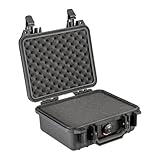
The 1200 is the smallest case here and, for a lot of photographers, the most useful. It is a genuinely compact hard case — roughly 9.25 × 7.12 × 4.12 inches of interior inside a 10.62 × 9.68 × 4.87 inch exterior — and it weighs under three pounds configured. That combination means it can live inside a backpack, a pannier, or a duffel as a protective core rather than being a separate bag you have to carry.
Key specs
- Interior: approximately 9.25 × 7.12 × 4.12 in (lid depth ~1.18 in, base depth ~2.94 in)
- Exterior: approximately 10.62 × 9.68 × 4.87 in
- Usable volume: roughly 270 cubic inches / 4.4 liters
- Configured weight: approximately 2.9 lb with foam
- Configuration: three-piece foam set — convoluted lid foam, pick-‘n’-pluck middle layer, solid base layer
- Sealing: watertight gasket, purge valve, crushproof and dustproof shell
- Price tier: budget
What actually fits
Do the math before you buy, because this case punishes optimism. A full-frame mirrorless body is roughly 5.9 × 4.6 inches in plan view; a compact zoom is about 3 inches in diameter and 3.5 to 4 inches long. Lying side by side that is roughly 6 inches of length and 8 inches of width once you add a quarter inch of foam clearance — which means a body with a small zoom attached fits comfortably, and a body with a separate short lens fits if you arrange them carefully. A 70–200mm f/2.8 does not fit alongside a body; its barrel is nearly as wide as the case’s usable interior.
Where the 1200 shines is in the kits nobody thinks of as camera kits. A compact camera plus two spare batteries and cards. A GoPro or action camera with mounts and a battery charger. A field recorder, two lav mics and a set of cables. A speedlight and a radio trigger set. The base depth of just under three inches is the limiting factor: anything taller than a small zoom needs the lid space, and the lid only gives you about 1.18 inches.
Strengths
Protection per pound is off the charts. You are getting the same gasket-and-purge-valve architecture as the premium cases in a package that weighs less than a bag of coffee, which means you can put real protection around a $1,500 body without committing to a case that weighs as much as the body. For travel where every ounce is counted — bikepacking, motorcycle touring, backpacking, climbing approaches — that is the entire argument.
The three-piece foam set is also the most economical way into a hard case. Pick-‘n’-pluck foam lets you carve a custom cavity by hand, the solid base layer underneath gives the cavity a floor, and the convoluted lid foam compresses against the top of your gear to stop it shifting. It is a crude system compared to padded dividers, and it is permanent — you get one chance to pluck it right — but it costs nothing extra and it fits odd-shaped items better than any divider system.
The 1200 is also the case most likely to be used as intended for years, because its size makes it easy to grab. A big case stays home; a case you can drop into a daypack goes everywhere.
Pros
- Under three pounds configured — negligible travel weight
- Budget price tier with full watertight, crushproof construction
- Small enough to nest inside a backpack as a protective core
- Custom foam cavity fits odd-shaped gear precisely
- Ideal for compact cameras, action cams, audio kits and battery/accessory loads
Cons
- Will not hold a body and a 70–200mm f/2.8 together
- Pick-‘n’-pluck foam is a one-shot decision — mistakes are permanent until you buy new foam
- Foam sheds dust into the interior over years of use
- No wheels and no retractable handle; strictly hand-carry
- Base depth of roughly 2.94 in rules out anything with a tall profile
How it compares
The obvious alternative is the 1400, which is the next size up and the better buy if you carry a second lens: the 1400 adds roughly 2.5 inches of interior length and 1.75 inches of width for about 1.6 pounds more. The Vault V100 sits between them in spirit — similar small-kit mission, similar budget tier — but it is a different shape, wider and shallower, which suits a drone and controller better than a camera and zoom. If you have exactly one body and one compact lens, the 1200 is the cheapest correct answer. The moment you add a second lens, skip it and buy the 1400.
4. Pelican Vault V100 with Foam – Best Budget Case for a Compact Camera or Drone Kit

The V100 is the smallest member of the Vault family and the one most likely to be bought for something other than a camera. Its listing describes it as a multi-purpose hard case for camera, drone, equipment, electronics and gear, and that breadth is the honest description: it is a small, tough, foam-lined box that happens to be exactly the right size for a folding drone with a controller, or a compact camera with accessories.
Key specs
- Interior: approximately 11.5 × 8 × 4.5 in (spec class for a small Vault case)
- Usable volume: roughly 400 cubic inches / 6.5 liters
- Configured weight: approximately 2.5–3 lb with foam
- Configuration: foam insert set with a pluckable middle layer
- Finish: OD green
- Mobility: hand-carry molded handle
- Sealing: watertight gasket and pressure equalization valve
- Price tier: budget
Who it suits
Think of the V100 as the case for a kit that has an awkward shape rather than a large one. A folding drone plus its controller is the classic load: the aircraft folds into a package roughly 3.5 × 3 × 8 inches, the controller is about 6 × 4 inches, and the pair plus two batteries fills a V100 almost exactly. Add a charger and a set of spare props and you are at capacity — which is precisely the point, because the case stops you from accumulating more.
The second natural load is a compact or bridge camera with a spare battery, a charger, cards and a cleaning kit. The third is audio or lighting: two wireless lav receivers, a transmitter, a small LED panel and cables. Photographers who shoot hybrid often end up with a V100 that never sees a camera at all, holding the accessory kit that would otherwise rattle loose in a bag.
Strengths
The value here is the shape. A roughly 11.5 × 8 inch footprint with a 4.5 inch depth is a much more useful proportion for boxy gear than the 1200’s near-square 9.25 × 7.12 interior, and it is wide enough that a controller and a folded drone can sit side by side rather than stacked. Vault cases also tend to have a slightly friendlier latch action out of the box than the heavy Protector latches, which matters if you open the case several times a day.
The OD green finish is a small thing that turns out to matter in the field: a black case sitting on dark ground in low light is easy to walk away from, and a case that reads as equipment rather than as a camera bag attracts less attention in transit.
Like every case in this list, the V100 is serviceable. Foam can be replaced, the gasket can be greased and eventually swapped, and the shell will outlast several camera bodies. At the budget tier, that longevity is what separates a hard case from a padded insert.
Pros
- Budget tier with genuine watertight construction
- Proportions suit drones, controllers and boxy accessories better than a square case
- Under three pounds — easy to carry alongside a main bag
- Foam can be plucked to fit an irregular kit precisely
- OD green finish is less conspicuous than a black camera case
Cons
- Too small for any full-size body with a fast zoom
- Foam, not dividers — one-shot layout with no reconfiguration
- Shallow depth limits taller accessories
- Hand-carry only; no wheels
- Vault-tier construction rather than Protector-tier
How it compares
Against the 1200, the V100 is wider and slightly shallower, which makes it better for drones and controllers and slightly worse for a body-plus-lens stack — the 1200’s deeper base is friendlier to a mounted zoom. Against the 1400, the V100 gives up about 2.5 inches of interior length and roughly 140 cubic inches of volume, which is the difference between a one-item case and a two-lens case. If your kit is a camera and a lens, buy the 1400; if it is a drone and a controller, the V100 is the better shape.
5. Pelican 1400 with Foam – Best Budget Case for a Body Plus Two Lenses

The 1400 is the budget case that stops being a compromise. With roughly 11.81 × 8.87 × 5.18 inches of interior — about 540 cubic inches, or nearly nine liters — it holds a body with a zoom attached plus a second lens, a flash and batteries, and it does so at about 4.5 pounds configured. That is the smallest case in this list that comfortably supports a real two-lens working kit.
Key specs
- Interior: approximately 11.81 × 8.87 × 5.18 in
- Exterior: approximately 13.37 × 11.62 × 6.00 in
- Usable volume: roughly 540 cubic inches / 8.9 liters
- Configured weight: approximately 4.5 lb with foam
- Configuration: three-piece foam set — convoluted lid foam, pluckable middle layer, solid base layer
- Sealing: watertight gasket, automatic purge valve, crushproof and dustproof shell
- Price tier: budget
What actually fits
The 5.18-inch base-and-lid depth is what unlocks the second lens. A mirrorless body with a 24–70mm f/2.8 attached stands roughly 5 inches tall with the hood reversed, which fits the 1400’s depth with a little room to spare — the same trick the 1510 performs at three times the size. Alongside it, an 11.81-inch interior length accepts a 70–200mm f/4 lying flat (typically about 7 inches long) plus a prime, or a wide zoom plus a speedlight.
What does not fit: a 70–200mm f/2.8 with the hood attached, two full-frame bodies, or a body with a 100–400mm mounted. Those loads belong in the 1510 or the V700. The 1400 is the case for the disciplined kit — one body, two lenses, one flash — and its main virtue is that it enforces that discipline.
Strengths
This is the best protection-per-dollar point in the entire list. You get the same watertight, crushproof architecture as the premium cases, a footprint that fits inside a large shoulder bag or a carry-on duffel, and enough interior volume for a genuine working kit — for a budget-tier price. For a photographer who shoots locally, travels by car, and wants their gear to survive a dropped bag or a spilled drink, the 1400 covers the requirement completely.
The 4.5 pound configured weight is also a sweet spot. It is light enough to carry by the handle all day, and light enough that you can pack it inside a soft travel bag and still stay under a cabin weight limit, which you cannot do with a 13.5-pound wheeled case.
Because the 1400 uses the standard three-piece foam set, replacement foam is cheap and easy to source, and re-foaming is the natural upgrade path when your kit changes. A photographer who starts with a 1400 and later adds a 70–200mm f/2.8 will usually re-foam it for the new lens rather than replace the case — and then eventually buy a 1510 as well, keeping the 1400 as the small-kit case.
Pros
- Budget tier with full watertight, crushproof construction
- Deep enough for a body with a 24–70mm f/2.8 attached
- Holds a body, two lenses and a flash comfortably
- About 4.5 lb configured — easy all-day carry
- Cheap, easily replaced foam makes re-kitting painless
- Small enough to nest inside a larger travel bag
Cons
- Foam rather than dividers — layout changes mean new foam
- No wheels or retractable handle
- Won’t take a 70–200mm f/2.8 alongside a body
- Not carry-on shaped; it will sit inside a carry-on bag rather than replace one
- Pluck foam sheds over time and needs replacing every few years with heavy use
How it compares
Against the 1200, the 1400 is the case you buy when you know you carry two lenses — the extra 2.5 inches of length and 1.75 inches of width change what is possible, and the 1.6-pound weight penalty is trivial. Against the Vault V100, the 1400 is longer and deeper but slightly narrower, which makes it better for camera-and-lens loads and worse for drone-and-controller loads. Against the V525, the 1400 gives up roughly 1,100 cubic inches of volume and the padded divider system, but costs a fraction as much and weighs less than half as much — a trade that makes sense for anyone whose kit genuinely stops at two lenses.
6. Pelican Air 1535 with TrekPak Dividers – Best Premium Pick for Weight-Conscious Travel

The Air 1535 is the case for photographers who have been burned by a cabin weight limit. It occupies essentially the same carry-on envelope as the 1510 and offers almost identical interior volume — approximately 20.39 × 11.20 × 7.21 inches, about 1,650 cubic inches — but it weighs roughly ten pounds configured instead of thirteen and a half. On a carrier that enforces a 10 kg cabin allowance, that three-and-a-half-pound difference is worth more than any other feature on this page.
Key specs
- Interior: approximately 20.39 × 11.20 × 7.21 in
- Usable volume: roughly 1,650 cubic inches / 27 liters
- Configured weight: approximately 10.0 lb with TrekPak dividers
- Configuration: TrekPak rigid divider panels with foam edge trim and steel pins
- Mobility: wheels and a retractable extension handle; carry-on class
- Sealing: watertight gasket, purge valve, crushproof construction in a lighter polymer shell
- Price tier: premium
What actually fits
Because the interior footprint is nearly identical to the 1510’s, the working loads are nearly identical too: a gripped body with a 70–200mm f/2.8 mounted lying flat in the base, a second body or a wide zoom, two primes, a flash, batteries and a charger. The difference is what happens to the lid. TrekPak’s panels are thin — the divider walls are measured in fractions of an inch rather than the inch-plus thickness of padded dividers — so the same interior yields noticeably more usable cavity space. In practice that means the Air 1535 holds roughly one extra lens or one extra accessory pouch compared with a padded-divider case of the same nominal volume.
Strengths
TrekPak is the reason to choose this version over a foam-loaded Air case. The system uses rigid corrugated panels trimmed with closed-cell foam on the top edge, held in place by steel pins pushed through the base foam. You cut each panel to length with the supplied cutter, pin it, and the result is a custom-fitted interior with vertical walls that stay vertical. Unlike pluck foam, TrekPak is fully reversible: pull the pins, reposition the panels, re-pin. Unlike padded dividers, it does not bulge or sag when you drop a heavy body against it.
The weight story deserves precision rather than marketing. Pelican’s Air line uses a lighter polymer and a structural rib design that keeps the case crushproof and watertight while reducing the shell’s mass substantially compared with the Protector line. What you give up is wall thickness and stiffness. Under a heavy stack of luggage, an Air case will flex more than a Protector case will, and over a decade of hard use the Protector’s extra material is likely to age more gracefully. For a case that stays in your hands, that trade is almost always worth taking.
Ownership realities are the same as any Pelican: the gasket is the wear item, followed by the latches, then the wheels. All