Key takeaways
- Power and wiring: 24 VAC control voltage; C-wire required. The listing states this plainly, and missing C-wire is the single most common reason this model gets returned.
- Scheduling: 7-day programming through the Alexa app, with the option to trigger schedule changes through Alexa Routines.
- Occupancy logic: no onboard occupancy sensor; away detection relies on Alexa Hunches, phone geolocation, and connected Alexa devices.
- HVAC compatibility: designed around common single-stage conventional systems and single-stage heat pumps with auxiliary heat. Multi-stage, dual-fuel, and communicating systems should be checked against the compatibility tool before you buy.
- Voice and ecosystem: Alexa built in for voice setpoint changes; Ring devices appear in the same app.
- Certification: ENERGY STAR certified, which is the screen most utility rebate programs apply.
If you want the shortest path to lower heating and cooling bills, the ecobee Smart Thermostat Enhanced is the best overall pick for energy savings: it pairs occupancy-aware eco+ scheduling with the broadest heat-pump and multi-stage support in this roundup, so it can cut runtime in a house that sits empty for long stretches without leaving you uncomfortable when you walk back in. It suits heat-pump owners, two-stage equipment, and anyone who wants room-level temperature sensing later.
If you already have a C-wire and an Alexa household, the Amazon Smart Thermostat delivers most of the core energy-saving behavior for the least money. If you want real occupancy sensing without paying premium prices, the Google Nest Thermostat is the strongest mid-range choice, thanks to radar-based presence detection. And if your wall plate has no C-wire, the Sensi Smart Thermostat ST55 is the most forgiving install of the group.
Top 3 Picks
Best overall: ecobee Smart Thermostat Enhanced. It is the pick when savings depend on getting the schedule right across a heat pump, a two-stage system, or a house with uneven temperatures. Occupancy-aware eco+ features trim runtime when nobody is home, and the platform accepts optional room sensors later if one bedroom or office never quite matches the rest of the house.
Best budget: Amazon Smart Thermostat. A C-wire and a straightforward single-stage system are the only prerequisites. Scheduling lives in the Alexa app, away detection piggybacks on Alexa Hunches and phone location, and ENERGY STAR certification keeps it eligible for most utility rebate lists. Nothing here is luxurious, but nothing here is wasteful either.
Best mid-range for occupancy sensing: Google Nest Thermostat. It uses radar-style motion sensing to notice when the house is empty, then leans on its own scheduling to avoid heating or cooling an unoccupied home. If you live in the Google Home ecosystem and want presence detection without a premium price tier, this is the one to shortlist.
Quick Comparison
| Product | Best for | Key specs | Price tier |
|---|---|---|---|
| Amazon Smart Thermostat | Alexa households with a C-wire and single-stage equipment | 24 VAC; C-wire required; 7-day scheduling in the Alexa app; no onboard occupancy sensor — away detection via Alexa Hunches and phone location; ENERGY STAR certified | Budget |
| Sensi Smart Thermostat ST55 | DIY replacements where a C-wire may be missing | 24 VAC; commonly installs without a C-wire; 7-day, multi-period scheduling; geofencing; humidity readout; heat-pump capable per Sensi’s compatibility list; ENERGY STAR certified | Mid-range |
| ecobee Smart Thermostat Essential | First-time ecobee buyers who want eco+ at a mid-range price | 24 VAC; C-wire recommended; full-color touchscreen; ecobee eco+ scheduling; heat-pump and multi-stage support per ecobee’s compatibility guide; ENERGY STAR certified | Mid-range |
| Google Nest Thermostat | Occupancy sensing at a mid-range price | 24 VAC; radar-based motion sensing for presence detection; Google Home app scheduling; C-wire recommended but many systems run without one; heat-pump support per Google’s compatibility checker | Mid-range |
| Honeywell Home T5 Smart Wi-Fi Thermostat | Simple app scheduling for budget buyers | 24 VAC; 7-day programmable; Resideo app control; geofencing; works with Alexa and Google Assistant; conventional and heat-pump support per Resideo’s guide | Budget |
| Honeywell Home RTH9600WF Smart Color Thermostat | A color touchscreen plus rebate-friendly certification | 24 VAC; C-wire required; ENERGY STAR certified; color touchscreen; 7-day programmable; Alexa-ready | Mid-range |
| ecobee Smart Thermostat Enhanced | Heat pumps, multi-zone homes, maximum savings | 24 VAC; C-wire recommended; large touchscreen; occupancy-aware eco+ logic; multi-stage and heat-pump support; ENERGY STAR certified; accepts optional room sensors | Premium |
| Sensi Lite Smart Thermostat ST25 | The least expensive reliable app-scheduled thermostat | 24 VAC; DIY install; 7-day scheduling; Alexa and Google Assistant; ENERGY STAR certified; no room-sensor expansion | Budget |
How We Chose
This roundup is built from published manufacturer specifications, compatibility documentation, and the practical constraints that decide whether a thermostat actually saves energy in a real house. We weighed four things. First, energy-saving logic: does the model support a proper 7-day schedule with multiple periods per day, does it adapt to occupancy, and does it offer any form of adaptive or pre-emptive recovery so the system is not fighting the schedule. Second, HVAC compatibility breadth: single-stage conventional, two-stage, heat pump with auxiliary or emergency heat, dual fuel, and the O/B reversing valve terminal that heat-pump owners must confirm before buying. Third, wiring reality: whether the model needs a C-wire, tolerates its absence, or ships with a power adapter, because a thermostat that short-cycles because it is stealing power is not saving anyone money. Fourth, ownership path: app quality, ecosystem fit, rebate eligibility through ENERGY STAR, and whether the platform can grow with optional room sensors or a newer smart-home standard. We spread the picks across budget, mid-range, and premium tiers so there is a sensible answer whether you are replacing a dead thermostat this weekend or planning a heat-pump upgrade next year.
1. Amazon Smart Thermostat – Best for Alexa Households on a Tight Budget
As an Amazon Associate we earn from qualifying purchases at no extra cost to you.

The Amazon Smart Thermostat is the least expensive way to get app-based scheduling, voice control, and ENERGY STAR efficiency into a house that already runs on Alexa. Its pitch is deliberately narrow: it handles the core job — a schedule you can change from your phone, a display that reacts as you walk past, and away logic driven by your Alexa devices and phone location — and it asks for a C-wire in exchange for skipping the cost of a premium touchscreen.
It suits two groups especially well. The first is a first-time smart-thermostat buyer who has already confirmed a C-wire at the wall plate and whose equipment is a straightforward single-stage furnace and air conditioner. The second is an Alexa household that already owns Echo speakers or Ring devices, because the thermostat’s away detection leans on that ecosystem rather than on a dedicated occupancy sensor inside the unit itself.
Key specs at a glance
- Power and wiring: 24 VAC control voltage; C-wire required. The listing states this plainly, and missing C-wire is the single most common reason this model gets returned.
- Scheduling: 7-day programming through the Alexa app, with the option to trigger schedule changes through Alexa Routines.
- Occupancy logic: no onboard occupancy sensor; away detection relies on Alexa Hunches, phone geolocation, and connected Alexa devices.
- HVAC compatibility: designed around common single-stage conventional systems and single-stage heat pumps with auxiliary heat. Multi-stage, dual-fuel, and communicating systems should be checked against the compatibility tool before you buy.
- Voice and ecosystem: Alexa built in for voice setpoint changes; Ring devices appear in the same app.
- Certification: ENERGY STAR certified, which is the screen most utility rebate programs apply.
Where it earns its keep
The savings here come from consistency rather than cleverness. A household that currently runs a manual or non-programmable thermostat and simply forgets to adjust it will get the biggest gain: a fixed weekday schedule that relaxes the setpoint during work hours and overnight, applied every day without fail, is worth more than any single advanced feature. Because the schedule lives in the Alexa app, changing it takes seconds, and that friction reduction is genuinely what keeps a schedule accurate over a full season. If you have Echo devices in more than one room, Alexa’s presence signals become more reliable, which means the away logic fires more often and the system spends fewer hours conditioning an empty house.
The second practical advantage is rebate eligibility. ENERGY STAR certification is the checkbox utility programs usually ask about, and a budget-tier thermostat that qualifies can effectively cost less than a non-certified mid-range model once a rebate lands.
Pros
- Lowest entry price of any model in this roundup.
- Deep, native integration with Alexa and Ring, including voice control and Routines.
- ENERGY STAR certified, so it appears on many utility rebate lists.
- Simple, uncluttered app experience if you already live in the Alexa app.
- Solid choice for single-stage gas furnace plus central air, the most common North American setup.
Cons
- Requires a C-wire; without one you are looking at an adapter kit or a different thermostat.
- No onboard occupancy sensor, so away detection depends on other devices being present and reliable.
- Limited support for multi-stage, dual-fuel, and communicating equipment.
- No room-sensor expansion, so it cannot fix a persistently cold bedroom.
- Feature ceiling is low if you later upgrade to a heat pump with more stages.
How it compares
Against the Sensi Lite ST25 — the other budget-tier pick — the Amazon model wins on ecosystem depth and loses on wiring flexibility. Sensi’s DIY line is famously tolerant of missing C-wires, while the Amazon unit is not. Against the Sensi Smart Thermostat ST55, the Amazon thermostat is cheaper but gives up humidity display, geofencing polish, and the broader heat-pump compatibility the ST55 documents. If your wall plate has four wires and you own Echo speakers, the Amazon thermostat is the value play. If your wall plate has two or three wires, or you plan to move to a heat pump, step up.
2. Sensi Smart Thermostat ST55 – Best for DIY Installs Without a C-Wire

The Sensi Smart Thermostat ST55 is the thermostat you buy when the wiring in your wall is the thing you are worried about. Sensi built its reputation on DIY replacement in older homes, and the ST55 carries that forward: Wi-Fi control from the Sensi app, geofencing-based away mode, a humidity readout, and broad equipment support, all without the premium price of a large touchscreen display.
It suits the homeowner who is replacing a 15-year-old programmable thermostat on a Saturday morning, has pulled the old unit off the wall, and found four or five wires of uncertain purpose. Sensi’s documentation and app walkthroughs are aimed squarely at that person. It also suits anyone whose HVAC contractor quoted a substantial labor charge for a thermostat swap — the ST55 is a genuinely manageable DIY job for someone comfortable turning off a breaker and labeling wires.
Key specs at a glance
- Power and wiring: 24 VAC; commonly installed without a C-wire in many systems, though a C-wire remains the more reliable option and Sensi’s own guidance recommends it where available.
- Scheduling: 7-day programming with multiple periods per day, editable in the app.
- Occupancy logic: geofencing uses your phone’s location to switch into away mode, so the house is not conditioned while you are out.
- HVAC compatibility: supports conventional systems and heat pumps per Sensi’s published compatibility list, including auxiliary heat configurations on supported equipment.
- Extras: indoor humidity display and humidity-aware behavior in the app.
- Certification: ENERGY STAR certified.
Where it earns its keep
Geofencing is the headline energy feature, and it is genuinely useful for households with irregular schedules. Instead of guessing when everyone leaves, the thermostat watches phone location and relaxes the setpoint when the last person departs, then brings the system back before someone arrives. For a two-worker household with variable hours, that beats a rigid weekday schedule. The humidity readout is a quiet bonus: high indoor humidity in summer makes 74°F feel warmer than it is, and seeing the number helps you decide whether the right fix is a setpoint change or a dehumidifier.
On installation, the practical reality is that older homes often lack a C-wire because the original thermostat was battery-powered. Sensi’s design and documentation account for that. If you do have a C-wire, use it — constant power is more reliable than power-stealing, and it avoids the flickering or short-cycling behavior that can appear on systems that do not supply enough current through the existing wires.
Pros
- Often installable without a C-wire, which removes the biggest DIY obstacle.
- Geofencing delivers real away-mode savings for irregular schedules.
- Humidity display adds context that plain temperature control lacks.
- Straightforward app with a clean scheduling interface.
- ENERGY STAR certified and typically rebate-eligible.
- Heat-pump support documented by the manufacturer, unlike some budget competitors.
Cons
- Display is functional rather than attractive; no color touchscreen.
- No room-sensor ecosystem, so multi-zone temperature complaints stay unsolved.
- Geofencing depends on every household member installing and sharing the app, which some families resist.
- Power-stealing installs without a C-wire can behave inconsistently on some equipment.
- Fewer smart-home integrations than the ecobee or Google ecosystems.
How it compares
Against the Sensi Lite ST25, the ST55 is the better thermostat in almost every respect: geofencing, humidity sensing, and broader equipment support justify the step up. Against the Amazon Smart Thermostat, the ST55 trades ecosystem depth for wiring flexibility and heat-pump documentation — if you own Echo devices and have a C-wire, Amazon is cheaper; if your wall plate is sparse, Sensi is the safer buy. Against the Google Nest Thermostat, the ST55 gives up radar-based occupancy sensing but gains tolerance for awkward wiring.
3. ecobee Smart Thermostat Essential – Best for First-Time ecobee Buyers

The ecobee Smart Thermostat Essential is the entry point into ecobee’s ecosystem: a full-color touchscreen, ecobee’s eco+ energy-saving logic, and the broad equipment compatibility the brand is known for, at a mid-range price rather than a premium one. It is the thermostat to consider if you want the ecobee platform — including its strong heat-pump handling — without paying for the top tier.
It suits the homeowner who has compared a cheap thermostat against a good one and decided the difference matters, but who does not need every premium feature. It is also a sensible choice for someone with a heat pump who has been burned by a budget thermostat that could not handle auxiliary heat properly. The Essential tier keeps the scheduling engine and the equipment support while trimming the extras.
Key specs at a glance
- Power and wiring: 24 VAC; C-wire recommended for reliable operation, with adapter options available for systems that lack one.
- Scheduling: ecobee’s 7-day scheduling with multiple comfort periods per day, managed in the ecobee app.
- Energy features: eco+ suite, which includes schedule adjustments based on occupancy signals, pre-heating and pre-cooling logic, and features that respond to time-of-use or demand-response signals where your utility supports them.
- HVAC compatibility: conventional multi-stage and heat-pump systems per ecobee’s compatibility documentation, including auxiliary heat configurations.
- Display: full-color touchscreen with a clean, readable layout.
- Certification: ENERGY STAR certified.
Where it earns its keep
eco+ is the reason to pick ecobee over a plain programmable thermostat. The feature set is a bundle of behaviors rather than a single trick: it can relax the setpoint when the house is likely empty, pre-condition ahead of a scheduled comfort period so the system is not running at full tilt when you walk in, and — depending on your utility — respond to peak-demand events that pay you back through a bill credit. That last one matters more than most buyers realize, because it turns the thermostat into a participant in a utility program rather than just a controller.
Heat-pump handling is the other differentiator. Heat pumps are less tolerant of aggressive setbacks than gas furnaces: dropping the setpoint several degrees in winter can trigger auxiliary resistance heat on recovery, which costs more than the setback saved. A thermostat that understands staged heating and recovery ramps can hold a gentler setback and avoid that trap. That capability is exactly what separates the ecobee tier from the cheapest options.
Pros
- eco+ energy logic is more sophisticated than simple scheduling.
- Full-color touchscreen at a mid-range price.
- Strong documented heat-pump and multi-stage compatibility.
- Demand-response and time-of-use participation can unlock utility bill credits.
- Path into ecobee’s room-sensor ecosystem for homes with uneven temperatures.
- ENERGY STAR certified.
Cons
- Premium-tier ecobee models add features this one lacks.
- Room sensors are typically sold separately, so multi-zone control costs more.
- C-wire recommended; older wiring may need an adapter.
- App is feature-dense, which can feel like a lot for a basic user.
- Overkill if you have a single-stage system and a predictable schedule.
How it compares
Against the ecobee Smart Thermostat Enhanced, the Essential gives up the upper tier’s larger display and more advanced sensing, but keeps the scheduling engine and heat-pump support that drive the actual savings. If your goal is a heat pump running on a smarter schedule, the Essential gets you most of the way. Against the Google Nest Thermostat, the Essential trades radar presence detection for a broader equipment matrix and the ecobee sensor ecosystem — a better fit for multi-stage and heat-pump homes, a slightly worse fit for pure Google Home households.
4. Google Nest Thermostat – Best for Occupancy Sensing at a Mid-Range Price

The Google Nest Thermostat brings presence detection down to the mid-range tier. Its motion sensing is the feature that matters most for energy savings: the thermostat notices when the house is empty and when someone is moving around, and it uses that information to avoid conditioning an unoccupied home. It also reports on your HVAC system’s behavior in the Google Home app, which turns invisible runtime into something you can actually see and act on.
It suits the household that wants savings without building a detailed schedule by hand. If your week is irregular — shift work, school pickup variations, a home office that is occupied three days out of five — a rigid 7-day schedule is a poor fit, and presence-based logic is a better one. It also suits anyone already using Google Home, since the thermostat appears alongside other devices in the same app.
Key specs at a glance
- Power and wiring: 24 VAC; a C-wire is recommended for the most reliable operation, though many systems run without one because the unit draws power through the existing wiring and holds a charge.
- Occupancy sensing: radar-style motion sensing built into the thermostat for presence detection, rather than relying on an external hub or phone location alone.
- Scheduling: schedules managed in the Google Home app, with the thermostat able to adjust based on occupancy.
- HVAC compatibility: most common 24-volt systems and heat pumps per Google’s compatibility checker; dual-fuel and proprietary communicating systems should be verified before purchase.
- Ecosystem: native Google Home integration; works with voice control through Google Assistant.
- Finish: the charcoal variant is a neutral option that blends with most wall colors.
Where it earns its keep
Presence detection is the mechanism that converts good intentions into savings. A manually scheduled thermostat only saves money when the schedule matches reality, and reality changes: a sick day, a late shift, a weekend trip. A thermostat that senses the house is empty and backs off the setpoint captures savings in exactly those unplanned gaps, which is where a large share of wasted runtime actually lives.
The runtime reporting is the second quiet benefit. Seeing how many hours your system ran last week, and on which days, is the fastest way to find out that your setback is too shallow, that a window is leaking heat, or that your schedule has drifted out of sync with your life. That feedback loop is what makes the next schedule adjustment an informed one rather than a guess. Google Home also lets you group the thermostat with other devices, so leaving the house can trigger a broader away scene rather than a single-device change.
Pros
- Radar-based presence sensing at a mid-range price tier.
- Automatic savings during unplanned absences, not just scheduled ones.
- Runtime and system reporting in the Google Home app.
- Clean, understated industrial design; the charcoal finish suits most interiors.
- Often installs without a C-wire, though a C-wire is still preferred.
- Straightforward for households already using Google Home.
Cons
- Compatibility is narrower than ecobee’s for complex multi-stage and dual-fuel systems.
- Less granular scheduling control than ecobee’s period-based comfort settings.
- No room-sensor expansion, so single-zone temperature complaints remain.
- Presence sensing works best in a hallway or living-area location, not a closed-off room.
- Power-stealing installs without a C-wire can occasionally behave unpredictably.
How it compares
Against the ecobee Smart Thermostat Essential, the Nest Thermostat wins on automatic occupancy handling and loses on equipment breadth and expandability. Against the Honeywell Home T5, it is more expensive but considerably smarter about unoccupied periods — the T5 relies on schedules and geofencing, not on sensing what is happening inside the house. Against the Amazon Smart Thermostat, the Nest costs more but does not need a C-wire and does not depend on a separate speaker ecosystem for away detection.
5. Honeywell Home T5 Smart Wi-Fi Thermostat – Best for Simple App Scheduling on a Budget
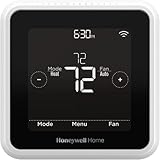
The Honeywell Home T5 Smart Wi-Fi Thermostat is the practical budget option from a brand that has been in the thermostat business far longer than the smart-home startups. It covers the essentials — 7-day programming, app control through the Resideo app, geofencing-based away mode, and voice control through Alexa or Google Assistant — without a large display or a premium price.
It suits the homeowner who wants reliable, boring thermostat control with a phone app and does not want to learn a new ecosystem. It also suits rental properties and second homes, where a familiar interface and simple schedules matter more than advanced occupancy logic. And it suits anyone replacing an older Honeywell unit who wants the wiring and terminal labels to match what is already there.
Key specs at a glance
- Power and wiring: 24 VAC; Resideo’s documentation for this model generally calls for a C-wire, so confirm your wall plate before ordering.
- Scheduling: 7-day programmable with multiple periods per day, editable in the Resideo app or on the device.
- Occupancy logic: geofencing through the app switches the system into an away state when everyone leaves.
- HVAC compatibility: conventional systems and heat pumps per Resideo’s published compatibility guidance.
- Voice control: works with Alexa and Google Assistant.
- Installation: standard two-piece wall plate and thermostat body, familiar to anyone who has swapped a Honeywell before.
Where it earns its keep
The T5’s value is reliability and predictability. Honeywell’s terminal labeling follows the conventions HVAC technicians already use, which reduces the chance of a miswired installation — a real and expensive failure mode. The schedule editor is unglamorous but complete: you set wake, away, return, and sleep periods for each day, and the thermostat follows them. For a household with a stable routine, that is enough to capture most of the available savings.
Geofencing adds a useful layer for the gaps. If you normally leave at 7:30 and the schedule relaxes the setpoint at 8:00, geofencing can start the away state earlier on the days you actually leave early. The flip side is that geofencing only works if the household members who come and go have the app installed and location sharing enabled, which is a practical hurdle in shared households.
For second homes and rentals, the T5’s simplicity is an advantage: a cleaner or property manager can adjust the schedule in the app without needing to understand eco+ or occupancy-learning behavior.
Pros
- Budget-tier price with a full 7-day programmable schedule.
- Familiar Honeywell terminal conventions reduce installation errors.
- Works with both Alexa and Google Assistant.
- Geofencing provides away-mode savings without a rigid schedule.
- Reliable brand with widely available documentation and support.
- Simple enough for rentals, guest houses, and shared properties.
Cons
- Generally expects a C-wire, which rules out some older homes without an adapter.
- No onboard occupancy sensor; savings depend on schedule plus geofencing.
- Display and app are functional rather than polished.
- No room-sensor expansion.
- Compatibility list is less expansive than ecobee’s for complex heat-pump setups.
How it compares
Against the Sensi Smart Thermostat ST55, the T5 is broadly similar in capability, with the main difference being wiring tolerance — Sensi is more comfortable in homes without a C-wire, while Honeywell’s documentation leans toward requiring one. Against the Amazon Smart Thermostat, the T5 gives up deep Alexa integration but works across both major voice platforms and does not lock you into one ecosystem. Against the Honeywell Home RTH9600WF, the T5 is the plainer sibling: same brand, less screen, lower price.
6. Honeywell Home RTH9600WF Smart Color Thermostat – Best for a Rebate-Friendly Color Touchscreen
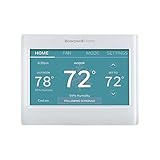
The Honeywell Home RTH9600WF sits in the middle of Honeywell’s smart lineup: a color touchscreen, ENERGY STAR certification, 7-day programming, Wi-Fi control through the Resideo app, and Alexa readiness. It is the model to consider when you want a thermostat that looks like a modern appliance and still qualifies for the rebate programs that screen for ENERGY STAR.
It suits the homeowner replacing an aging thermostat in a visible hallway location, where a small monochrome display would look like a downgrade. It also suits anyone who wants the rebate paperwork to be simple — ENERGY STAR certification is the line item utility programs check first. And it suits households that want app control plus a touchscreen that guests and family members can operate without a phone.
Key specs at a glance
- Power and wiring: 24 VAC; C-wire required, as stated in the product listing.
- Display: color touchscreen with a readable layout for temperature, schedule, and system status.
- Scheduling: 7-day programmable with multiple periods per day.
- App control: Wi-Fi control through the Resideo app, including remote setpoint changes.
- Voice control: Alexa-ready, with Google Assistant support through the Resideo ecosystem.
- Certification: ENERGY STAR certified.
Where it earns its keep
The RTH9600WF’s energy story is the same as any good programmable thermostat’s: a consistent 7-day schedule that matches your actual routine, applied without fail. What elevates it in practice is the touchscreen. A thermostat that is easy to adjust on the wall gets adjusted — when you leave for a weekend, when a guest is staying over, when the house is unusually full. Thermostats that are fiddly get ignored, and an ignored thermostat runs the same schedule whether anyone is home or not.
The C-wire requirement is worth treating as a feature rather than an obstacle. A constant power connection means the thermostat never has to steal current through the heating and cooling wires, which avoids the flickering and occasional short-cycling that power-stealing installs can produce on some equipment. If you have a C-wire, this is the more robust configuration. If you do not, budget for an adapter kit or an electrician.
Rebate eligibility is the practical bonus. Many utility programs publish a list of qualifying models and pay a fixed credit for installation, sometimes conditional on enrolling the thermostat in a demand-response program. Because the RTH9600WF is ENERGY STAR certified, it usually clears the first screen — but always confirm the specific model against your utility’s current list before buying, since program lists change.
Pros
- Color touchscreen makes on-wall adjustments easy, which keeps schedules accurate.
- ENERGY STAR certified and typically rebate-eligible.
- C-wire design avoids power-stealing quirks.
- Alexa-ready with broad voice-assistant support.
- Solid 7-day programmable scheduling with app control.
- Established brand with widely available documentation.
Cons
- C-wire required — a hard blocker for some older homes.
- No occupancy sensor; savings rely on the schedule you build.
- Less advanced energy logic than ecobee’s eco+.
- No room-sensor expansion for multi-zone temperature problems.
- Touchscreen adds cost versus the simpler T5.
How it compares
Against the Honeywell Home T5, the RTH9600WF is the upgrade: same scheduling engine and app, but a color touchscreen and a clearer claim on rebate eligibility. Against the ecobee Smart Thermostat Essential, the Honeywell gives up eco+ logic and room-sensor expandability but is often the easier install for a Honeywell-to-Honeywell swap. Against the Google Nest Thermostat, it trades presence sensing for a screen-first experience and broader voice-assistant support.
7. ecobee Smart Thermostat Enhanced – Best Overall for Heat Pumps and Multi-Zone Homes
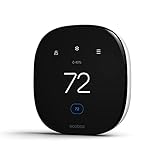
The ecobee Smart Thermostat Enhanced is the best overall pick in this roundup because it combines the two things that actually drive savings on modern equipment: occupancy-aware scheduling and broad support for heat pumps, multi-stage systems, and auxiliary heat. It pairs a large touchscreen with ecobee’s eco+ energy logic and a platform that can grow into room-level sensing later.
It suits three situations particularly well. The first is a heat-pump household, where getting setback behavior wrong can trigger expensive auxiliary resistance heat and erase the savings. The second is a two-stage or multi-stage system, which budget thermostats often cannot control properly. The third is a home with a persistently cold bedroom or a hot upstairs, where adding a room sensor and averaging temperatures solves a comfort problem that no amount of schedule tuning will fix.
Key specs at a glance
- Power and wiring: 24 VAC; C-wire recommended for reliable operation, with adapter options for systems without one.
- Display: large touchscreen designed for on-wall readability from across a room.
- Energy features: eco+ scheduling that adjusts based on occupancy signals, pre-heating and pre-cooling, and utility demand-response participation where available.
- HVAC compatibility: conventional multi-stage and heat-pump systems per ecobee’s compatibility documentation, including auxiliary heat configurations and the O/B reversing valve terminal heat pumps require.
- Expansion: supports optional ecobee room sensors for multi-zone temperature averaging and occupancy detection in specific rooms.
- Certification: ENERGY STAR certified.
Where it earns its keep
Heat pumps are the reason this model sits at the top. A gas furnace recovers quickly from a deep setback, so dropping the setpoint 8°F overnight is usually a straight win. A heat pump does not behave that way: recovery from a large setback can call on auxiliary resistance heat, which is several times more expensive per unit of heat than the compressor. A thermostat that understands staged heating can hold a gentle 2°F to 3°F setback and recover on the compressor alone, capturing most of the savings without the penalty. That single behavior can be worth more than the price difference between tiers over a few winters.
Room sensors address a different problem. In a two-story house with one thermostat, the hallway reads 71°F while the upstairs bedrooms sit at 66°F. The system keeps running because the hallway is never satisfied, and the bedrooms get hotter or colder depending on the season. Adding a sensor in the problem room and telling the thermostat to average the readings changes the control target, which shortens runtime and improves comfort at the same time. It is a rare case where the energy-saving fix and the comfort fix are the same fix.
Demand-response participation is the third lever. Where a utility runs a bring-your-own-thermostat program, the thermostat can receive a signal during peak events, make a small setpoint adjustment, and earn the household a bill credit. It is not a large amount per event, but across a summer it adds up, and it costs nothing but a checkbox in the app.
Pros
- Best-in-roundup heat-pump handling, including gentle setback recovery to avoid auxiliary heat.
- Broad multi-stage and dual-fuel compatibility.
- eco+ occupancy-aware scheduling plus pre-heating and pre-cooling.
- Optional room sensors solve real multi-zone comfort and runtime problems.
- Utility demand-response participation can generate bill credits.
- ENERGY STAR certified and premium build quality.
Cons
- Premium price tier — hard to justify for a single-stage system with a predictable schedule.
- Room sensors are typically sold separately.
- C-wire recommended; older wiring may need an adapter.
- Feature depth means a longer setup and learning curve.
- More thermostat than a small apartment or a single-zone home needs.
How it compares
Against the ecobee Smart Thermostat Essential, the Enhanced is