Key takeaways
- Format: single compact bar, roughly two feet wide – proportioned for televisions in the 32 to 50 inch class
- Channel layout: two-channel stereo with a one-touch dialogue mode on the remote
- Dialogue tools: a dedicated dialogue lift plus adjustable bass and treble
- Connections: HDMI-ARC, optical digital, Bluetooth, and a wired analog input in this class of product
- Subwoofer: none separate – low frequencies are handled by drivers inside the cabinet, so there is no extra box and no extra cable
- Placement: sits on a shelf or tabletop, or wall-mounts with a bracket
The best soundbar for clearer dialogue overall is the Bose Smart Dolby Atmos Soundbar: its A.I. Dialogue Mode, all-in-one Dolby Atmos cabinet and HDMI eARC connection make it the most complete single-box answer for a household that wants speech to stay intelligible without adding a subwoofer, rear speakers or a second remote. If your only real complaint is that actors mumble and you want to spend as little as possible, the ZVOX AccuVoice AV157, with 12 levels of voice boost, is the budget pick. If your hearing has changed with age and you want the maximum amount of speech lift a soundbar can give, the ZVOX AccuVoice AV855 with 20 levels of voice boost is the premium choice.
Those three recommendations assume different rooms and different ears, which is why the rest of this guide walks through the criteria that actually move dialogue clarity: whether the bar can build a convincing centre image, how its voice-enhancement mode works, whether it can hold speech at a consistent volume when explosions and commercials arrive, whether its size suits your room, and which connection your TV can actually accept. Get those five things right and almost any bar on this list will outperform your TV’s built-in speakers by a wide margin.
Top 3 Picks
Best overall: Bose Smart Dolby Atmos Soundbar. It combines a genuine all-in-one Atmos design with an A.I. Dialogue Mode that adapts the speech lift automatically rather than making you hunt through menus. It suits anyone who wants one box, one cable and the option to add a bass module or surrounds later.
Best budget: ZVOX AccuVoice AV157. Twelve discrete levels of voice boost, a compact footprint and a price tier that makes it an easy experiment for a bedroom or a second TV. It suits viewers whose single complaint is muddy speech on a modest-sized screen.
Best premium for speech: ZVOX AccuVoice AV855. Twenty levels of AccuVoice voice boost plus Output Leveling, which is the feature that stops loud effects and commercials from forcing you to dive for the remote. It suits anyone who wants the most aggressive dialogue-first processing available in a soundbar.
Quick Comparison
Every product below is covered in detail further down. Price tiers are given as budget, mid-range and premium rather than exact figures, because listing prices move daily and vary by region and promotion. Read the “key dialogue specs” column as the shortlist filter: voice-boost level count, channel layout, and whether the bar carries its own bass or needs a separate subwoofer.
| Product | Best for | Key dialogue specs | Price tier |
|---|---|---|---|
| Bose TV Speaker (2nd Gen) | Small rooms and the simplest possible setup | Compact 2-channel bar; one-touch dialogue mode; HDMI-ARC, optical and Bluetooth; bass built into the cabinet, no separate subwoofer | Budget |
| Amazon Fire TV Soundbar Plus | Built-in bass without adding a subwoofer box | 3.1 channels with built-in subwoofer; Dolby Atmos; dialogue clarity tuning; HDMI eARC and Bluetooth | Mid-range |
| Bose Smart Dolby Atmos Soundbar | Best overall all-in-one for mixed households | All-in-one Dolby Atmos bar; A.I. Dialogue Mode; built-in voice control; Wi-Fi and Bluetooth; HDMI eARC; expandable with a Bose bass module and surrounds | Premium |
| ZVOX AccuVoice AV855 | Maximum voice boost for difficult speech | 20 levels of AccuVoice voice boost; Output Leveling for consistent speech volume; dialogue-first tuning | Premium |
| ZVOX AccuVoice AV835 | Strong voice boost at a mid-range tier | 20 levels of AccuVoice voice boost; Output Leveling; dialogue-first tuning in a smaller cabinet than the AV855 | Mid-range |
| ZVOX AccuVoice AV157 | Lowest-cost fix for muddy dialogue | 12 levels of AccuVoice voice boost; compact bar sized for bedrooms and secondary TVs | Budget |
How We Chose
This list was assembled from published manufacturer specifications, the documented feature set of each product line, and the way dialogue problems actually present in ordinary living rooms. No product here was tested, benchmarked or owned by us, and nothing in this guide comes from measurement sessions. The selection criteria were deliberately narrow, because “clear dialogue” is not the same shopping problem as “big cinematic sound”.
First, category fit: a bar had to address speech directly, either through a named dialogue mode, a documented voice-boost system, or a centre-channel-style design that anchors voices to the screen. Second, specification quality: channel layout, whether the cabinet carries its own bass, which HDMI standard it supports, and how many discrete voice-boost steps it offers. Third, use-case coverage: we wanted at least one credible option for a bedroom, one for a mid-sized living room and one for a large or open-plan space, plus a genuine budget entry and a genuine premium ceiling. Fourth, upgrade path: whether the bar can be expanded with a separate subwoofer or surround speakers, or whether it is deliberately a closed, one-box system. Finally, tier balance, so that every reader finds an option at their budget rather than a list that quietly assumes a premium purchase.
1. Bose TV Speaker (2nd Gen) – Best for Small Rooms and Simple Setups
As an Amazon Associate we earn from qualifying purchases at no extra cost to you.
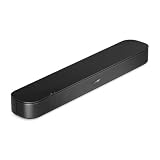
The Bose TV Speaker (2nd Gen) is the bar to buy when your complaint is narrow and specific: the TV’s own speakers sound thin, dialogue disappears under background music, and you want the fix to take ten minutes with no second remote to learn. It is a compact two-channel bar with a dedicated dialogue mode, HDMI-ARC and optical inputs, and Bluetooth for music. It suits bedrooms, apartments, dens and secondary TVs where a full-size bar with a separate subwoofer would be visually or acoustically too much.
Key specs
- Format: single compact bar, roughly two feet wide – proportioned for televisions in the 32 to 50 inch class
- Channel layout: two-channel stereo with a one-touch dialogue mode on the remote
- Dialogue tools: a dedicated dialogue lift plus adjustable bass and treble
- Connections: HDMI-ARC, optical digital, Bluetooth, and a wired analog input in this class of product
- Subwoofer: none separate – low frequencies are handled by drivers inside the cabinet, so there is no extra box and no extra cable
- Placement: sits on a shelf or tabletop, or wall-mounts with a bracket
What it does well. The whole point of this bar is subtraction. There is no room calibration to run, no app you must install to make it work, and no subwoofer to place behind a sofa where a pet or a vacuum cleaner will find it. The dialogue mode is a single button, which matters more than it sounds: the best voice-enhancement feature is the one a household member can find without reading a manual. Because the cabinet is small, it also fits under a television that sits on a low media unit, and it is light enough to wall-mount without structural worry in most homes.
Bass is the trade-off. A two-channel bar with no separate subwoofer will not reproduce the low-frequency rumble of a film soundtrack with any authority, and it will not fill a large open-plan room. What it will do is make speech legible at low volume, which is exactly the goal for late-night viewing in a flat or a room next to a sleeping child.
Pros
- Genuinely simple setup: HDMI-ARC or optical, then you are finished
- One-touch dialogue mode that non-technical household members will actually use
- Compact footprint that suits bedrooms, dens and smaller media units
- Bluetooth streaming means it doubles as a music speaker when the TV is off
- Budget price tier, so it is a low-risk experiment if you are unsure a soundbar will help
Cons
- No separate subwoofer, so deep bass and large-room impact are limited
- Two-channel design cannot produce the discrete centre-channel effect of a true 3.1 or Atmos bar
- Only one dialogue setting rather than a ladder of adjustable voice-boost levels
- No upward-firing height channels, so no true overhead Atmos effect
How it compares. Against the ZVOX AccuVoice AV157, the other budget option here, the Bose wins on build polish, Bluetooth convenience and music playback, while the ZVOX wins on speech specifically: 12 discrete voice-boost levels give you far more control over exactly how much lift you apply, which matters if a household member has mild hearing loss. Against the Amazon Fire TV Soundbar Plus one tier up, the Bose gives up a built-in subwoofer, a 3.1 layout and Dolby Atmos in exchange for a smaller cabinet and a lower price. Choose the Bose if the room is small and the priority is simplicity; choose the Fire TV bar if you want more weight and height in the same footprint class.
2. Amazon Fire TV Soundbar Plus – Best for Built-In Bass on a Mid-Range Budget

The Amazon Fire TV Soundbar Plus is the mid-range answer for people who want a single box that sounds noticeably bigger than a compact bar, without adding a separate subwoofer to the floor plan. It is a 3.1-channel design with a built-in subwoofer, Dolby Atmos support and dialogue clarity tuning, and it connects over HDMI eARC as well as Bluetooth. It suits a mid-sized living room where the television is the main screen and the household wants a step up in both speech intelligibility and low-end weight at the same time.
Key specs
- Channel layout: 3.1 channels, which means a dedicated centre channel for dialogue plus bass handled internally
- Subwoofer: built in – no separate box, no cable run across the room
- Immersive format: Dolby Atmos support for height and object placement on compatible content
- Dialogue tools: dialogue clarity tuning as part of the sound modes
- Connections: HDMI eARC plus Bluetooth; optical connectivity is available in this class of product for older televisions
- Voice control: integrates with the Fire TV ecosystem for voice search and control
What it does well. The 3.1 layout is the single most important specification here. A three-channel bar has a real centre channel – a dedicated set of drivers whose only job is to reproduce voices – and that is a structural advantage over any two-channel bar, because dialogue arrives from the middle of the screen instead of being simulated by left and right drivers working together. Add a built-in subwoofer and you get the low-frequency foundation that makes a compact bar feel thin, all without a second box on the floor.
Dolby Atmos support extends the soundstage upward on compatible content, which helps separate a voice from the music and effects layered around it. In practice, the Atmos benefit is modest on a bar without discrete upward-firing drivers, but the object-based processing still tends to place dialogue more precisely than a plain stereo downmix.
The built-in subwoofer is also a practical win in a pet household. A separate subwoofer is a low, carpet-level box with a cable that cats chew, dogs lean on and robot vacuums bump into. Keeping bass inside the bar removes an entire category of household friction.
Pros
- 3.1 layout with a true centre channel gives dialogue a physical anchor at the screen
- Built-in subwoofer adds weight without a separate box or cable run
- Dolby Atmos processing improves separation between speech and effects
- HDMI eARC keeps control simple – one remote, automatic input switching
- Mid-range price tier for a specification set that used to sit a tier higher
Cons
- Built-in bass cannot match a large external subwoofer for depth or impact
- Atmos height effects are limited without upward-firing drivers
- Fire TV integration is deepest with a Fire TV device; other platforms get the audio benefits but not the full ecosystem convenience
- Dialogue tuning is a set of sound modes rather than a long ladder of adjustable voice-boost steps
How it compares. Against the Bose TV Speaker (2nd Gen), the Fire TV Soundbar Plus is a clear specification upgrade: three channels instead of two, a built-in subwoofer instead of none, and Atmos instead of standard Dolby decoding, for one tier more money. It is the better choice if your room is mid-sized and you want films to have some weight. Against the ZVOX AccuVoice AV835, also mid-range, the comparison is about priorities rather than quality: the ZVOX offers 20 discrete levels of voice boost and Output Leveling for speech-volume consistency, while the Fire TV bar offers a centre channel, a built-in subwoofer and Atmos. If speech intelligibility is the only thing you care about, the ZVOX processing is more surgical. If you want one box that handles films and dialogue reasonably well, the Fire TV Soundbar Plus is the more balanced buy.
3. Bose Smart Dolby Atmos Soundbar – Best Overall All-in-One

The Bose Smart Dolby Atmos Soundbar is the best overall pick because it solves the dialogue problem without making you choose between speech and everything else. It is an all-in-one Dolby Atmos bar with A.I. Dialogue Mode, built-in voice control, Wi-Fi and Bluetooth streaming, and HDMI eARC, and it can be expanded later with a Bose bass module and surround speakers. It suits a main living-room television in a mixed household where one person wants clearer speech, another wants film sound, and nobody wants to manage three remotes and a calibration app.
Key specs
- Format: single all-in-one bar; no separate subwoofer required to get started
- Immersive format: Dolby Atmos support built into the bar itself
- Dialogue tools: A.I. Dialogue Mode, which adjusts speech enhancement automatically rather than asking you to pick a level
- Voice control: built-in voice assistant support for hands-free control
- Connections: HDMI eARC, Wi-Fi streaming, Bluetooth, plus the standard optical path in this class of product
- Upgrade path: compatible with a Bose bass module and Bose surround speakers for a full system later
- Control: app-based EQ and setup, with room calibration in this product class
What it does well. A.I. Dialogue Mode is the headline for this guide. Most voice-enhancement systems ask you to pick a level and then live with it, which means the setting that rescues a mumbling drama will make a news broadcast sound harsh. An adaptive system listens to what is playing and adjusts the speech lift continuously, which in practice means fewer trips to the settings menu and fewer arguments between household members with different hearing.
The all-in-one design is the second strength. Atmos processing, a wide cabinet and internal bass give the bar enough presence for a mid-sized living room on its own, so a buyer who is unsure about committing to a subwoofer can start with one box and add components only if the room demands it. That staged approach is genuinely useful: it means you are not over-buying before you know how the room behaves.
HDMI eARC and Wi-Fi streaming keep the system tidy. eARC carries higher-bandwidth audio than plain ARC, which matters for Atmos content, and it lets the TV remote control the bar’s volume without any programming. Wi-Fi streaming also tends to be more stable than Bluetooth for music, and it allows multiroom grouping if the household already uses a compatible speaker ecosystem.
Pros
- A.I. Dialogue Mode adapts automatically, so no manual level-hunting between programmes
- All-in-one Atmos design with no mandatory subwoofer or surround speakers
- Clear upgrade path to a bass module and surrounds if the room needs more
- HDMI eARC, Wi-Fi and Bluetooth cover modern and legacy sources
- Built-in voice control and app EQ suit a household with mixed technical comfort
Cons
- Premium price tier – the most expensive route to clearer dialogue on this list
- Adaptive processing gives you less manual control than a bar with 20 discrete voice-boost steps
- All-in-one bass will not satisfy a viewer who wants deep, physical low-frequency impact
- Expanding with a bass module and surrounds pushes the total cost well beyond the bar itself
How it compares. Against the ZVOX AccuVoice AV855, the other premium pick, the split is philosophical. The Bose gives you Atmos, streaming, voice control and an upgrade path, with dialogue handled by adaptive processing. The ZVOX gives you 20 discrete levels of voice boost and Output Leveling, with dialogue handled by explicit, user-controlled processing. If a household member has meaningful hearing difficulty and wants to dial in exactly the right amount of lift, the ZVOX is the more surgical instrument. If you want one bar that does everything well and looks after dialogue automatically, the Bose is the better all-rounder. Against the Amazon Fire TV Soundbar Plus, the Bose adds Atmos processing, Wi-Fi, voice control and expandability, at a higher tier.
4. ZVOX AccuVoice AV855 – Best for Maximum Voice Boost

The ZVOX AccuVoice AV855 is the premium choice for one specific job: making speech as intelligible as a soundbar can make it. It offers 20 levels of AccuVoice voice boost, the most granular speech control on this list, alongside ZVOX’s Output Leveling feature, which evens out the volume difference between quiet dialogue and loud effects. It suits viewers who have noticed that they are turning the volume up during conversation scenes and down again during action scenes, and who want a bar designed around that problem rather than around cinema spectacle.
Key specs
- Dialogue system: AccuVoice voice boost with 20 selectable levels
- Speech consistency: Output Leveling, which compresses the gap between soft dialogue and loud effects and commercials
- Technology basis: AccuVoice processing derived from hearing-aid style speech enhancement
- Design priority: dialogue-first tuning rather than an immersive-format feature race
- Placement: designed for a television stand or shelf in a living room or bedroom
- Control: remote-based voice-boost selection, so the level can be changed in seconds
What it does well. Twenty levels sounds like overkill until you have lived with a single on/off dialogue mode. The right amount of speech lift is highly personal: it depends on the room, the programme, the source quality and the listener’s hearing. A deep ladder of levels means you can find a setting that makes dialogue clear without making it sound artificial, and you can step it down for content that is already well mixed. That flexibility is the reason this bar exists in the premium tier.
Output Leveling is arguably the more transformative feature for day-to-day viewing. The most common dialogue complaint is not that speech is inaudible in isolation – it is that speech sits far below the loudest moments of the soundtrack, so you set the volume for the quiet parts and get blasted by the loud ones. Leveling narrows that range, which means fewer remote adjustments per episode and less late-night volume anxiety in a flat or a house with sleeping children.
The hearing-aid lineage matters too. AccuVoice processing is built around the frequency ranges where speech consonants live, rather than simply boosting the whole midrange. That is a more targeted approach than a generic “clear voice” preset, and it is why this bar appears so often in conversations about intelligibility rather than about bass.
Pros
- 20 discrete voice-boost levels – the finest speech control on this list
- Output Leveling keeps dialogue and effects at more consistent loudness
- Hearing-aid-derived processing targets speech frequencies specifically
- Dialogue-first design: no feature budget spent on formats you may not use
- Remote-based adjustment makes level changes quick for less technical users
Cons
- Premium price tier for a bar focused on speech rather than immersive formats
- No Dolby Atmos or object-based height processing
- Not the pick for a viewer whose priority is cinematic bass and surround effects
- Aggressive voice boost at the highest levels can make some content sound processed
How it compares. Against the ZVOX AccuVoice AV835, the AV855 is the larger, premium sibling with the same 20 levels of voice boost and the same Output Leveling feature. If both are available to you, the AV835 is the smarter buy for a small or mid-sized room, and the AV855 is the one to choose for a larger room or a viewer who wants the fullest version of the system. Against the Bose Smart Dolby Atmos Soundbar, the choice is speech-first versus everything-first: the ZVOX gives you explicit control and volume leveling, while the Bose gives you Atmos, streaming, voice control and expandability with adaptive dialogue processing. If you want to fine-tune speech by hand, choose ZVOX. If you want the bar to handle it for you, choose Bose.
5. ZVOX AccuVoice AV835 – Best for Big Voice Boost at a Mid-Range Tier
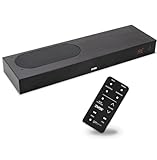
The ZVOX AccuVoice AV835 brings the same core dialogue technology as the AV855 – 20 levels of AccuVoice voice boost and Output Leveling – at a mid-range price tier and in a smaller cabinet. It suits a viewer who has already decided that speech intelligibility is the only feature that matters, and who wants that capability without paying for immersive formats or premium finishes. It is the sensible middle of the ZVOX range and, for many households, the best value on this list.
Key specs
- Dialogue system: AccuVoice voice boost with 20 selectable levels
- Speech consistency: Output Leveling to reduce the gap between quiet dialogue and loud effects
- Form factor: a more compact cabinet than the AV855, suited to mid-sized rooms and bedrooms
- Design priority: dialogue clarity rather than Dolby Atmos or object-based surround
- Control: remote-based voice-boost selection with quick level stepping
- Price tier: mid-range, which puts full 20-level voice control within reach of most budgets
What it does well. The value argument here is straightforward. Voice-boost level count is the specification that most directly determines how well a bar can be tuned to a specific listener, and this bar offers the same 20 levels as the premium ZVOX model. That means the practical dialogue experience is very close to the top of the range, and the money you save goes toward not buying Atmos processing or a larger cabinet you may not need.
Output Leveling earns its place in a mid-range bar because it addresses the second half of the dialogue problem. Voice boost makes speech louder relative to other frequencies; leveling makes speech louder relative to the loudest moments in the mix. Together they cover both the “I cannot hear what they are saying” complaint and the “I am constantly adjusting the volume” complaint, which are usually two symptoms of the same underlying issue.
The smaller cabinet is an advantage in rooms where a full-width bar would crowd a media unit or block a television’s infrared receiver. It is also easier to place at the correct height, and correct height matters: a bar sitting on a low shelf, well below ear level and firing into a coffee table, will sound muddier than the same bar placed closer to ear height with a clear path to the listener.
Pros
- 20 levels of voice boost at a mid-range tier – the best speech-control-per-unit-of-budget here
- Output Leveling reduces constant volume adjustment during films and commercial breaks
- Compact cabinet suits mid-sized rooms, bedrooms and crowded media units
- Remote-based control is quick for guests and less technical household members
- Dialogue-first tuning means you are not paying for unused immersive formats
Cons
- No Dolby Atmos or height-channel processing
- Smaller cabinet will not fill a large open-plan room as convincingly as a bigger bar
- Fewer streaming and smart-home features than the Bose or Fire TV options
- No expansion path to add surrounds within the same system
How it compares. Against the ZVOX AccuVoice AV855, this is the value play: same 20 levels of voice boost, same Output Leveling, smaller cabinet, lower tier. Step up to the AV855 only if your room is large or you want the fullest version of the hardware. Against the ZVOX AccuVoice AV157, the AV835 doubles the voice-boost resolution from 12 levels to 20 and adds Output Leveling, which is a meaningful upgrade if you watch a lot of films with dramatic dynamic range rather than mainly news and talk shows. Against the Amazon Fire TV Soundbar Plus, the trade is clear: the ZVOX wins on speech control and volume consistency, the Fire TV bar wins on centre-channel layout, built-in subwoofer weight and Atmos.
6. ZVOX AccuVoice AV157 – Best Budget Dialogue Bar for Small Rooms

The ZVOX AccuVoice AV157 is the cheapest sensible answer to muddy television dialogue. It is a compact AccuVoice bar with 12 levels of voice boost, designed for bedrooms, small living rooms and secondary televisions where the goal is legible speech at low volume rather than cinematic scale. It suits a viewer who has tried the TV’s own “clear voice” setting, found it inadequate, and wants a dedicated speech processor without spending mid-range money.
Key specs
- Dialogue system: AccuVoice voice boost with 12 selectable levels
- Form factor: compact bar, sized for bedrooms and TVs in the 32 to 50 inch class
- Design priority: speech intelligibility at modest volume rather than bass or immersion
- Placement: shelf, tabletop or in front of a smaller television
- Control: remote-based voice-boost selection, with a smaller ladder of levels than the AV835 and AV855
- Price tier: budget – the lowest entry point to dedicated voice-boost processing on this list
What it does well. Twelve levels of voice boost is still a great deal more control than the single dialogue button on most budget bars. In a small room, that is usually plenty: the acoustic problem in a bedroom is rarely scale, it is that the television’s tiny downward-firing speakers muffle consonants and that the listener is sitting close enough for a modest bar to sound full. This bar is designed for exactly that situation.
The budget tier also makes it a low-risk purchase. If you are not sure whether a soundbar will meaningfully improve speech for you, spending at the budget level and discovering that voice boost transforms your viewing is a far better outcome than spending at the premium level and discovering you needed something else entirely. It is also a sensible second-system buy for a spare room or a guest bedroom.
Where it gives ground is dynamic range management. Without Output Leveling, a film with wide swings between whispered dialogue and loud effects will still push you toward the remote. If that is your main frustration, the AV835’s leveling feature is worth the step up in tier.
Pros
- 12 discrete voice-boost levels at a budget price tier
- Compact enough for bedrooms, dens and small media units
- AccuVoice speech processing is the same family of technology used across the ZVOX range
- Low-risk entry point if you are unsure a soundbar will help your hearing situation
- Straightforward remote-based control with no app requirement
Cons
- No Output Leveling, so wide dynamic-range content still requires volume adjustments
- Fewer voice-boost steps than the AV835 and AV855, so finer tuning is limited
- Limited bass and no immersive format support
- Small cabinet will struggle in a large or open-plan room
How it compares. Against the Bose TV Speaker (2nd Gen), the other budget option, the AV157 is the more specialised tool: 12 levels of voice boost versus a single dialogue mode, and processing tuned specifically for speech rather than a general-purpose bar. The Bose counters with better build, Bluetooth music streaming and a more polished all-round sound. If your household watches television for dialogue and little else, the ZVOX is the sharper choice. If the bar also has to play music and handle films at modest volumes, the Bose is more versatile. Against the ZVOX AccuVoice AV835, the AV157 saves money but gives up eight voice-boost levels and Output Leveling – a fair trade only if your viewing is mostly news, sport and talk content rather than films.
How to Choose
Choosing a soundbar for dialogue is a different exercise from choosing one for home cinema. Bass depth, surround channels and room-filling power all matter less than five things: whether the bar can anchor speech to the screen, how its voice-enhancement system works, whether it can hold speech at a consistent level, whether its size suits your room, and whether your television can accept the connection it offers. Work through them in that order and the shortlist usually collapses to one or two products.
1. Centre-channel design and dialogue separation
The single biggest structural advantage a bar can have for speech is a dedicated centre channel. In a 3.1 layout, a separate set of drivers reproduces voices and anchors them to the middle of the screen, so dialogue stays put even when you sit off to one side. In a two-channel bar, the centre image is “phantom” – created by the left and right drivers working together – and it collapses as you move off-axis.
How much does that matter? Here is the arithmetic. The stereo separation angle from a bar is 2 x arctan((bar width / 2) / seating distance). A 24 inch bar viewed from 8 feet gives roughly 14 degrees of separation. A 36 inch bar at the same distance gives roughly 21 degrees. In a small room where you sit 6 to 8 feet back and roughly centred, a 14 degree window is workable. In a larger room with seating spread across a sofa, a 36 inch three-channel bar is the difference between everyone hearing dialogue and only the person in the middle hearing it. If your seating is wider than about 6 feet, prioritise a 3.1 or larger layout.
2. How voice-enhancement modes actually differ
Not all dialogue modes are equivalent, and the differences determine how usable they are day to day.
- Single dialogue preset: one button, one amount of lift. Fast and foolproof, but you cannot adjust it, and the same setting applies to a whispered drama and a shouted sports broadcast. Common at the budget tier.
- Stepped voice boost: a ladder of selectable levels – 12 on the AV157, 20 on the AV835 and AV855. You tune the amount of lift to the listener and the content. Best when the person who needs the boost is also the person willing to press a button.
- Adaptive or A.I. dialogue processing: the bar analyses the audio and adjusts the lift automatically. Best when several people share the television and nobody wants to manage a setting.
- Speech-frequency processing: enhancement targeted at the consonant range where intelligibility lives, rather than a broad midrange boost. Tends to sound less artificial at high settings.
A practical tip: whichever type you choose, adjust it while watching real content you actually struggle with, not a demo clip. Dialogue clarity problems are content-specific – a well-mixed news broadcast will sound fine on a bar that fails on a mumbled prestige drama with a heavy score.
3. Speech volume consistency: the feature people forget to check
If you find yourself turning the volume up during conversation and down during action, your problem is dynamic range, not frequency balance. Voice boost alone will not fix it. You need a leveling or night-mode feature that compresses the difference between the quietest dialogue and the loudest effects. ZVOX calls this Output Leveling; other manufacturers call it night mode, dynamic range control or dialogue enhancer. Whatever the name, it is the feature that decides whether you touch the remote six times an episode or not at all.
If you watch a lot of films and streamed drama, treat leveling as close to mandatory. If your viewing is mostly news, sport, game shows and talk content, where the mix is already fairly even, you can skip it and save money by staying at the budget tier.
4. Room-size fit, with numbers
Soundbars are usually under-specified for the room they end up in, and an under-specified bar sounds thin and strained, which makes dialogue harder to follow, not easier. Estimate your room volume – length x width x ceiling height – and use it as a filter.
| Room volume (L x W x H) | Typical situation | Bar class to target | Voice-boost levels to look for |
|---|---|---|---|
| Up to about 1,000 cubic feet (e.g. 10 x 11 x 9 ft) | Bedroom, den, small spare room | Compact two-channel or small 3.1 bar | 12 levels is usually enough |
| About 1,000 to 2,000 cubic feet (e.g. 12 x 14 x 9 ft) | Typical living room, closed plan | Full-width bar or 3.1 with built-in subwoofer | 20 levels plus leveling |
| About 2,000 to 3,000 cubic feet (e.g. 15 x 18 x 9 ft) | Large living room or open kitchen-living space | Wide bar with strong internal bass, or a bar plus separate subwoofer | 20 levels plus leveling; consider expansion |
| Over about 3,000 cubic feet | Open plan with hard floors and high ceilings | Bar plus external subwoofer, or a bar plus surrounds | 20 levels plus leveling, with placement work |
Two acoustic realities sit behind that table. First, sound falls off with distance, so a bar that sounds authoritative at 8 feet will sound thin at 16 feet; if your sofa is far from the screen, size up. Second, hard surfaces create reflections that smear consonants. Rugs, curtains, upholstered furniture and yes, pet beds and soft toys, all reduce reflections. A room with bare floors, bare walls and a large glass table is a genuinely harder dialogue environment than a carpeted room with a sofa and curtains, and no voice-boost setting fully compensates for it. If you are choosing between two bars, the one that fits the room will usually beat the one with more features.
5. TV connection options and what you lose with each
| Connection | What it carries | What you lose | Best for |
|---|---|---|---|
| HDMI eARC | Full-bandwidth audio including Dolby Atmos; TV remote controls the bar’s volume | Nothing significant, if your TV has the port | Any modern TV; the default choice |
| HDMI ARC | Standard audio formats, TV remote volume control | Atmos and other high-bandwidth formats may be downmixed | TVs from the ARC-only era |
| Optical (TOSLINK) | Standard stereo and compressed surround audio | No Atmos, no TV-remote volume control on most setups, one more cable | Older TVs with no HDMI ARC at all |
| Bluetooth | Wireless audio, usually for music from a phone | Lip-sync can drift; not ideal as a permanent TV connection | Music playback and casual use |
| Wi-Fi streaming | Network audio, multiroom grouping, app control | Adds setup complexity; requires a stable network | Households already using a multiroom ecosystem |
Check your television’s ports before you buy, not after. If your TV has eARC, use it: you get the best audio the bar can produce and one-remote control. If it only has optical, the bar will still deliver a large improvement in dialogue, but any Atmos capability on the bar becomes irrelevant. If your TV has no audio output at all beyond its own speakers, no soundbar will help until you add a source device with an audio output.
6. Placement, and the mistakes that undo good hardware
- Height matters more than width. A bar sitting well below ear level, firing into a coffee table, will sound muddier than a smaller bar placed closer to ear height. Aim to have the bar’s drivers at roughly seated ear level, or tilt it slightly upward.
- Do not bury the bar in a cabinet. Enclosing a soundbar in a shelf compartment creates resonances and blocks the drivers. Leave at least a few inches of clearance on all sides.
- Keep the centre of the bar centred. Line it up with the middle of the screen so the phantom or real centre channel matches what your eyes see.
- Check for IR interference. A tall bar in front of a TV can block the television’s infrared remote sensor. If your remote stops working, that is usually why.
- Run the calibration if the bar offers it. Room correction is not marketing filler in this class; it adjusts for the boundary effects of your specific shelf and wall.
7. A worked ownership calculation
It helps to think in cost per year rather than sticker price, because soundbars last a long time and the tiers separate less than they appear to. Assume a five-year working life, which is realistic for a powered bar that is not abused. A budget bar that costs roughly one third of a premium bar works out at about 0.067 of the