Key takeaways
- Format: set of four rectangular ceramic baking dishes, white glazed finish inside and out
- Size span: roughly 8×6 inches at the small end to 13×9 inches at the large end, in graduated steps
- Capacity class: the largest dish sits in the 3-quart working-capacity class, enough for a lasagna serving six to eight
- Material: glazed ceramic — dense, non-porous once fired, and heavier than thin stamped steel or aluminium
- Compatibility: oven, microwave, freezer, and dishwasher compatible per the listing
- Handles: integrated side handles on the larger pieces for a two-handed lift out of a hot oven
- Storage: nests to roughly the footprint of the largest dish plus the height of four stacked rims
The best stoneware baking dishes for even results are the MALACASA Casserole Dishes for Oven, Ceramic Baking Dishes Set of 4 in white. Four graduated rectangular pans cover the everyday range — a small gratin for two through a full 13-inch lasagna — and the thick ceramic walls heat slowly and release heat slowly, which is what keeps a casserole’s edges from drying out before the centre sets. It suits a household that cooks from scratch three or more nights a week and wants one matched, nestable stack instead of a drawer of mismatched pans. If you would rather spend less and buy a single deep pan, the DOWAN Casserole Dish, 9×13, at 4.2 quarts is the best budget pick and the deepest single pan in this group. If you want the highest published heat ceiling here and a glaze built to travel from oven to table, the Staub 3-Piece Ceramic Baking Dish Set, oven safe to 570°F, is the premium choice.
Top 3 Picks
Best overall: MALACASA Casserole Dishes for Oven, Set of 4
A matched four-piece ceramic set in white that spans roughly 8×6 inches up to 13×9 inches, so one purchase replaces three or four odd pans. The thick, fully glazed walls hold heat steadily, which is the single biggest factor in whether a casserole browns evenly rather than scorching at the corners, and the set nests into about the footprint of its largest dish. It is the right buy for anyone who wants a complete baking drawer in one decision.
Best budget: DOWAN 9×13 Ceramic Baking Dish, 4.2 Quarts
One deep pan instead of a set, and the deepest single dish on this list at 4.2 quarts of working capacity. If your baking is mostly lasagna, big-batch casseroles, and oven roasts for eight or more, a single deep 9×13 with handles does more work than a shallow four-piece set at a lower outlay. It is also the easiest of these to justify if you have almost no cabinet space.
Best premium: Staub 3-Piece Ceramic Baking Dish Set, Turquoise
The only set here with a published oven ceiling of 570°F, well above the 450–500°F class that most stoneware and ceramic bakeware tops out at. That extra headroom matters for high-heat roasting, finishing under moderate broiler heat, and for anyone whose oven runs hot. The turquoise glaze and three-piece graduated sizing make it a genuine oven-to-table set rather than a set you bake in and then transfer out of.
Quick Comparison
| Product | Best for | Key specs | Price tier |
|---|---|---|---|
| MALACASA Casserole Dishes for Oven, Ceramic Baking Dishes Set of 4, White | Best overall — a complete everyday set | 4 rectangular ceramic dishes, white glaze, graduated sizes approx. 8×6 in to 13×9 in, oven/microwave/freezer/dishwasher compatible, nestable | Mid-range |
| MARTHA STEWART 3-Piece Oven to Table Stoneware Bakeware Set, Dusty Blue | Best budget set with a serving look | 3-piece stoneware set, baking dish plus casserole shapes, dusty blue glaze, oven-to-table design, dishwasher safe | Budget |
| DOWAN Casserole Dish, 9×13, 4.2 Quarts | Best deep single pan | 9×13 in ceramic, 4.2 qt working capacity, deep walls, built-in handles, oven/microwave/freezer/dishwasher compatible | Budget |
| Howise Ceramic Baking Casserole Dish with Handles | Best two-pan starter pair | Large 9×13 in pan plus a middle-size baking pan, porcelain body, side handles, serving-ready glaze | Budget |
| COOK WITH COLOR Ceramic Bakeware Set of 4 | Best premium four-piece set | 4 rectangular porcelain casserole dishes, graduated sizes, integrated handles, oven/microwave/freezer/dishwasher compatible | Premium |
| Staub 3-Pc Ceramic Baking Dish Set, Turquoise | Best for high-heat roasting and oven-to-table | 3-piece ceramic set, oven safe to 570°F, turquoise glaze, graduated sizes, dishwasher safe | Premium |
How We Chose
This roundup is built from published product specifications, brand documentation, and the physical norms of the stoneware and ceramic bakeware category — not from laboratory measurement. The criteria were chosen in the order a buyer actually feels them after the box is open.
First, wall thickness and thermal mass, because they determine browning evenness more than any other single variable; a 6 mm wall and a 9 mm wall behave very differently in a 375°F oven. Second, glaze durability and coverage, including whether the exterior is glazed and whether the rim is left raw. Third, usable capacity in quarts rather than the length-and-width numbers shoppers default to, since two 9×13 pans can differ by a full quart of food. Fourth, the practical compatibility matrix: oven, microwave, freezer, dishwasher, and broiler. Fifth, thermal-shock tolerance, which is where most cracked bakeware comes from. Sixth, storage practicality, including nesting and whether the set fits a standard 12-inch cabinet depth. Finally, upgrade path — whether a given pick is a first set that will be outgrown, or a set that stays useful after the next purchase.
1. MALACASA Casserole Dishes for Oven Set of 4 – Best for Everyday Family Baking
As an Amazon Associate we earn from qualifying purchases at no extra cost to you.

This is the set to buy when you want the baking drawer solved in one order. Four rectangular dishes in the same white glaze, sized so that the smallest handles a two-person gratin and the largest handles a full 13-inch lasagna, means you are never deciding between “too small” and “wasteful”. It suits households of three to five that cook from scratch several nights a week, and it suits anyone who dislikes the look of mismatched bakeware coming to the table.
Key specs
- Format: set of four rectangular ceramic baking dishes, white glazed finish inside and out
- Size span: roughly 8×6 inches at the small end to 13×9 inches at the large end, in graduated steps
- Capacity class: the largest dish sits in the 3-quart working-capacity class, enough for a lasagna serving six to eight
- Material: glazed ceramic — dense, non-porous once fired, and heavier than thin stamped steel or aluminium
- Compatibility: oven, microwave, freezer, and dishwasher compatible per the listing
- Handles: integrated side handles on the larger pieces for a two-handed lift out of a hot oven
- Storage: nests to roughly the footprint of the largest dish plus the height of four stacked rims
The reason this set wins on even results is thermal mass. A thick ceramic wall absorbs heat from the oven, spreads it laterally across the base, and then releases it slowly into the food. That lag is what stops the edges of a casserole from setting and browning while the middle is still liquid — the classic failure mode of thin metal pans, where the base heats fast and unevenly and the corners catch. In practice you get a gentler, more uniform bake and a longer window where the dish is still warm at the table without a reheat.
Glaze durability is the second strength. A fully glazed body — interior, exterior, and rim — resists the staining that turns white bakeware grey over a couple of years, and it means there is no raw clay edge to absorb oil or trap odour. The trade-off of white is honesty: tomato sauce, turmeric, and beet juice will show if you leave them on. A short soak and a normal dishwasher cycle handle almost everything, but baked-on cheese at the rim is the one thing worth attacking with a plastic scraper before the wash cycle rather than after.
Against the nearest alternative in this list, the COOK WITH COLOR set of four, this MALACASA set trades a step of material density and premium finish for a lower price tier while offering the same four-piece coverage. Against the MARTHA STEWART three-piece set, it offers one more dish for a modest step up in price. Choose this one if completeness matters more than material prestige.
Pros
- Four graduated sizes cover nearly every recipe a home oven produces
- Thick ceramic walls give even, forgiving browning and long heat retention
- Fully glazed inside and out, so no raw rims to stain or hold odour
- Oven, microwave, freezer, and dishwasher compatible
- Nests compactly; a matched set stores better than four odd pans
Cons
- Heavier than metal bakeware, especially the largest dish when full
- White glaze shows sauce and spice staining if you skip the soak
- No lid, so transport and refrigerator storage need foil or a wrap
- Not the right pick if you only ever bake one size of casserole
2. MARTHA STEWART 3-Piece Oven to Table Stoneware Bakeware Set – Best Budget Set for Serving at the Table

This is the set that assumes the dish goes from the oven directly to the table and looks intentional when it gets there. Three pieces in a dusty blue stoneware glaze, covering a baking dish and casserole-style shapes, give you the core sizes without paying for the fourth dish you might use twice a year. It suits smaller households, couples who entertain casually, and anyone furnishing a first kitchen who wants bakeware that doubles as serving ware.
Key specs
- Format: 3-piece stoneware bakeware set, baking dish plus casserole shapes
- Finish: dusty blue glazed stoneware, oven-to-table styling
- Material: stoneware — fired denser than basic earthenware, with a glaze that resists chipping better than soft clay bodies
- Compatibility: oven safe and dishwasher safe per the listing
- Handles: integrated handles sized for oven gloves
- Storage: three-piece nesting, roughly 4 to 5 inches of stacked height
Stoneware is the material to think about here, because it is the category this whole roundup is named for and it behaves differently from thin ceramic. Stoneware is fired to a higher temperature than earthenware, which makes it denser, less porous, and noticeably more resistant to the chipping that ruins a dish’s rim within a year or two of regular use. The trade-off is weight: a stoneware dish of the same capacity will generally feel heavier than a porcelain one of similar size, because the body is thicker.
The strength of this set is its role flexibility. A dusty blue glaze reads as a serving piece, which means you are not washing a separate platter every time you roast vegetables or bake a gratin for guests. That single fact removes a whole step from weeknight cooking, and it is the reason oven-to-table sets outsell plain white bakeware in the budget tier despite doing the same job in the oven.
The limit is coverage. Three pieces means there is no very small dish for a single portion and no second 13-inch pan for cooking two things at once on a holiday. If you regularly cook a main and a side that both need the oven at the same temperature, you will want a fourth piece, which is exactly the gap the MALACASA and COOK WITH COLOR sets fill. Compared with the DOWAN single deep pan, this set gives you more shapes but less depth — the DOWAN’s 4.2-quart walls hold a much larger volume than a standard casserole of the same footprint.
Pros
- Budget tier pricing for three usable pieces
- Stoneware body is denser and more chip-resistant than basic earthenware
- Dusty blue glaze is presentable enough to skip a serving platter
- Dishwasher safe, so cleanup is not a hand-wash chore
- Compact three-piece stack suits small kitchens
Cons
- Three pieces leaves gaps: no very small dish, no second large pan
- Stoneware is heavy, and a full casserole is a two-hand lift
- No lid included for refrigerator storage or transport
- Coloured glaze can show utensil marks more than plain white
3. DOWAN Casserole Dish 9×13, 4.2 Quarts – Best Deep Single Pan for Big-Batch Cooking

If you make one large thing at a time — a deep lasagna, a double batch of baked ziti, a whole roast chicken with vegetables underneath — this single 9×13 pan with 4.2 quarts of working capacity does more than a four-piece set of shallow dishes. It suits cooks feeding six to ten, batch cookers, and anyone with limited cabinet space who would rather own one excellent pan than four adequate ones.
Key specs
- Format: single rectangular ceramic baking dish
- Footprint: 9×13 inches — the standard size most recipes and boxed directions assume
- Capacity: 4.2 quarts working capacity, which implies walls in the 3-inch class rather than the standard 2 inches
- Material: glazed ceramic
- Handles: built-in side handles, a meaningful feature on a dish this heavy when full
- Compatibility: oven, microwave, freezer, and dishwasher compatible per the listing
- Depth advantage: deep walls contain bubbling sauces that would otherwise spill onto the oven floor
The capacity number is the whole story here, and it is worth doing the arithmetic because 9×13 tells you almost nothing on its own. A 9×13 pan with 2-inch walls holds roughly 3 quarts of food comfortably, about 4 quarts filled to the brim. Raise the walls to 3 inches and the same footprint holds roughly 4.5 quarts comfortably, around 6 quarts to the brim. That is a 40 to 50 percent increase in usable volume from a change most shoppers never notice, and it is the difference between a lasagna that fits and one that volcanoes over the rim.
Depth also changes cooking behaviour. A deeper dish means a taller column of food, so the interior takes longer to reach temperature while the exposed surface browns at the same rate — which is why deep casseroles benefit from a slightly lower oven temperature and a few extra minutes, and why they hold their heat for far longer once out. If you serve at the table, a deep ceramic dish will still be warm twenty minutes after it leaves the oven, which a thin metal pan will not manage.
The nearest alternative in this list is the Howise set, which also centres on a 9×13 pan but pairs it with a middle-size dish and uses a porcelain body. Choose the DOWAN if depth and volume are your priority; choose the Howise if you want two pans and a denser material. Compared with the MARTHA STEWART stoneware set, this pan gives you more capacity in one piece but no small dish for sides.
Pros
- 4.2 quarts of working capacity in the standard 9×13 footprint
- Deep walls contain sauce and reduce oven cleanup
- Built-in handles make a heavy full dish manageable
- One pan solves big-batch cooking at a low price tier
- Holds heat far longer than metal at the table
Cons
- Only one size — no small dish for sides or single portions
- Heavy when full; not a one-hand dish
- Deep walls need adjusted time and temperature for some recipes
- No lid, so storage and transport need covering
4. Howise Ceramic Baking Casserole Dish with Handles – Best Two-Pan Starter Pair

Two pans, two jobs: a large 9×13 for the main bake and a middle-size pan for sides, small casseroles, or a dessert going in alongside. It suits cooks who want coverage without buying a full four-piece set, and it suits anyone who prefers a porcelain body — denser and harder than standard stoneware — for its resistance to chipping and its tight, non-porous surface.
Key specs
- Format: two-piece set — one large 9×13-inch pan and one middle-size baking pan
- Material: porcelain — fired hotter than stoneware, giving a denser, harder, less porous body
- Handles: integrated side handles on both pieces, sized for oven gloves
- Finish: fully glazed, serving-ready surface for oven-to-table use
- Compatibility: oven, microwave, and dishwasher compatible per the listing
- Storage: the middle pan nests inside the large one, roughly 3 inches of stacked height
Porcelain versus stoneware is the decision that matters in this section. Porcelain is fired at higher temperatures, which produces a body that is denser and harder and, in practice, more resistant to the small chips and hairline crazing that eventually dull a glaze. The counterpoint is that harder, denser bodies are often less forgiving of abrupt temperature change, so thermal-shock discipline matters more, not less, with porcelain. Treat it gently and it will outlast a softer stoneware dish; treat it carelessly and it can crack in one bad move.
The two-pan format is genuinely well judged for a first bakeware purchase. A large pan plus a middle pan covers the majority of home recipes: the 9×13 for lasagna, sheet-style casseroles, roasts, and brownies; the middle pan for a gratin for two, a side of roasted vegetables at the same oven temperature, or a small dessert baked while the main rests. What it deliberately omits is the very small dish and the extra-large deep dish, which is where the DOWAN and the four-piece sets come in.
Compared with the DOWAN single 9×13 at 4.2 quarts, this set offers two pans but less depth in the large one — a standard-depth 9×13 rather than a deep one. If you routinely overflow a normal pan, the DOWAN is the better answer. If you routinely cook a main and a side together, this pair is. Compared with the MALACASA four-piece set, you give up two sizes and gain a denser material at a similar or lower outlay.
Pros
- Porcelain body is dense, hard, and resistant to chipping
- Two pans cover a main bake plus a side or dessert
- Handles on both pieces, including the small one
- Nests into a compact stack for small cabinets
- Budget tier price for a two-piece set
Cons
- No very small or very large dish in the set
- Standard depth, so big-batch recipes can crowd the rim
- Porcelain benefits from careful thermal-shock handling
- No lid included
5. COOK WITH COLOR Ceramic Bakeware Set of 4 – Best Premium Four-Piece Porcelain Set

This is the set for someone who has decided to buy bakeware once and keep it for a decade. Four rectangular porcelain casserole dishes in graduated sizes, with integrated handles and a fully glazed serving-ready finish, give the same coverage as the MALACASA set but in a denser material at a premium price tier. It suits frequent bakers, people who cook for crowds, and anyone replacing a mismatched collection with a single coherent stack.
Key specs
- Format: set of four rectangular casserole dishes, graduated sizes
- Material: porcelain — the densest and hardest body in this roundup
- Handles: integrated handles on the larger pieces
- Finish: fully glazed, serving-ready interior and exterior
- Compatibility: oven, microwave, freezer, and dishwasher compatible per the listing
- Storage: nests to roughly the footprint of the largest dish
The case for porcelain over ceramic here is longevity of appearance. A denser body takes a smoother, tighter glaze, and a tighter glaze resists the fine network of surface cracks — crazing — that gradually dulls cheaper bakeware and traps colour from sauces. Over three to five years of regular use, that difference is the main visible gap between a premium set and a budget one. What porcelain does not do is make food cook faster or more evenly; evenness comes from wall thickness and thermal mass, and a well-made ceramic dish can match a porcelain one on that front.
Four pieces at this price tier only make sense if you will actually use all four. The honest test is whether you have ever needed two different-sized dishes in the same oven session in the past month. If yes, the fourth piece earns its place. If your baking is one pan, once a week, this is more set than you need and the DOWAN single deep pan or the Howise pair will serve you better for less.
Against the MALACASA four-piece set, this is the same coverage in a denser material at a higher price tier — the upgrade is material and finish quality, not capability. Against the Staub three-piece set, this set offers one more dish and a neutral finish, while the Staub offers a higher published oven ceiling of 570°F and a more decorative glaze. If you roast at high heat or want the dish to be the table centrepiece, the Staub has the edge; if you want maximum coverage in the densest material, this set does.
Pros
- Four graduated sizes in a dense, hard-wearing porcelain body
- Tight glaze resists crazing and staining over years of use
- Integrated handles on the larger dishes
- Oven, microwave, freezer, and dishwasher compatible
- Full nesting stack keeps storage tidy
Cons
- Premium price tier for coverage many kitchens will not fully use
- Heaviest option here when a large dish is full
- Porcelain still needs thermal-shock discipline
- No lids, so refrigerator storage and transport need covering
6. Staub 3-Pc Ceramic Baking Dish Set, Turquoise – Best for High-Heat Roasting and Oven-to-Table Serving
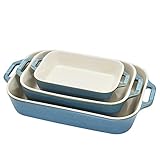
Three ceramic dishes with a published oven-safe rating of 570°F — the highest ceiling in this roundup and a meaningful margin above the 450–500°F class most stoneware and ceramic bakeware carries. It suits anyone whose oven runs hot, who roasts at high heat, or who wants bakeware that looks deliberate on a laid table. The turquoise glaze is the most decorative finish here, and the three-piece sizing covers the core recipes without redundancy.
Key specs
- Format: 3-piece ceramic baking dish set, graduated sizes
- Oven rating: safe up to 570°F per the listing — the highest published ceiling in this roundup
- Material: glazed ceramic
- Finish: turquoise glaze, oven-to-table styling
- Compatibility: oven safe and dishwasher safe per the listing
- Storage: three-piece nesting stack
Why the 570°F figure matters more than it first appears: most recipes call for 350–425°F, so any oven-safe dish clears them. The gap opens at the edges of normal cooking — a 450°F roast, a recipe that calls for a hot start then a reduction, an oven with a 25°F calibration error pushing a 475°F setting toward 500°F, or a short spell under a broiler. A dish rated to 570°F has headroom in all of those situations, and headroom is what prevents the thermal-shock cracks that most often appear at exactly these moments. It is not a licence to abuse the dish; it is a margin of safety.
Thermal shock is the real risk with any glazed ceramic, regardless of rating, and the rules are consistent across the category. Never move a dish straight from a freezer to a preheated oven — let it come to room temperature first. Never pour cold liquid into a hot dish. Never set a hot dish on a cold or wet surface, including a wet towel or a stone countertop; use a dry trivet or a wooden board. Never add liquid to a dry, hot dish. And let the dish cool to warm before it meets dishwater or the dishwasher. Most cracked bakeware traces back to one of those five moves rather than to a manufacturing fault.
Against the COOK WITH COLOR four-piece set, this set offers one fewer dish and a lower-capacity range, but a significantly higher heat ceiling and a more distinctive glaze. Against the MALACASA four-piece set, you trade coverage for heat headroom and table presence. If your cooking is mostly 375°F casseroles, the extra rating buys you peace of mind rather than new capability — but if you roast, broil briefly, or bake in an oven you do not fully trust, it is the most defensible choice on this list.
Pros
- Highest published oven ceiling here at 570°F, with real headroom over everyday recipes
- Decorative turquoise glaze is genuinely oven-to-table
- Three graduated sizes cover the core recipe range
- Dishwasher safe for easy cleanup
- Compact nesting stack
Cons
- Premium price tier for three pieces rather than four
- No very large deep dish for big-batch cooking
- Decorative glaze limits mixing and matching with existing bakeware
- Still requires the same thermal-shock discipline as any ceramic
How to Choose
Start with capacity in quarts, not length and width
Two dishes can both be labelled 9×13 and differ by half their usable volume. Depth is the variable nobody lists prominently and the one that decides whether your recipe fits. Use this as your working guide:
| Dish size | Approx. working capacity | Typical use | Serves |
|---|---|---|---|
| 8×6 in | 1.5 qt | Small gratin, dip, single-portion bake | 2 |
| 9×7 or 11×7 in | 2 to 2.5 qt | Side dish, small roast vegetables, brownies | 3 to 4 |
| 9×9 in | 2.5 to 3 qt | Square bakes, small lasagna, dessert | 4 |
| 9×13 in, 2 in walls | ~3 qt | Standard lasagna, sheet casserole | 6 to 8 |
| 9×13 in, 3 in walls | 4 to 4.5 qt | Deep lasagna, roasts, big-batch casserole | 8 to 10 |
A useful rule when scaling: a 9×13 pan has roughly 117 square inches of base area, an 8×8 has 64, and a 9×9 has 81. So a 9×13 is about 1.8 times the base of an 8×8 — meaning a recipe written for an 8×8 doubled will fit a 9×13 with room to spare, but the same recipe doubled in a 9×9 will overflow. If you are halving a 9×13 recipe, an 8×8 or 9×9 is the correct target, not a 9×13 filled halfway, because a shallow layer browns and dries rather than baking through.
Thickness and heat retention: what actually produces even results
Even browning comes from thermal mass and lateral heat spread, not from the material’s name. Thicker walls absorb oven heat, distribute it across the base, and release it slowly into the food. That slow release is why a thick ceramic dish produces a gentler, more uniform bake than a thin metal pan, and why the corners of a casserole do not scorch before the centre sets. As a rough guide, walls in the 5 to 6 mm range are on the thin side and will heat and cool quickly; 7 to 9 mm is the sweet spot for even results without making the dish unmanageable. Beyond that, you gain heat retention but pay in weight, especially with a full 4-quart dish lifted out of a hot oven.
Stoneware, ceramic, or porcelain
Stoneware is fired to a high temperature, producing a dense, low-porosity body that resists chipping well and holds heat admirably. It is usually the heaviest option for a given capacity. Ceramic is a broad category term that covers many fired clay bodies; the practical question is whether the piece is fully glazed and reasonably thick, not what the label says. Porcelain is fired hotter still, giving the densest and hardest body, the tightest glaze, and the best resistance to crazing and staining over time — at a higher price and with a somewhat lower tolerance for abrupt temperature change. None of the three makes food taste better. Thickness and glaze quality do more for your results than the material name on the box.
Glaze durability: what wears first
In practice, the glaze fails before the body does. The first signs are utensil marks on the base, a dull patch where you always cut, and fine crazing lines that trap colour. Three things slow this down: a fully glazed exterior and rim, which stops moisture and oil from wicking into raw clay; using silicone, wood, or plastic utensils rather than metal; and never cutting directly in the dish with a knife. Avoid sudden temperature changes on a glazed surface too, since crazing is often thermal rather than mechanical in origin. A well-cared-for glazed dish should hold a clean, food-safe surface for many years; a chipped or heavily crazed one should be retired.
Thermal shock: the five rules that prevent cracks
- Never go freezer to oven. Let the dish reach room temperature first — this is the single most common cause of a cracked dish.
- Never pour cold liquid into a hot dish, or add liquid to a dry, hot one.
- Never place a hot dish on a cold or wet surface — wet towels, cold stone, and metal trays all qualify. Use a dry trivet or wooden board.
- Never move a dish straight from the oven to cold water. Let it cool to warm first.
- Respect the published ceiling. Most stoneware and ceramic bakeware tops out in the 450–500°F class; a set rated to 570°F has more headroom, but the rules still apply.
Dishwasher and microwave compatibility
All six picks here are listed as dishwasher compatible, which is the practical baseline for 2026. Two caveats are worth knowing. First, dishwasher detergents are abrasive over time and will gradually dull a glossy glaze, so hand-washing the piece you use most will extend its looks. Second, a dishwasher’s dry cycle involves rapid temperature change; letting dishes cool fully before loading them is the same thermal-shock principle as above. On microwaving, glazed ceramic and porcelain are fine for reheating, but a dish that is still cold from the refrigerator should not go straight into a hot microwave run at full power — the same gradual-warming logic applies.
Storage practicality and nesting math
A four-piece nested set typically occupies the footprint of its largest dish plus 4 to 5 inches of stacked height. A three-piece set saves roughly an inch and a half. The larger question is cabinet depth: a 13-inch-long dish needs a cabinet or shelf at least 13.5 inches deep to sit flat, and many upper cabinets are shallower than that, which is why large bakeware ends up in a low cabinet or on top of the refrigerator. If your storage is tight, measure before you buy — a set of four is only useful if all four pieces have a home.
Cost per use: the calculation that settles the tier question
Assume a mid-range four-piece set in the region of $60 at typical street pricing. Used three times a week, that is roughly 156 uses a year, or 780 uses over five years — about 8 cents per use. Now compare a single budget pan at around $25, used once a week: 52 uses a year, 156 over three years, about 16 cents per use. The set is cheaper per use despite costing more, because it gets used more often and lasts longer. That is the real argument for buying a set over a single pan — not the price on the box, but whether the extra sizes actually get used. If they will not, the single pan wins on both counts.
Decision matrix: match the pick to your situation
| Your situation | What to prioritise | Suggested pick |
|---|---|---|
| First bakeware, cooking for 3 to 5 most nights | Full size coverage, even browning, nesting | MALACASA Set of 4 |
| Small kitchen, tight cabinets | Compact nesting, few pieces | MARTHA STEWART 3-Piece or Howise pair |
| Mostly one big dish: lasagna, batch casseroles | Depth and working capacity above 4 quarts | DOWAN 9×13, 4.2 qt |
| Cooking a main and a side in the same oven | Two pans in different sizes | Howise two-piece set |
| Roasting at high heat or an oven that runs hot | Published oven ceiling with headroom | Staub 3-Piece, 570°F |
| Entertaining and serving at the table | Decorative glaze, oven-to-table styling | Staub 3-Piece or MARTHA STEWART |
| Buying once for a decade | Densest body, tightest glaze, most sizes | COOK WITH COLOR Set of 4 |
| Budget under $40 for the whole purchase | Fewer pieces, one deep pan, or a three-piece set | DOWAN, Howise, or MARTHA STEWART |
Frequently Asked Questions
Is stoneware better than ceramic or porcelain for baking?
Not inherently — they are three fired clay bodies with different densities, and the differences show up in weight, chip resistance, and glaze longevity rather than in how well food bakes. Stoneware is dense and chip-resistant but usually heaviest. Porcelain is the densest and hardest, with the tightest glaze and the best resistance to staining over time. Ceramic is a broad term covering many bodies, so judge a ceramic dish by whether it is fully glazed and reasonably thick rather than by the word on the box. Even results come from wall thickness and thermal mass, not from the material name.
Can stoneware baking dishes go in the microwave and the dishwasher?
Glazed stoneware, ceramic, and porcelain bakeware is generally safe in both, and every pick in this roundup is listed as dishwasher compatible. The caveats are about temperature change rather than the appliance itself: let a hot dish cool to warm before it meets dishwasher water or a dry cycle, and do not move a cold dish straight into a hot microwave run at full power. Dishwasher detergent also dulls glossy glazes gradually, so hand-washing your most-used piece will keep it looking newer for longer.
Why did my baking dish crack in the oven?
Almost always thermal shock rather than a manufacturing fault. The usual causes are moving a dish straight from the freezer or refrigerator into a preheated oven, pouring cold liquid into a hot dish, setting a hot dish on a cold or wet surface, or adding liquid to a dry hot pan. Rapid, uneven expansion across the ceramic body causes a crack that often appears at the rim or the base corner. Letting dishes come to room temperature and using a dry trivet prevents nearly all of it.
What size baking dish do I need for lasagna?
A standard lasagna for six to eight people fits a 9×13-inch pan with 2-inch walls, which holds roughly 3 quarts of working capacity. If your recipe is generous, uses no-boil noodles that swell, or includes a thick meat sauce, choose a deep 9×13 with walls in the 3-inch class — around 4 to 4.5 quarts of working capacity — so the sauce does not bubble over the rim. For a two-person lasagna, an 8×8 or 9×9 is the right target rather than a large pan filled shallowly.
Can I put a stoneware baking dish under the broiler?
Only if the manufacturer’s documentation says so, and many glazed ceramic and stoneware dishes are not rated for broiler use. Broiler heat is radiant and intensely local, which creates a sharp temperature difference between the exposed surface and the rest of the dish — exactly the conditions that cause thermal shock. A dish with a published ceiling of 570°F has more margin than one rated to the 450–500°F class, but the safest approach is to check the specific product’s instructions before using the broiler at all.
How do I stop food from sticking to stoneware?
A glazed dish is not a non-stick surface, so the fix is standard kitchen practice rather than seasoning. Grease the dish lightly before adding food, use a recipe’s fat rather than reducing it, and let baked items rest for five to ten minutes before lifting them out — most sticking happens when food is removed too early, while it is still setting. For baked-on residue, soak in warm water with a little detergent and use a plastic scraper rather than metal, which will scratch the glaze.
Do stoneware baking dishes need to be seasoned like cast iron?
No. Stoneware, ceramic, and porcelain bakeware are glazed, which means the food never touches the clay body and there is nothing to season. The glaze is the cooking surface. Seasoning applies to bare cast iron and some carbon steel, where a polymerised oil layer builds up over time. Trying to season a glazed dish will only leave a sticky, uneven film that is difficult to remove.
How should I store heavy bakeware without damaging it?
Nest the pieces with a soft barrier between them — a thin cloth, a sheet of shelf liner, or a paper towel — so rims are not grinding against rims every time you pull a dish out. Store the heaviest piece at the bottom and keep the stack low rather than overhead, since a dropped 4-quart ceramic dish will break and can injure. Measure your cabinet depth before buying: a 13-inch dish needs at least 13.5 inches of flat depth, which many upper cabinets do not have.
How long should a good stoneware baking dish last?
With careful handling, a well-made glazed dish can stay in service for many years, and the body usually outlasts the glaze. Watch for chipping at the rim, deep crazing that traps colour, and any crack that goes through the body — a cracked dish can fail completely in a hot oven and should be retired. Handle it with the five thermal-shock rules, use non-metal utensils, and hand-wash your most-used piece, and the practical lifespan is long enough that cost per use becomes trivial.
The Short Version
Buy the MALACASA Casserole Dishes for Oven set of four if you want the whole baking drawer solved in one order and you cook for three to five people several nights a week — it is the most complete, most nestable, most evenly baking option here at a mid-range tier. Buy the DOWAN 9×13 at 4.2 quarts if you bake one large thing at a time, feed six or more, or have almost no cabinet space, and you want the deepest single pan for the least money. Buy the Howise two-piece set if you regularly cook a main and a side in the same oven and prefer a denser porcelain body. Buy the MARTHA STEWART three-piece stoneware set if you are furnishing a first kitchen on a budget and want bakeware that can go straight to the table. Buy the COOK WITH COLOR four-piece porcelain set if you are replacing a mismatched collection and intend to keep the replacement for a decade. And buy the Staub three-piece set if your oven runs hot, you roast at high heat, or you want the 570°F headroom and the most presentable glaze in this group. Whichever you choose, the two habits that will keep it performing are the same: match the dish’s capacity to the recipe rather than the other way around, and never shock a hot dish with cold — that single rule prevents most of the cracked bakeware in the world.