Key takeaways
- Compare the best dog treat puzzle toys, from rolling dispensers to sliding boards, with difficulty tips, sizes and what to check before buying.
For most dogs that already know the basics of working for food, the best treat puzzle in this group is the Outward Hound Nina Ottosson Dog Brick, a Level 2 board with 20 hidden compartments that rewards sniffing, lifting and sliding without being frustrating. A treat puzzle is any toy that makes a dog work to release food, which turns a thirty-second snack into several minutes of problem solving. The other five picks cover different needs, from rolling dispensers to sliding boards to a simple rubber ball pair, so the right choice depends on your dog’s experience, size and chewing habits.
This guide ranks six listed puzzle toys, explains how to match difficulty to your dog, and flags the details worth confirming before you order.
Quick List
- PETSTA Puzzle Board – best for dogs that like sliding and nosing a maze-style board
- BSISUERM Treat Ball – best for chasers that enjoy a rolling, adjustable dispenser
- Barkwhiz 3-Level Puzzle – best for owners who want one toy that grows in difficulty
- HIPPIH 2-Pack Treat Balls – best for puppies and gentle chewers on a simple routine
- Outward Hound Dog Brick – best overall for dogs ready for a step-up puzzle
- DR CATCH Slider Puzzle – best for small dogs and puppies learning to slide
Which One Is Right for You?
| If you… | Choose |
|---|---|
| want one reliable puzzle for a dog that has outgrown a basic treat ball | Outward Hound Dog Brick |
| need a puzzle you can make harder over several weeks | Barkwhiz 3-Level Puzzle |
| have a dog that loves to push and chase a toy across the floor | BSISUERM Treat Ball |
| are starting from zero with a puppy or a nervous dog | HIPPIH 2-Pack Treat Balls |
| want a board with sliders and a squeak to catch the dog’s attention | PETSTA Puzzle Board |
| share a home with a small dog or puppy and want a flat, compact slider | DR CATCH Slider Puzzle |
Start with the easiest format your dog can solve in under a minute, then step up only after they succeed several times in a row. A puzzle that is too hard teaches a dog to give up or chew the toy open. Whatever you choose, treat every one of these as supervised play rather than something to leave out with an unattended dog.
All 6 Picks in Detail
1. PETSTA Puzzle Board – Best for Maze-Style Sliding Play
As an Amazon Associate we earn from qualifying purchases at no extra cost to you.
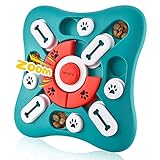
The PETSTA is a flat enrichment board that hides food behind sliders and tracks, so the dog has to nose, paw and push parts into the right position. The listing is written around IQ training and brain stimulation for puppies and dogs, and it also mentions cats. This brand sells its board in several levels and sizes, so check which version and size the listing ships before ordering.
- Format: flat puzzle board with sliding pieces and hidden food holes
- Skill trained: sniffing, pawing and learning an order of moves
- Material: plastic construction (confirm exact material on the listing)
- Extras: the brand’s boards include a squeaker button to draw attention; confirm on this version
- Best location: a non-slip floor or a mat so the board stays still
Pros:
- Several separate challenges on one board keep it interesting
- Works for dogs that prefer using their nose over chasing
- Flat storage compared with bulky balls
Cons:
- Not intended for chewing, and a determined chewer can damage the sliders
- Level and size vary between versions, so the right one needs checking
Compared with the Barkwhiz board, it leans on a squeak and a maze concept, while the Barkwhiz spreads difficulty across three clearly labeled levels.
Who it suits: a dog that already enjoys hunting for food and has the patience to try the same board a few times. Introduce it with the sliders in the easiest position and a few high-value treats, and let the dog watch you slide one piece before they try. If the squeaker proves too exciting, stay calm and keep sessions short, since a dog that fixates on noise may ignore the food. Rotate it with other puzzles every few days so the layout stays interesting rather than becoming a memorized routine.
2. BSISUERM Treat Ball – Best for Chasers Who Love a Rolling Dispenser

This is a dumbbell-style rolling dispenser with differently sized spheres at each end. As the dog pushes it, kibble or small treats drop through openings. The listing highlights an adjustable opening, which lets you widen the gap for easy rewards or narrow it to slow the release. It suits dogs that are motivated by movement and that get bored with static puzzles.
- Format: rolling treat dispenser with two adjustable spheres
- Adjustability: opening size changes the difficulty and the kibble size it can release
- Skill trained: nudging and chasing; also slows eating if filled with part of a meal
- Material: hard plastic, per the listing (confirm on the product page)
- Cleaning: compartments are meant to come apart for washing
Pros:
- Easy to tune for different kibble sizes
- Gives active dogs a reason to move around
Cons:
- Loud on hard floors, and it can bump furniture
- Not a chew toy; remove it if the dog starts gnawing it
Next to the HIPPIH balls, it offers real adjustability, while the HIPPIH pair is simpler and gentler on the floor.
Who it suits: energetic adult dogs and adolescents that need a physical outlet as well as a mental one. Begin with the openings set wide and a handful of kibble, then narrow them as the dog gets faster. Use it on a rug or in a yard rather than on a polished wood floor, where the rolling noise can bounce around. Because the two ends are different sizes, it may tumble unpredictably, which many dogs find part of the fun. Check that the halves are fastened firmly after every wash.
3. Barkwhiz 3-Level Puzzle – Best for Growing Difficulty

The Barkwhiz is described as a three-level puzzle for bored and clever dogs of all breeds. The idea is that the same board offers easier and harder ways to play, so you begin with simple flips and sliding and add steps as the dog improves. Descriptions of this product mention a flip game, a linear sliding track and a lever or sliding piece that must be moved to reach the food.
- Format: multi-challenge board with flip lids and sliding tracks
- Levels: three difficulty settings, so one toy lasts longer
- Storage: around 14 food holes, per product descriptions (confirm on the listing)
- Grip: product descriptions mention silicone anti-slip pads
- Cleaning: wash with warm soapy water; air dry fully
Pros:
- Scales with your dog, which helps with value over time
- Works as a slow feeder for part of a meal
- Suitable for a range of breed sizes
Cons:
- Moving parts can be pried by an enthusiastic chewer
- Some owners find the sliding pieces take practice to reset
Compared with the Outward Hound Dog Brick, it adds more steps per level, while the Brick is simpler to reload and more established as a brand.
Who it suits: owners who expect their dog to improve and do not want to buy a new puzzle every month. Begin at the easiest level for a week, make sure the dog is solving with confidence, and only then add the next step. A tidy routine helps: load it while the dog waits, set it down on a mat, and pick it up when the session ends. If your dog gets stuck, reduce the challenge for a session instead of helping with your hands, which teaches independence.
4. HIPPIH 2-Pack Treat Balls – Best for Puppies and Gentle Chewers

The HIPPIH set contains two rubber treat balls in two different sizes, roughly 2.75 and 3.14 inches according to the listing. You push kibble or small treats inside, and the dog rolls and nudges the ball until pieces fall out. The listing also markets them for teething and slow feeding. They are the simplest toys in this guide, which makes them a sensible first step for a dog that has never worked for food.
- Format: two rubber treat-dispensing balls
- Sizes: about 2.75 and 3.14 inches per the listing; confirm which fits your dog
- Material: rubber, per the listing
- Cleaning: rinse in warm water and dry after use
- Skill trained: rolling and nudging; no sliding or lifting needed
Pros:
- Two balls means one can be washed while the other is in use
- Low learning curve for puppies and anxious dogs
Cons:
- Small sizes are not safe for large dogs that could swallow or choke on them
- Limited challenge once the dog works out the rolling trick
Against the BSISUERM, the HIPPIH balls are simpler and easier on the floor, but they have no adjustable opening.
Who it suits: puppies, seniors and shy dogs for whom a complicated board would feel like a test. Fill one ball with a few pieces of kibble so the first rewards come quickly, then add more as the dog gets the idea. Keep the second ball as a rotation toy, and wash them both on a regular schedule. Because balls this small can be dangerous for large breeds, check the size against your dog’s muzzle before buying, and retire any ball that develops tears or soft spots.
5. Outward Hound Dog Brick – Best Overall for a Step-Up Puzzle

The Nina Ottosson Dog Brick is a Level 2 intermediate puzzle that is 12.8 inches across and contains 20 hidden compartments holding about one and a half cups of food. Dogs lift flip-up lids and slide blocks to uncover more treats, and removable bone covers add a step. It sits comfortably between a plain treat ball and a multi-lock puzzle, which is why it suits so many households.
- Level: Level 2 intermediate in the maker’s difficulty scale
- Size: 12.8 inches, per the listing name
- Capacity: 20 hidden compartments, around 1-1/2 cups
- Mechanics: flip lids, sliding blocks and removable bone covers
- Food: works with dry kibble or small soft treats
Pros:
- Big capacity makes it handy for feeding part of a meal
- Clear difficulty level helps you choose the right next step
- Removable covers let you make it easier or harder
Cons:
- Takes more floor space than balls or small boards
- It is a puzzle, not a chew toy, so supervise closely
Compared with the Barkwhiz, it is more straightforward and has a longer-established design, while the Barkwhiz offers a wider range of levels in one product.
Who it suits: the owner who wants a dependable middle step and a toy that is simple to load. Set it on a mat, scatter treats under a few lids, and leave the bone covers off for the first session so the dog learns that lifting and sliding both lead to food. Add the covers once the dog is quick with the basics. Its size also makes it handy for splitting a meal between several compartments, which encourages slower eating at the same time.
6. DR CATCH Slider Puzzle – Best for Small Dogs and Puppies
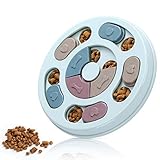
The DR CATCH is a slider-style puzzle in blue that hides food under pieces the dog moves with a nose or paw. Listing text describes it as an IQ-training and mental-enrichment feeder that doubles as a slow feeder. Reported dimensions for this product are around 9 to 10 inches across and about an inch thick, which is on the compact side and points toward smaller dogs. Confirm the size on the listing.
- Format: slider puzzle that hides treats beneath moving pieces
- Size: compact, roughly 9 to 10 inches across (confirm on the listing)
- Material: plastic, per the listing (confirm the exact type)
- Use: slow feeding and short training sessions
- Color: blue, as named in the listing
Pros:
- Compact and easy to store
- Simple concept that small dogs learn fast
Cons:
- May be too small and too easy for large, experienced dogs
- Not durable enough for heavy chewing
Compared with the PETSTA, it offers a simpler single-task design, while the PETSTA adds extra play elements.
Who it suits: a small dog or young puppy that needs an easy win. Use a few tiny treats, show the dog how a piece slides, and praise every attempt. Because the toy is compact, it fits easily into a crate area or a quiet corner, and it can be washed and put away between sessions. If your dog graduates quickly, that is a sign to move to a more demanding board such as the Dog Brick or the Barkwhiz.
Specs Compared
| Product | Format | Difficulty | Size / capacity | Best dog size |
|---|---|---|---|---|
| PETSTA Puzzle Board | Sliding board | Varies by version; confirm on listing | Confirm on listing | Puppies to medium dogs |
| BSISUERM Treat Ball | Rolling dispenser | Adjustable opening | Confirm on listing | Small to large; confirm size |
| Barkwhiz 3-Level Puzzle | Flip and slide board | Three levels | Confirm on listing | All breeds, per listing |
| HIPPIH 2-Pack Treat Balls | Two rubber balls | Beginner | About 2.75 and 3.14 in., per listing | Puppies and small dogs |
| Outward Hound Dog Brick | Lid and slider board | Level 2 intermediate | 12.8 in.; 20 compartments; about 1-1/2 cups | Small to large |
| DR CATCH Slider Puzzle | Slider board | Beginner to easy | Compact; confirm on listing | Small dogs and puppies |
How We Chose These
This guide is based on desk research rather than physical trials. We read each listing name and description, compared the stated formats, sizes and difficulty labels, and cross-checked brand information from the makers and from public specification pages where available. We looked for variety, so the list covers sliding boards, rolling dispensers and simple balls. We favored toys with a clear difficulty level, easy cleaning and a stated capacity. Where a listing did not state a spec, we say to confirm it on the product page rather than guess. Chewing behavior is individual, so no pick is described as indestructible.
What to Look For
Match difficulty to your dog’s experience
Treat puzzles are usually grouped into beginner, intermediate and advanced levels. Beginner puzzles need only one action, such as pushing a ball or lifting a lid. Intermediate puzzles combine two actions, such as sliding a block and then lifting a cover. Advanced ones chain three or more steps. A good rule is to pick the level at which your dog succeeds about eight times out of ten on the first few tries. If your dog quits within a minute, step down and rebuild confidence with easier food.
Choose a format that fits how your dog plays
Dogs that love to chase tend to enjoy rolling dispensers, because the movement is part of the reward. Dogs that prefer to sit and sniff are usually better matched with boards that have lids and sliders. Flat puzzles also work well for homes with hard floors, since they stay put and make less noise than balls. If your dog gets overexcited around rolling toys, a board lets you control the pace more easily.
Size, materials and safety
Size matters most with balls. A ball that fits entirely into a dog’s mouth can become a choking hazard, so choose one clearly larger than the back of the dog’s throat. For boards, check that no small pieces can be pulled free. Look for plastics described as food safe and non-toxic, and avoid toys with cracked or chewed edges. Remove any puzzle that is splintering, and never leave puzzles with dogs that chew them apart. Wash after each use because food residue attracts bacteria and pests.
Worked example: using a puzzle as part of a meal
Suppose a 40-pound dog eats two cups of kibble a day. Using a puzzle for the morning meal means measuring one cup, placing it inside the puzzle and letting the dog work for it, instead of adding extra treats. That keeps total calories steady, which matters because treats are commonly kept to roughly ten percent of daily calories. A one and a half cup capacity, like the Dog Brick listing states, holds an entire morning portion with room to spare. Ask your veterinarian about the right daily amount for your dog.
Introducing a puzzle the right way
The first session sets the tone. Choose a quiet room, a time when your dog is a little hungry but not frantic, and a handful of treats the dog really likes. Let the dog see and smell the food, help with the first move by showing a slide or lift, and then step back. Praise calmly and end while the dog is still interested. After a few days, build up to a full meal and rotate between two or three toys so none becomes boring. Keep the sessions where you can see them, and never use a puzzle to punish or to keep a dog quiet for long stretches.
Cleaning and maintenance
Rinse rubber balls with warm water and let them dry completely. For boards with lids and sliders, take apart whatever the maker allows and brush out crumbs from the tracks. Do not put a toy in the dishwasher unless the listing says it is dishwasher safe, because heat can warp some plastics. Check seams and sliders regularly, and retire any toy with cracks or loose parts.
Questions
How long should a dog work on a treat puzzle?
Most sessions run from about five to twenty minutes, depending on the puzzle and the dog. If your dog is panting heavily, whining or abandoning the toy, end the session and offer an easier puzzle next time.
Can a puppy use a treat puzzle?
Yes, with the right toy. Beginner formats such as rubber treat balls are a common starting point, and puppies should always be supervised because they often chew things they should not. Check the size so that the toy cannot be swallowed.
Are treat puzzles good for dogs that eat too fast?
They can help, because working for each piece naturally slows eating. Choose a puzzle with a moderate challenge and use part of the regular meal, then ask your veterinarian if fast eating is a recurring concern.
What food works best in a puzzle?
Dry kibble works in most designs, and small soft treats or freeze-dried pieces work in many boards. Avoid sticky or oversized foods that jam the openings, and cut treats smaller if they will not pass through.
Should I leave the puzzle with my dog while I am out?
It is safer not to. These toys are made for supervised play, and a dog that cracks open a puzzle or swallows a part may need urgent care. Use puzzles when you are home and can watch.
How do I stop my dog from just flipping the puzzle over?
Place it on a rug or non-slip mat, and start with easier settings so the dog is rewarded for gentle attempts. If your dog keeps tossing it, try a heavier or flatter design.
Update History
- October 20, 2026 – Initial publication; product set drawn from current catalog listings.
- Check the product page for current specifications and availability before buying.
Sources
- Manufacturer and brand product pages for Outward Hound and Nina Ottosson
- Retailer listing titles, descriptions and specification fields for each listed product
- Public product pages and descriptions for PETSTA, BSISUERM, Barkwhiz, HIPPIH and DR CATCH