Our Short List of 3

- Best for: Large saltwater tanks that need high flow and generous media space.
- For aquariums up to 100 gallons
- Flow rate of 383 US gallons per hour
- Multi-stage filtration with free media included
- ETEC energy-efficient motor technology

- Best for: First-time saltwater keepers who want a forgiving hang-on-back filter.
- For aquariums up to 110 US gallons (400 L)
- Flow rate of 450 US gallons per hour
- Self-priming pump that restarts automatically
- Built-in surface skimmer

- Best for: Aquarists who want to choose and arrange their own filter media.
- For 60- to 110-gallon aquariums
- Pump output of 500 US gallons per hour
- Four-stage filtration: mechanical, chemical and biological
- CycleGuard beneficial bacteria support
All 4 Picks at a Glance
| Product | Specs | Action |
|---|---|---|
| Fluval 407 Performance Canister Filter |
| Check price on Amazon |
| Seachem Tidal 110 Power Filter |
| Check price on Amazon |
| AquaClear 110 Power Filter |
| Check price on Amazon |
 Marineland Penguin 350 BIO-Wheel Power Filter |
| Check price on Amazon |
Key takeaways
- Compare the best filtration for saltwater aquarium setups with four proven canister and hang-on-back filters, flow rates, tank sizes and media choices.
Saltwater aquariums punish weak filtration faster than freshwater tanks do. Fish, corals and invertebrates produce waste that breaks down into ammonia and nitrite, and even small spikes can stress livestock or trigger algae blooms. The real decision is not which filter looks impressive on a shelf, but which one moves enough water, holds enough biological media and keeps working reliably in a corrosive salt environment week after week.
This guide is for reef keepers setting up their first marine tank, fish-only saltwater owners upgrading from an undersized filter, and aquarists who want a proven canister or hang-on-back unit without building a sump. Every product below was chosen from its Amazon listing name and specifications, so the flow rates, tank sizes and features match what the manufacturer states.
Quick Picks
As an Amazon Associate we earn from qualifying purchases
| Product | Best for | Key spec from title |
|---|---|---|
| Fluval 407 Performance Canister Filter | Large reef and fish-only tanks | For aquariums up to 100 gallons |
| Seachem Tidal 110 Power Filter | First saltwater setups that need easy priming | 450 US GPH flow rate |
| AquaClear 110 Power Filter | Keepers who want to customise filter media | 500 US GPH pump output |
| Marineland Penguin 350 BIO-Wheel Power Filter | Smaller marine tanks and simple setups | 350 GPH with Bio-Wheel |
How to Choose
Match Flow Rate to Tank Volume
A saltwater filter should turn the tank over roughly four to six times per hour, so a 75-gallon tank needs a unit moving around 300 to 450 gallons per hour. Check the flow figure on the listing rather than the headline tank size, because two filters rated for the same tank can move very different volumes of water. A reef tank with corals and heavy feeding needs the higher end of that range, while a lightly stocked fish-only tank can sit near the lower end. Keep in mind that flow drops as media clogs, so buy the flow you need with a little headroom, and use the flow control to calm the current when livestock prefers gentler water.
Cover All Three Filtration Stages
Mechanical filtration traps particles, biological filtration converts ammonia and nitrite, and chemical filtration removes dissolved organics and odours. A good saltwater filter handles all three, either with separate media baskets or a biological wheel that stays wet and oxygenated. Canister filters win here because their stacked baskets let you run foam, ceramic rings and carbon in a chosen order, while hang-on-back units rely on a smaller media chamber. Look at how much media the unit actually holds, not just the number of stages printed on the box. A filter with generous media space keeps water stable after feeding and between water changes, which matters far more in saltwater than in freshwater.
Choose Materials That Survive Salt
Saltwater is corrosive, and cheap plastic, unsealed metal parts and weak seals fail sooner in a marine tank than they ever would in freshwater. Look for a filter with sturdy housing, reliable O-ring seals and a motor head that sits well clear of splashes. Salt creep builds up around lids, intake tubes and outflow lips, so the unit should come apart without tools or force. A filter that is hard to open will be cleaned less often, and a dirty filter is worse than a modest one kept clean. Read the listing for construction details and spare parts availability, because a single worn seal or cracked impeller cover should not force a full replacement.
Weigh Maintenance Access Against Noise
The best filter for a saltwater aquarium is the one you will actually maintain, so check how the unit primes, how the baskets lift out and how often cartridges need changing. Self-priming pumps save a frustrating siphon routine after every water change, and a maintenance alert that signals a clogged basket helps beginners who cannot yet read water clarity by eye. Noise matters too when the tank sits in a living room or bedroom, and a quiet motor plus a well-seated lid makes a real difference over months of continuous running. A filter with quick-release valves and lift-out baskets turns a dreaded chore into a ten-minute job.
The 4 Best Options
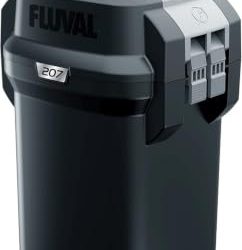
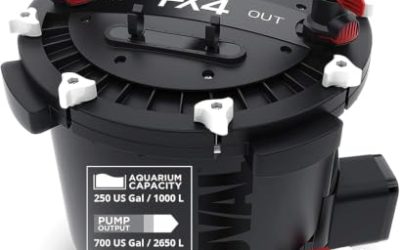
Fluval 407 Performance Canister Filter
- Best for: Large saltwater tanks that need high flow and generous media space.
- For aquariums up to 100 gallons
- Flow rate of 383 US gallons per hour
- Multi-stage filtration with free media included
- ETEC energy-efficient motor technology
Large saltwater tanks that need high flow and generous media space.
The canister is bulky, so measure cabinet space and hose runs before ordering.
The Fluval 407 suits large saltwater tanks where a hang-on-back unit cannot hold enough media. Its stacked baskets give you room to run foam, ceramic rings and carbon in whatever order your tank needs, and the strong flow keeps water moving through the whole system. The canister sits in the cabinet, so the display tank stays clean and uncluttered, which reef keepers value once corals start growing. It is a solid choice for a 75 to 100 gallon fish-only or reef tank with a moderate to heavy bioload, and the energy-efficient motor keeps running costs in check while the unit works around the clock.
Seachem Tidal 110 Power Filter
- Best for: First-time saltwater keepers who want a forgiving hang-on-back filter.
- For aquariums up to 110 US gallons (400 L)
- Flow rate of 450 US gallons per hour
- Self-priming pump that restarts automatically
- Built-in surface skimmer
First-time saltwater keepers who want a forgiving hang-on-back filter.
The unit is wide, so check rim space and lid clearance on rimless tanks.
The Seachem Tidal 110 is the easiest hang-on-back filter in this guide to live with, and that matters for anyone new to saltwater. The self-priming pump restarts itself after a water change or power cut, so there is no siphon to coax and no dry-running motor to worry about. A built-in surface skimmer pulls in the oily film that forms on marine tanks, and the adjustable flow lets you calm the current for delicate fish or crank it up after feeding. The large media basket accepts foam, carbon and biological media, giving a small footprint far more flexibility than its size suggests.
AquaClear 110 Power Filter
- Best for: Aquarists who want to choose and arrange their own filter media.
- For 60- to 110-gallon aquariums
- Pump output of 500 US gallons per hour
- Four-stage filtration: mechanical, chemical and biological
- CycleGuard beneficial bacteria support
Aquarists who want to choose and arrange their own filter media.
The intake tube is long, so check clearance above tall rockwork and sand beds.
The AquaClear 110 is the pick for keepers who like to tune their own media instead of buying pre-packed cartridges. Its large basket holds foam, activated carbon and BioMax ceramic rings, and the patented refiltration system sends water through the media more than once before returning it to the tank. The 500 gallon per hour pump gives a 60 to 110 gallon marine tank strong turnover, and the flow control lever lets you dial it back for shy fish or feeding time. Media is included in the box, so the filter is ready to run, and the simple clip-on design makes it easy to lift off the tank for cleaning.
Marineland Penguin 350 BIO-Wheel Power Filter
- Best for: Smaller saltwater tanks that need reliable biological filtration on a simple setup.
- Flow rate of 350 gallons per hour
- For aquariums up to 70 gallons
- Bio-Wheel wet and dry biological filtration
- Multi-stage aquarium filtration
Smaller saltwater tanks that need reliable biological filtration on a simple setup.
The Bio-Wheel must keep spinning freely, so check it after every cleaning.
The Marineland Penguin 350 is a straightforward hang-on-back filter for smaller saltwater tanks, and its Bio-Wheel is the reason it earns a place here. The wheel stays wet and exposed to air, giving beneficial bacteria an oxygen-rich surface that converts ammonia and nitrite efficiently. Multi-stage filtration runs through replaceable Rite-Size C cartridges, so maintenance is a simple cartridge swap plus a rinse of the wheel housing. It is best suited to a tank up to 70 gallons, where its 350 gallon per hour flow provides solid turnover without overwhelming the livestock.
Which One Fits Your Situation
Running a Large Reef Tank With a Heavy Bioload
Choose the Fluval 407. Its 383 gallon per hour flow and stacked media baskets handle the waste load of a stocked reef, and the canister hides in the cabinet so the display stays clean. The large media volume also gives you room to add carbon when the water needs polishing, which is a regular job on a reef with hungry corals and fish.
Setting Up Your First Saltwater Tank
Choose the Seachem Tidal 110. The self-priming pump removes the most common beginner frustration, and the surface skimmer deals with the film that forms on new marine tanks. With flow up to 450 gallons per hour and a roomy media basket, it covers tanks up to 110 gallons without needing extra equipment on day one.
You Want to Customise Your Media
Choose the AquaClear 110. The open basket lets you stack foam, carbon and ceramic rings in any order, and the refiltration system passes water through the media twice. At 500 gallons per hour it suits a 60 to 110 gallon tank, and the flow lever gives you control when fish need calmer water.
A Smaller Tank With a Simple Setup
Choose the Marineland Penguin 350. The Bio-Wheel gives a smaller tank strong biological filtration, and cartridge changes keep maintenance simple. It fits tanks up to 70 gallons, so it works well for a first marine setup or a quarantine tank where you want reliable filtration without a canister under the stand.
Common Mistakes
- Buying a filter rated exactly for your tank size and then stocking heavily, which leaves no flow in reserve as media clogs.
- Skipping biological media and relying on cartridges alone, which leaves ammonia and nitrite with nowhere to convert.
- Cleaning all the media at once in tap water, which wipes out the bacteria colony the tank depends on.
- Placing the intake beside the sand bed, where it sucks in grit that wears the impeller and clouds the water.
- Ignoring salt creep around the lid and seals, which eventually jams moving parts and causes slow leaks.
Frequently Asked Questions
How much flow does a saltwater aquarium need?
Aim for four to six times the tank volume per hour, so a 75-gallon tank needs roughly 300 to 450 gallons per hour from its filter. Reef tanks with corals and heavy feeding sit at the higher end, while lightly stocked fish-only tanks manage near the lower end. Remember that flow drops as media clogs, so pick a filter with a little headroom and clean it on schedule.
Can I use a canister filter on a reef tank?
Yes, a canister filter works well on a reef tank when it is cleaned regularly and loaded with the right media. Use foam for particles, ceramic rings for bacteria and carbon to polish the water. Clean the canister every few weeks, because trapped waste breaks down and feeds algae if it sits too long.
Do I still need a protein skimmer with a good filter?
A hang-on-back or canister filter and a protein skimmer do different jobs, so many saltwater keepers run both. The filter handles particles and converts ammonia, while the skimmer pulls dissolved organics out before they break down. A skimmer is not mandatory on a lightly stocked tank, but it makes water quality easier to hold steady.
How often should I clean a saltwater filter?
Rinse mechanical media every one to two weeks and replace chemical media such as carbon on the schedule the product states. Biological media should only be rinsed gently in old tank water, never scrubbed or soaked in tap water. Check the impeller and seals monthly, because salt creep builds up silently and can stop the filter working.
More from Amazon
Programs that pair well with the guide above. Offers and eligibility are set by Amazon and may change.
Set up recurring deliveries of everyday items on eligible products. Terms and savings are set by Amazon.
Explore Subscribe & SaveFree shipping on eligible items, Prime Video and more. Eligible new members can start with a free trial.
Start a Prime free trialAudiobooks and podcasts to listen to on the go. Eligible new members can start with a free trial.
Try Audible freeRead from a large library of eBooks and audiobooks on any device. Check Amazon for current plans.
Explore Kindle UnlimitedAs an Amazon Associate we earn from qualifying purchases.