Key takeaways
- Compare the 2 best 4 point harness bars for cars: universal 49-inch iron bars that hold racing harnesses at the right shoulder angle. Measure first.
A harness bar is the crossbar that sits behind the front seats and gives the shoulder belts of a racing harness a fixed anchor point. The real decision is not which brand looks best in a photo, but whether a universal 49-inch bar matches the width of your cabin and the factory seat-belt anchor points in your car. Buy the wrong length or the wrong mounting style and the belts end up at the wrong angle, which defeats the purpose of fitting harnesses in the first place.

This roundup is for weekend track drivers in coupes and sedans, UTV owners setting up a trail machine, and anyone fitting racing seats with 4-point belts. Both bars below were chosen from the name and specifications on the Amazon product page: universal 49-inch iron bars that work with 4-, 5-, and 6-point belts and are designed to hold the shoulder straps at the angle the harness maker intends.
Quick Picks
As an Amazon Associate we earn from qualifying purchases.
| Product | Best for | Key spec from title |
|---|---|---|
| ECOTRIC 49-Inch Universal Iron Harness Bar | A straightforward black universal bar | 49-inch iron bar, model VC-LYAM-257-1 |
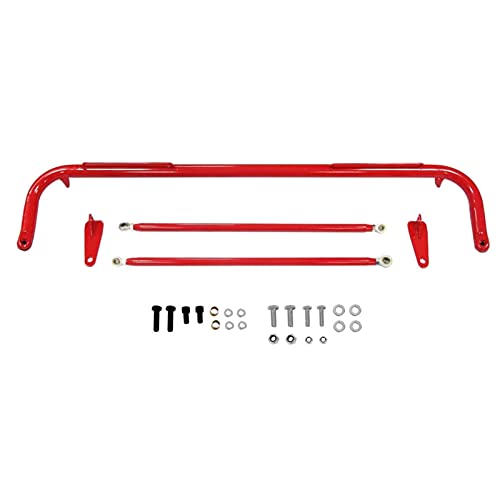
| MOOSUN 49-Inch Universal Iron Harness Bar, Red | A red finish for a themed cabin | 49-inch iron bar, red finish, tube diameter 1.5 inches |
How to Choose
Measure the cabin before you buy
A 49-inch bar suits many coupes and sedans, but cabin width varies, and the number on the listing is the bar length, not a promise that it spans your anchor points. Measure the distance between the seat-belt mounting points behind the front seats, then compare that span with the stated length and the brackets’ reach. A bar that is too short cannot reach both anchors, while one that is too long will not sit square. Check headroom too, because the bar sits behind the seats at shoulder height and can intrude on rear space. When the listing gives no dimensioned drawing, treat the length as a starting point and confirm the mounting geometry with the seller first.
Check how the bar mounts
Most universal bars bolt to existing factory seat-belt anchor locations, which keeps the install simple when the bolt pattern lines up. Some cars need minor modifications, such as reversing the bar ends, trimming interior panels, or adding spacers, and the listings for both bars below say so plainly. Look for the hardware that ships in the box: brackets, bolts, and support rods matter as much as the tube itself, because the bar is only as secure as its mounts. If your car has pillar-mounted belts or a sedan body style the listing excludes, the universal claim may not hold. Confirm the anchor style on your car against the listing before you commit.
Compare materials and construction
The bars in this roundup are iron with a powder-coated finish, a combination that keeps weight reasonable while resisting chips and rust in a cabin that sees sun and heat. Tube diameter matters too: a 1.5-inch tube is the common size for this class of bar, and it is the figure the MOOSUN listing states outright. Welds, brackets, and the finish around the mounting holes deserve a close look on arrival, since a thin coating at a stress point can flake and expose bare metal. Aluminium bars exist and weigh less, but they usually carry a different mounting design, so compare like with like and check the stated diameter rather than assuming one bar equals another.
Get the shoulder angle and safety limits right
A harness bar exists to hold the shoulder belts at roughly a 10-to-15-degree angle to the shoulders, the range both listings in this roundup state. Belts routed too steeply can compress the spine in a crash, while belts routed too flat can let the occupant slide forward, so the angle is the whole point of the part. A harness bar is not a roll bar or a roll cage, and it does not protect the cabin in a rollover; it only gives the belts an anchor. Use it for track days and off-road recreation, follow the harness maker’s fitting instructions, and have a professional check the install when anything about the mounting is unclear.
The 2 Best Options
ECOTRIC 49-Inch Universal Iron Harness Bar (Black)
The ECOTRIC is the plain, no-nonsense option in this pair: a black powder-coated iron bar that measures 49 inches and bolts behind the front seats at the factory seat-belt anchors. Its listing names Ford, Honda, and Mitsubishi fitment first, then adds that it works with 4-, 5-, and 6-point belts, which covers the common racing harness layouts. The stated purpose is the shoulder angle, holding the belts at 10 to 15 degrees, and the bar ships with mounting brackets and hardware. At 13.42 pounds it is the heavier of the two bars here, a fair trade for the iron build and the straightforward mounting.
Specs
- Overall length: 49 inches
- Material: lightweight iron with a black powder-coated finish
- Works with 4-, 5-, and 6-point seat belts
- Mounts behind the front seats at factory seat-belt anchor locations
- Model number: VC-LYAM-257-1
- Item weight: 13.42 pounds
- Package dimensions: 49.75 x 10.75 x 4.5 inches
- Listed fitment includes Ford, Honda, and Mitsubishi models
Best for: drivers who want a simple black universal bar for a compatible coupe or sedan.
Watch out for: the listing states instructions are not included, and some vehicles may need minor modifications.
MOOSUN 49-Inch Universal Iron Harness Bar (Red)
The MOOSUN takes the same universal 49-inch formula and adds a red finish, which suits cabins where the bar stays visible. Its listing states a 1.5-inch tube diameter, a powder-coated steel build, and compatibility with 4-, 5-, and 6-point belts, plus the same 10-to-15-degree shoulder-angle goal as the ECOTRIC. The fitment list runs from late-1970s Mustangs through 1990s Civics, Preludes, and Eclipses, so a popular coupe from that era has a good chance of appearing on it. At 10 pounds it is the lighter of the two bars, and the listing dates the product to April 2021, so its fitment claims have had years to become well known.
Specs
- Overall length: 49 inches
- Tube diameter: 1.5 inches
- Color: Red, with a powder-coated steel build
- Works with 4-, 5-, and 6-point seat belts
- Direct bolt-on installation; some vehicles may require minor modifications
- Model part number: MS-ZYHG-001
- Item weight: 10 pounds
- Listed fitment includes Ford Mustang 1979–1993, Toyota Corolla 1983–1987, VW GTi 1983–1991, Honda Civic 1992–1995, and Mitsubishi Eclipse Coupe 1995–1999
Best for: buyers who want a red-finished universal bar for a compatible car.
Watch out for: confirm the mounting points and the finished harness angle for your car, since the universal fitment still leaves some vehicles needing minor modifications.
Which One Fits Your Situation
You track a coupe or sedan on weekends
Pick the ECOTRIC when the car is a common coupe or sedan and the goal is a plain black bar that disappears behind the seats. Its 49-inch length and factory-anchor mounting suit the typical track-day setup, and the iron build holds up to repeated belt tension. Measure the anchor spacing first, then confirm the listing names your model family before ordering. Bring a tape measure to the car before ordering, since the listing length alone cannot confirm the fit.
You want the bar to match a red interior theme
Choose the MOOSUN Red when the bar will stay visible and the cabin already carries red accents in the seats, belts, or trim. The finish is the only real difference from a black bar of the same size, so the decision comes down to looks rather than function. Check the same fitment and angle details as with any universal bar. The red finish also makes the bar easy to spot in cabin photos, which helps when comparing installs.
You drive a UTV on the trails
Neither bar above is built for a UTV cage, so UTV owners should look for a vehicle-specific bar that clamps to the factory roll cage of their exact model and model year. A universal car bar will not match the tube spacing or the mounting points of a side-by-side, and drilling a factory cage to make it fit is a poor trade. Confirm the cage diameter and the harness points with the maker of the bar.
You are choosing between a bar and a full cage
A harness bar is the right call when the car stays a street car that also sees track days, since it adds belt anchors without the weight and cabin intrusion of a full cage. A cage is the answer when the car becomes a dedicated competition machine or the sanctioning body requires one. Decide on the car’s role first, then buy the restraint hardware that matches it.
Common Mistakes
- Buying on length alone without measuring the anchor spacing in your car.
- Assuming “universal” means every car fits without modification.
- Routing the shoulder belts at the wrong angle instead of checking the 10-to-15-degree range.
- Treating a harness bar as rollover protection; it is a belt anchor, not a cage.
- Skipping the harness maker’s fitting instructions and fitting the belts to the bar by guesswork.
Frequently Asked Questions
Will a 49-inch universal bar fit my car?
Not necessarily. The 49-inch figure is the bar length, and fit depends on the distance between your factory seat-belt anchors and the shape of the cabin behind the front seats. Measure the anchor spacing, compare it with the listing, and check whether your model appears in the fitment list. When the listing is silent on your car, ask the seller before ordering.
Can I use a harness bar with a 5-point harness?
Yes, both bars in this roundup are listed for 4-, 5-, and 6-point belts, and the bar anchors the shoulder straps while the lap and anti-submarine straps use their own mounting points. The bar itself does not change how the lower straps mount. Follow the harness maker’s instructions for the full belt layout. Check that the shoulder straps sit flat on the bar without twisting.
Is a harness bar the same as a roll bar?
No. A harness bar is a crossbar that gives shoulder belts an anchor at the right height and angle. A roll bar is a structural hoop designed to protect the cabin in a rollover. The two parts serve different purposes, and a harness bar should never be treated as rollover protection.
Do I need a professional to install a harness bar?
A confident home mechanic can often fit a bolt-on bar, but the stakes are high because the bar holds the belts that hold you. If the mounting needs modification, the anchor points are unclear, or the finished belt angle falls outside the 10-to-15-degree range, have a professional shop check the install before driving.
More from Amazon
Programs that pair well with the guide above. Offers and eligibility are set by Amazon and may change.
Set up recurring deliveries of everyday items on eligible products. Terms and savings are set by Amazon.
Explore Subscribe & SaveFree shipping on eligible items, Prime Video and more. Eligible new members can start with a free trial.
Start a Prime free trialAudiobooks and podcasts to listen to on the go. Eligible new members can start with a free trial.
Try Audible freeRead from a large library of eBooks and audiobooks on any device. Check Amazon for current plans.
Explore Kindle UnlimitedAs an Amazon Associate we earn from qualifying purchases.