Key takeaways
- The open design can expose a nervous dog to too much household activity.
- Bars and corners may injure a dog that repeatedly paws, bites, or throws its body against the door.
- Urine, vomit, or spilled water can spread beyond the tray and onto the floor.
- Thin wire can bend, rust, or develop sharp points after rough use.
The best dog crates are the ones that fit your dog precisely, match the way you travel or train, and provide enough ventilation and security without becoming difficult to clean or move.
Quick picks by situation
| Situation | Best crate type | Why it fits | Typical 2026 price range |
|---|---|---|---|
| Everyday home use on a budget | Wire crate | Good airflow, removable divider, fold-flat storage | $40–$150 |
| Air or car travel | Hard plastic kennel | Enclosed sides, secure door, easier airline-style handling | $60–$220 |
| Calm dog in a hotel or office | Soft-sided crate | Lightweight, compact, quiet to carry | $50–$180 |
| Powerful chewer or escape artist | Heavy-duty metal crate | Reinforced frame and stronger hardware | $150–$700+ |
| Limited floor space | Wire crate with folding design | Stores more easily than a rigid kennel when not in use | $40–$150 |
Wire crates: the practical all-rounder
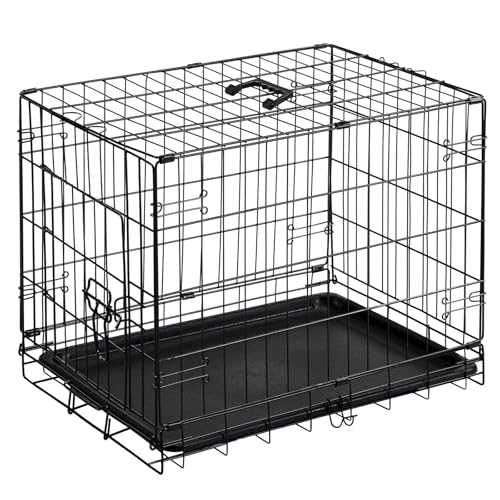
Wire crates are usually the best dog crates for home training, supervised rest, and families that want a flexible long-term option. The open grid provides ventilation on all four sides, and many models include a divider panel so one crate can accommodate a growing puppy.
Our top picks


As an Amazon Associate we earn from qualifying purchases at no extra cost to you. Ratings are shown as listed on Amazon.
The main advantage is adjustability. A divider lets you reduce the usable area while your puppy is learning to keep the sleeping space clean, then expand it as the dog grows. Look for a crate with two doors if you need more placement options, but inspect the latches carefully: a clever or anxious dog may learn to manipulate lightweight sliding bolts.
Where wire crates fall short
- The open design can expose a nervous dog to too much household activity.
- Bars and corners may injure a dog that repeatedly paws, bites, or throws its body against the door.
- Urine, vomit, or spilled water can spread beyond the tray and onto the floor.
- Thin wire can bend, rust, or develop sharp points after rough use.
A fitted cover can make a wire crate feel more private, but leave at least two sides substantially open for airflow. Never use a loose blanket that can be pulled through the bars and chewed.
Plastic kennels: best for travel and dogs that prefer a den
Hard plastic crates have solid sides, a ventilated door, and air openings around the body. They block some visual stimulation and contain messes better than wire crates, making them useful for car journeys, boarding, and dogs that settle more easily in an enclosed space.
Choose a model with a metal door rather than a purely plastic one if your dog is strong or persistent. Check that the two halves are joined by multiple screws or robust fasteners. A crate that depends on a few small plastic clips may loosen with repeated assembly.
Plastic is also easier to wipe down after accidents. However, it can retain odors if the interior has textured surfaces or inaccessible seams. Replacement doors and hardware may not be available for every model, so confirm parts availability before buying an expensive kennel.
Travel and vehicle caution
A general-purpose plastic crate is not automatically crash-tested. If the crate will be used in a moving vehicle, secure it according to the vehicle and crate manufacturer’s instructions, and consider a travel system specifically designed for vehicle use. A loose kennel can become a hazard during sudden braking.
Soft-sided crates: portable, but only for the right temperament
Soft-sided crates are made from fabric panels over a folding frame. They are convenient for calm adult dogs at shows, outdoor events, visits, and temporary indoor use. Many weigh only 5–15 pounds in medium sizes, compared with roughly 15–35 pounds for similarly sized wire or plastic crates.
Portability is their major benefit: the frame folds, fabric panels are quiet, and carrying handles are common. Some models include removable, machine-washable liners and mesh windows on three or four sides.
They are a poor choice for puppies still chewing, dogs that scratch when confined, or any dog that has escaped from fabric enclosures before. Mesh tears, zippers fail, and corner seams wear first. A dog can also overheat if the crate is covered or positioned in direct sun. Use soft-sided crates only after the dog is already comfortable resting in a more secure crate.
Heavy-duty crates: for containment problems, not punishment
Heavy-duty crates use thicker steel, reinforced welds, stronger hinges, and escape-resistant latches. They are designed for large, powerful, anxious, or highly persistent dogs that can bend standard wire or defeat ordinary doors.
These crates offer greater security, but they are heavy and often expensive. A large steel crate can weigh 50–100 pounds before the dog enters it, making it unsuitable for frequent carrying. The bars may also be less forgiving if a dog repeatedly lunges or traps a paw.
Containment should not replace behavior support. If your dog panics, injures itself, drools heavily, or repeatedly crashes into a crate, stop increasing confinement time and consult a qualified trainer or veterinarian. The goal is safe rest, not simply preventing escape.
How to choose the correct crate size
Your dog should be able to stand naturally without crouching, turn around without squeezing, and lie down fully on its side. More space is not always better: an oversized crate may encourage a puppy to sleep at one end and toilet at the other.
Measure your dog while standing:
- Length: nose to the base of the tail, then add 2–4 inches.
- Height: floor to the top of the head or highest ear, then add 2–4 inches.
- Width: use the crate’s internal width; your dog should turn without rubbing its shoulders.
For example, a dog measuring 30 inches from nose to tail base and 24 inches from floor to ear height needs an internal crate length of about 32–34 inches and an internal height of about 26–28 inches. Check internal measurements rather than relying only on labels such as “large” or “42-inch.” Door frames, rounded corners, and thick liners reduce usable space.
Head-to-head comparison
| Criterion | Wire | Plastic | Soft-sided | Heavy-duty metal |
|---|---|---|---|---|
| Ventilation | Excellent | Good, depending on openings | Good when mesh is unobstructed | Good to excellent |
| Portability | Folds; moderate weight | Rigid; moderate weight | Best; usually 5–15 lb | Lowest; often 50–100 lb for large sizes |
| Mess containment | Fair; tray may need floor protection | Very good | Fair to poor | Fair; add a washable pan or liner |
| Escape resistance | Fair to good | Good for calm dogs | Poor for chewers and scratchers | Very good |
| Cleaning effort | Medium | Low to medium | Medium to high | Medium; inspect welds and coatings |
| Typical useful life | 5–10 years with indoor care | 5–12 years | 1–5 years, depending on use | 8–15 years with sound coating |
Ownership costs and maintenance that listings overlook
Budget for more than the crate itself. A washable mat may cost $20–$80, a divider $10–$35, a replacement pan $20–$70, and a crate cover $20–$60. If a $100 wire crate lasts eight years and the dog uses it four nights per week, that is about 1,664 uses, or roughly six cents per use before replacing accessories. A $400 heavy-duty crate used daily for the same period costs about 14 cents per use, but only if its weight and size suit your household.
Inspect the crate weekly during the first month. Check for bent bars, loose screws, damaged welds, frayed fabric, sharp edges, and latches that no longer close completely. Wash plastic trays and hard surfaces with a pet-safe cleaner, rinse thoroughly, and dry them fully. Fabric covers should be cleaned according to their care label; avoid reinstalling damp fabric, since trapped moisture encourages odors and mildew.
Do not attach a collar, leash, or long chew tether inside a crate. Remove harnesses if they can catch on bars or hardware. Provide only items your dog has already used safely under supervision, and keep water available when confinement lasts long enough to require it.
Bottom line
Choose a wire crate for adaptable home use, a plastic kennel for travel and den-like privacy, a soft-sided crate for calm dogs and frequent carrying, and a heavy-duty crate when ordinary doors and frames cannot safely contain your dog. Correct internal sizing, reliable ventilation, secure hardware, and your dog’s individual temperament matter more than appearance or the highest price. If confinement causes panic or self-injury, seek help from a veterinarian or qualified behavior professional before selecting a more restrictive crate.