Key takeaways
- Which side is intended for infant use.
- Whether the infant side must face upward in the crib.
- Whether the toddler side is intended only after transitioning out of the crib.
- Whether the cover can be removed without exposing loose foam or filling.
- Whether rotating or flipping the mattress affects the warranty.
The best crib mattresses are firm, correctly fitted to the crib, easy to clean, and certified for applicable crib-mattress safety standards—not necessarily the thickest, softest, or most expensive option.
Our top picks



As an Amazon Associate we earn from qualifying purchases at no extra cost to you. Ratings are shown as listed on Amazon.
Quick picks by buying situation
| Situation | Best choice | What to prioritize | Typical market range |
|---|---|---|---|
| Lowest practical cost | Firm innerspring mattress with a waterproof cover | Snug fit, durable edge support, cleanable cover | $50–$100 |
| Frequent leaks or messy sleep | Firm foam mattress with a seamless waterproof surface | Wipe-clean construction and sealed seams | $80–$180 |
| One mattress for infant and toddler use | Dual-sided infant/toddler mattress | Clearly marked sides and a genuinely firmer infant side | $100–$250 |
| Breathability is a major concern | Firm mattress with a washable, breathable cover or ventilated core | Firmness must remain compliant; avoid loose pads or toppers | $200–$400 |
| Lowest chemical-emission preference | Mattress with GREENGUARD Gold or equivalent emissions certification | Certification applies to the complete product, not merely one fabric | $150–$400 |
What makes a crib mattress safe?
Safety starts with firmness and fit. A crib mattress should remain firm and relatively flat under the baby’s weight. It should not form a deep indentation when pressed, and it should not have pillow-top cushioning, memory-foam comfort layers, quilted padding, or detachable inserts that could create an uneven surface.
For a standard full-size U.S. crib, the mattress is generally about 28 inches by 52 inches, although the permitted dimensions are defined by the crib and mattress standards rather than by a single universal retail size. Measure the crib’s interior and follow the crib manufacturer’s instructions. A mattress that is too small can leave a dangerous gap around its perimeter; one that is too large may bow, prevent the crib hardware from fitting correctly, or make the sides difficult to assemble.
Use the two-finger check around the entire edge: when the mattress is centered and pushed firmly against one side, no gap should be large enough to admit more than two adult fingers. This check does not replace the crib manufacturer’s specifications. If the mattress does not fit cleanly, return it rather than filling the gap with towels, foam, or padding.
Firmness: foam versus innerspring
Firm foam
Foam mattresses are often lighter and easier to turn over for cleaning. Polyethylene or food-grade polymer waterproof surfaces can be particularly convenient because they do not rely on a separate fabric cover that must be removed before every wipe-down. A quality foam mattress should have a stable, supportive core and should not soften substantially at room temperature or after repeated use.
Look for a surface that stays flat when the mattress is placed in the crib. “Breathable” foam does not make a soft mattress safe, and ventilation holes do not compensate for inadequate firmness.
Innerspring
Innerspring mattresses commonly use steel coils surrounded by firm cushioning and reinforced edges. They can feel substantial and may tolerate years of use, but their weight makes them less convenient to move. The waterproof cover matters: exposed fabric can absorb urine and spit-up, while stitched seams can become the first points of failure.
Coil count alone is not a useful safety score. A mattress with more coils is not automatically firmer, better fitting, or longer lasting. Check the finished mattress, edge support, cover construction, and certification instead.
Waterproof covers and breathability: the real trade-off
A waterproof surface is one of the most useful features for ownership. It prevents liquid from reaching the core, where odors and microbial growth can persist even after the surface appears clean. The most practical designs have a seamless or tightly sealed surface, welded or well-protected seams, and no exposed zipper teeth on the sleeping side.
Breathability is more complicated. A perforated cover or ventilated core can improve air movement, but it does not make it safe to add a soft breathable topper. The sleep surface still needs to remain firm and fitted. Do not place a loose protector, quilted pad, blanket, or aftermarket “airflow” layer beneath the fitted sheet unless the crib and mattress manufacturers specifically approve it.
Many waterproof covers use vinyl, polyethylene, polyester-coated fabric, or polyurethane laminate. Each can work when properly made. Compare how the cover is cleaned, whether it can be removed without damaging the mattress, and whether replacement covers are available. A washable cover is useful, but a removable cover is not automatically safer if it wrinkles or fits loosely.
Dual-sided mattresses: useful, but inspect both sides
Dual-sided mattresses have an infant side and a toddler side. The infant side should be visibly firmer and clearly labeled; the toddler side may use a little more cushioning for a child who is developmentally ready for a toddler bed. The presence of two sides does not mean either side is suitable for a younger child without checking the label and instructions.
Before purchase, confirm:
- Which side is intended for infant use.
- Whether the infant side must face upward in the crib.
- Whether the toddler side is intended only after transitioning out of the crib.
- Whether the cover can be removed without exposing loose foam or filling.
- Whether rotating or flipping the mattress affects the warranty.
Dual-sided construction can extend ownership, but it may also add weight and cost. If a child will use the crib for only a short period, a simpler single-sided mattress may be the better value.
Certifications and labels worth checking
In the United States, look for a mattress designed and labeled for use in a compliant crib and verify that it meets applicable requirements from the U.S. Consumer Product Safety Commission, including flammability rules under 16 CFR parts 1632 and 1633. ASTM F2938 is a relevant voluntary safety specification for full-size crib mattresses.
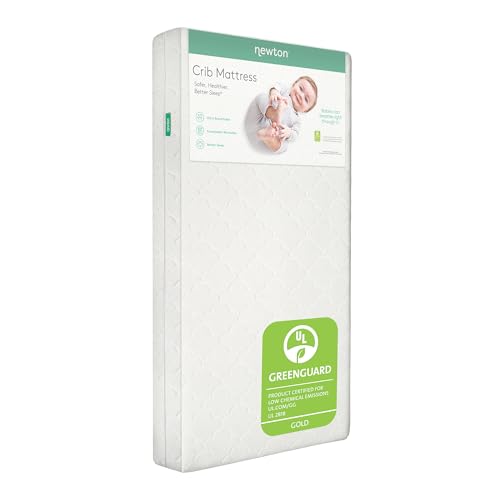
GREENGUARD Gold certification addresses chemical emissions from the complete product under specified testing conditions. It can be useful for shoppers who want lower-emission materials, but it does not replace crib fit, firmness, or safe-sleep practices. Certifications should be traceable to the exact product or model, not just a company’s general statement that its materials are “non-toxic.”
Organic or natural-fiber labels describe materials and farming or processing claims; they do not by themselves establish that a mattress is firm enough or correctly sized. Treat safety certification, emissions certification, and material certification as separate questions.
Ownership costs and maintenance
The initial price is only part of the cost. Suppose a $120 mattress lasts three years of nightly use. At roughly 1,095 nights, its mattress cost is about 11 cents per night. A $300 mattress lasting six years costs about 14 cents per night. The cheaper option is not necessarily better value if its cover cracks, absorbs leaks, or needs replacement after the first year.
The cover usually wears before the core. Watch for cracking, peeling, persistent odor, broken seams, exposed zipper components, sagging, or a surface that no longer lies flat. Replace the mattress if the waterproof barrier is damaged or if it no longer fits snugly.
For routine care, remove the fitted sheet, wipe the waterproof surface with mild soap and water, and dry it fully before making the crib. Follow the manufacturer’s directions for disinfectants; harsh chemicals can weaken coatings. Do not soak a mattress unless the instructions explicitly allow it. Use only a fitted sheet made for that exact mattress size, and keep the crib free of pillows, loose blankets, bumper pads, and positioners.
Final buying checklist
- Measure the crib interior and compare it with the mattress specifications.
- Choose a firm, flat surface without pillow-top or plush comfort layers.
- Confirm there is no hazardous perimeter gap when the mattress is centered.
- Prefer a waterproof, sealed, wipe-clean surface for easier leak management.
- Check whether breathability claims preserve the required firmness.
- For dual-sided models, verify the infant side and follow the orientation label.
- Look for applicable safety compliance information and, if desired, GREENGUARD Gold certification.
- Inspect the mattress after unpacking; return it if it smells strongly, bows, sags, or does not fit.
The right crib mattress is the one that fits the specific crib without gaps, stays firm and flat, resists liquid, and has documentation you can verify. Features such as lightweight foam, breathable covers, and dual-sided use are helpful only after those fundamental requirements are satisfied.