Our Top Picks
 Rueekfil Heavy-Duty Portable Car Lift 7000 LBS CapacityHydraulic 7000 lbs74.1 x 15.4 x 6.5 inches418 poundsCheck on Amazon
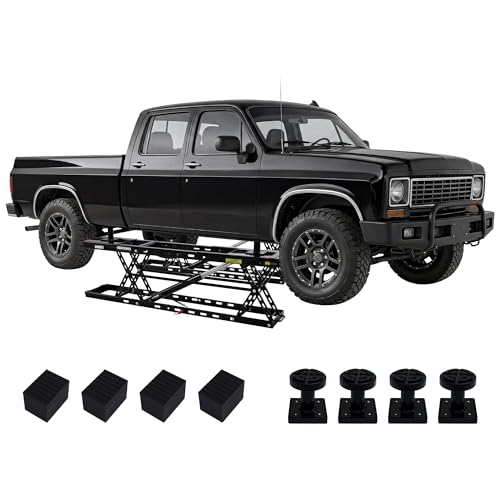


The best portable car lift for most home garages is the Albott 8000 LBS Portable Car Lift. Its 8,000 lb rating covers the mid-size SUVs, crossovers, minivans and half-ton pickups that fill most driveways, and it runs from a standard 120V household outlet without drilling a single anchor into the slab, so it can be moved out of the way when the job is done. If your heaviest vehicle is a compact car or a small crossover and cost is the deciding factor, the Albott 7000 LBS Portable Car Lift with Extension Plates does the same job for less. If you want genuine seated-height clearance underneath the car rather than creeper-height, the KATOOL Mid Rise Scissor Lift and its 39-inch maximum lift height is the pick — provided your ceiling and door tracks allow it. Everything else in this roundup sits between those three points, and the right answer almost always comes down to two numbers: the curb weight of your heaviest vehicle, and how much usable ceiling height your garage actually has.
Top 3 Picks
Best overall: Albott 8000 LBS Portable Car Lift
The 8,000 lb capacity gives useful headroom above the 4,000–5,500 lb band where most family vehicles sit, which means the lift is never working near its limit on a routine oil change. It is a portable frame-style lift with a 120V hydraulic power unit, so it needs no permanent installation and no 240V circuit. It suits the two-car household that wants one lift to cover everything from a sedan to a half-ton truck.
Best budget: Albott 7000 LBS Portable Car Lift with Extension Plates
The 7,000 lb rating is still generous for compacts, sedans and small crossovers, and the included extension plates let you position the lifting points further out to match wider or unusual wheelbases. It is the lowest-cost way into the portable-lift category from a brand that already builds in this segment, and it leaves budget for a proper hydraulic jack and stands as backup.
Best premium: KATOOL Mid Rise Scissor Lift, 7000 lbs, 39″ Max Height
Thirty-nine inches of maximum lift height is roughly ten inches more than the low-rise portable lifts in this roundup, and that difference is what lets you sit on a rolling stool or work standing at the front of the car instead of sliding around on a creeper. It is a mid-rise scissor design, so it is heavier and less casual to move than a frame lift, and it demands a genuinely tall garage. It is the pick for the home mechanic who treats the garage as a real workshop.
Quick Comparison
The table below covers every lift in this roundup. Price tiers are relative bands within the portable-lift category — budget, mid-range and premium — rather than fixed figures, because listings and promotions change constantly. Check the current listing for each product before you buy.
| Product | Best for | Key specs | Price tier |
|---|---|---|---|
| Albott 8000 LBS Portable Car Lift | Heavier daily drivers, SUVs, half-ton trucks | 8,000 lb capacity; portable frame lift; 120V hydraulic power unit; no permanent installation | Mid-range |
| Albott 7000 LBS Portable Car Lift with Extension Plates | Lowest-cost entry for sedans and small crossovers | 7,000 lb capacity; extension plates for wider lifting points; portable; 120V power unit | Budget |
| VEVOR Portable Car Lift, 7,000 LBS, 26.8″ Max Height | Predictable fit in a standard two-car garage | 7,000 lb capacity; 26.8 in maximum height; heavy-duty carbon steel; 120V power unit | Mid-range |
| Rueekfil Heavy-Duty Portable Car Lift 7000 LBS | Budget buyers who want mechanical safety locks | 7,000 lb capacity; 28 in maximum lift height; mechanical safety locks; heavy-duty construction | Budget |
| VEVOR Portable Car Lift, 9000 lbs, 28″ Max Height | Full-size trucks, heavy SUVs, repeated heavy use | 9,000 lb capacity; 28 in maximum height; heavy-duty steel; 120V power unit | Premium |
| KATOOL Portable Car Lift Mid Rise Scissor, 7000 lbs | Maximum under-car access and working comfort | 7,000 lb capacity; 39 in maximum lift height; mid-rise scissor design; low-profile collapsed position | Premium |
| 7000 LBS Portable Car Lift with Extension Plates, Black (Real Relax) | Low-cost lifting with adjustable reach | 7,000 lb capacity; extension plates; black powder-coat finish; portable frame design | Budget |
| RocVanc 9000 LBS Portable Hydraulic Car Lift | Quick-jack-style portability with heavy capacity | 9,000 lb capacity; portable hydraulic frame design; quick-jack style; low collapsed profile | Mid-range |
How We Chose
Every lift in this roundup was selected on published specification and category fit, not on hands-on use. We started with the four numbers that decide whether a lift is usable at all in a home garage: rated capacity, maximum lift height, collapsed height and power requirement. A lift that cannot reach your heaviest vehicle’s curb weight with a reasonable margin, or that will not physically fit under a low-clearance car, is disqualified regardless of how good it looks on paper.
From there we sorted by use case rather than by ranking. Someone lifting a Miata twice a year and someone pulling the transmission on a Silverado every weekend have almost nothing in common, so the roundup is built around situations: heavy daily drivers, tight budgets, tall garages, low ceilings, wide vehicles and quick-jack-style portability. Capacity bands of 7,000, 8,000 and 9,000 lb were kept distinct because that spread is what separates a compact-car lift from a truck lift.
We also weighted the upgrade path and the ownership realities. A budget lift with extension plates is more useful long-term than a similarly priced lift without them, because it fits more vehicles as your household changes. Mechanical safety locks, replaceable hydraulic hoses and a power unit that runs on ordinary 120V household current all matter more over a five-year ownership period than a slightly higher peak height. Finally, we kept the price tiers relative to one another within the category so the table stays accurate even when individual listings move.
1. Albott 8000 LBS Portable Car Lift – Best for Heavier Daily Drivers
As an Amazon Associate we earn from qualifying purchases at no extra cost to you.
This is the lift to look at first if your driveway holds a mid-size SUV, a minivan, a crossover or a half-ton pickup. At 8,000 lb of rated capacity, it sits a full step above the 7,000 lb lifts that dominate the budget end of the category, and that step is what keeps you away from the ceiling of the lift’s capability during ordinary maintenance. A 4,500 lb crossover plus a full tank of fuel, a couple of passengers’ worth of gear in the back and a jack pressing up on one corner does not leave as much margin as people assume, and having 8,000 lb underneath you makes the whole job less of a calculation.
It is a portable frame-style lift paired with a separate 120V hydraulic power unit. That combination is the reason it belongs on this list at all: no 240V circuit to install, no anchors in the concrete, and no permanent footprint in a garage that has to double as storage. The listing describes it as a home-garage lift, which is exactly the use case — occasional to regular maintenance, not a commercial shop running vehicles up and down all day.
Key specs
- Rated capacity: 8,000 lbs
- Format: portable frame lift with a separate hydraulic power unit
- Power: 120V household current, no 240V circuit required
- Installation: none — it is not bolted to the slab
- Height class: low-rise, giving creeper-height or stool-height access rather than standing height
- Storage: designed to be moved aside rather than left in the middle of the bay
Where it earns its place
The capacity is the headline, but the practical benefit is that it future-proofs the purchase. Households change vehicles far more often than they change lifts. Buying at 7,000 lb when your current car weighs 3,200 lb feels fine until the next vehicle is a 5,200 lb three-row SUV, at which point the lift is working at three-quarters of its rating on every job. The 8,000 lb figure gives you room to absorb that change without buying again.
The 120V power requirement matters more than most buyers expect. A surprising number of garages have exactly one convenient outlet, often shared with a freezer or a garage-door opener, and adding a 240V circuit for a lift is a real cost and a real project. Staying on standard household current means the lift works the day it arrives, assuming the circuit is not already loaded.
Where it gives up ground is height. Like every low-rise portable lift in this roundup, it lifts the car enough to work underneath on a creeper or a low stool, not enough to stand under. If your goal is standing clearance, no 8,000 lb low-rise frame lift will get you there — that is a different product class, and it is why the KATOOL mid-rise scissor lift appears later in this list.
Pros
- 8,000 lb capacity covers mid-size SUVs, minivans and half-ton pickups with margin to spare
- Runs on standard 120V household current — no electrician, no 240V circuit
- No permanent installation, so the garage floor stays usable for parking and storage
- Portable enough to reposition between bays or move out of the way between jobs
- Capacity headroom means less wear per lift and a longer useful life
Cons
- Costs more than the 7,000 lb budget lifts without offering more height
- Low-rise only — you will not be standing underneath the vehicle
- Still needs a level, sound concrete slab and a clear area around the lifting points
- Overkill for a household that only ever lifts compact cars
How it compares
Against the Albott 7000 LBS model with extension plates, the difference is straightforward: roughly 1,000 lb of extra capacity in exchange for a step up in price and the loss of the extension plates. If your heaviest vehicle is under 4,000 lb, the 7,000 lb lift is the smarter buy and the plates make it more adaptable. If anything in your fleet is a full-size SUV or a pickup, the 8,000 lb version is the one that will still be adequate in five years. Against the VEVOR 7,000 lb carbon-steel lift, the Albott offers more capacity while the VEVOR offers a documented 26.8-inch maximum height, which is the number to compare if ceiling clearance is your constraint.
2. Albott 7000 LBS Portable Car Lift with Extension Plates – Best for Tight Budgets and Lightweight Cars

This is the value play in the roundup. It carries a 7,000 lb rating — comfortably above the curb weight of virtually every compact car, sedan and small crossover on the road — and it includes extension plates, which is the feature that separates a lift you outgrow from one you keep. It suits the first-time lift buyer who wants to stop sliding a floor jack around on a concrete slab, and who would rather spend the difference on tools.
The extension plates are the reason this one is worth more than its price tier suggests. Lifting points on modern unibody cars are not in the same place from model to model, and on some vehicles they are further out toward the sills than a fixed-width frame will comfortably reach. Plates let you extend the contact points outward to line up with the manufacturer’s designated lift locations, which is safer and reduces the chance of crushing a rocker panel or a plastic side skirt.
Key specs
- Rated capacity: 7,000 lbs
- Format: portable frame lift with a separate hydraulic power unit
- Included: extension plates for adjustable lifting-point reach
- Power: 120V household current
- Installation: none required
- Height class: low-rise, creeper-height access
Where it earns its place
The capacity math is the same for every 7,000 lb lift, so the deciding factor here is price against included accessories. Extension plates are not a gimmick — they are the difference between a lift that fits your current car and one that fits your current car plus the next two. On a vehicle with a 106-inch wheelbase, small changes in where the pads land translate into meaningful changes in stability, and being able to widen the stance is worth real money.
The trade-off is straightforward: 7,000 lb is a working rating, not a generous one. If your daily driver is a full-size pickup or a large three-row SUV, you will be running this lift close to its limit, and that is not where you want to live. For a 3,000–4,000 lb sedan or hatchback, though, it is more than enough, and the lighter vehicle means less stress on the frame, the hoses and the power unit on every lift.
As with any portable frame lift, the setup ritual matters. You roll the frames into position, align the pads with the vehicle’s designated lift points, connect the hydraulic hoses to the power unit, and raise in stages while checking that nothing has shifted. That process takes a few minutes the first time and much less once you have done it twice. The advantage is that when you are finished, the whole thing goes against the wall and the car comes back in.
Pros
- Lowest-cost way into a genuinely useful portable lift from an established brand in the category
- 7,000 lb capacity is ample for sedans, hatchbacks and compact crossovers
- Extension plates widen the effective lifting-point spread for odd or wide wheelbases
- Runs on 120V household current and needs no permanent installation
- Frees budget for a quality floor jack, stands and lighting
Cons
- Not enough capacity for full-size trucks or the heaviest three-row SUVs
- Low-rise height only — no standing clearance underneath
- Extension plates add setup steps and need to be positioned correctly every time
- Frames and hoses still take up floor or wall space when stored
How it compares
Against the Real Relax 7000 LBS Portable Car Lift with Extension Plates, these two are close cousins on paper: same capacity, same extension-plate approach, both in the budget tier. The Real Relax version adds a black finish, which is cosmetic; the practical differences come down to current pricing and whichever frame geometry fits your vehicle’s lift points. Against the Albott 8000 LBS model, this lift gives up about 1,000 lb of headroom but keeps the extension plates and the lower price — a trade most compact-car owners should happily make.
3. VEVOR Portable Car Lift – 7,000 LBS Capacity, 26.8″ Max Height – Best for Predictable Garage Fit

This is the lift to pick when you know your garage’s constraints and want a documented number to check against them. VEVOR publishes a 26.8-inch maximum height for this model, and having that figure up front is more useful than it sounds — it lets you do the ceiling arithmetic before you buy rather than after. The 7,000 lb capacity puts it in the same working band as the budget Albott, while the heavy-duty carbon steel construction and the brand’s established presence in garage equipment make it a mid-range proposition.
It suits the owner of a two-car suburban garage with a standard eight- or nine-foot ceiling who wants to work under a sedan or crossover without permanently giving up a parking space. It also suits anyone who has been burned by vague listings before and wants a lift with numbers attached.
Key specs
- Rated capacity: 7,000 lbs
- Maximum lift height: 26.8 inches
- Construction: heavy-duty carbon steel
- Power: 120V power unit
- Format: portable, no permanent installation
- Height class: low-rise with a documented ceiling figure
Where it earns its place
Twenty-six point eight inches is enough to get a creeper under a sedan and enough to sit upright on a low stool for brake work, oil changes and suspension jobs. It is not enough to stand under, and it will not let you swing a long breaker bar on a control-arm bolt with your whole body behind it. What it does give you is a firm number for the ceiling calculation: add the lift height to the vehicle’s roof height, then add the thickness of the door tracks and the opener rail above it, and compare the total to your ceiling. If the sum comes in above your ceiling, no amount of skill will make the lift work.
Carbon steel construction is the other meaningful detail. Portable lifts take a beating from being rolled around, dropped onto concrete and stored in unheated garages, and steel gauge is one of the places where cheap lifts save money. VEVOR builds a wide range of garage and shop equipment, so this lift sits inside an established product line rather than being a one-off import — which matters mainly for the availability of replacement hoses and power-unit parts later.
The 7,000 lb rating is the same as the budget Albott, so the honest comparison between them is height and construction versus capacity and extension plates. If you are lifting a 3,500 lb crossover and you care about knowing exactly how tall the lift gets, this is the cleaner choice. If you might be lifting something closer to 5,000 lb, the capacity matters more than the number on the spec sheet.
Pros
- Published 26.8-inch maximum height makes ceiling math possible before purchase
- Heavy-duty carbon steel construction suited to regular garage use
- Runs on standard 120V household current
- Portable and storable — the bay goes back to parking duty afterward
- Comes from a brand with a broad, established garage-equipment lineup
Cons
- 7,000 lb capacity rules out full-size trucks and heavy SUVs
- 26.8 inches is lower than the 28-inch lifts in this roundup, so ceiling clearance is less of a constraint than working room
- No extension plates mentioned in the listing, so lifting-point reach is fixed
- Low-rise only — you will still be on a creeper for most jobs
How it compares
Against the Rueekfil 7000 LBS lift, the difference is height and safety hardware: Rueekfil lists 28 inches and mechanical safety locks, which is roughly an inch and a half more working room plus a mechanical backup. Against the Albott 7000 LBS with extension plates, the VEVOR gives you a documented height and steel construction while the Albott gives you adjustable reach and a lower price. Pick based on whether your bottleneck is ceiling clearance or lift-point alignment.
4. Rueekfil Heavy-Duty Portable Car Lift 7000 LBS – Best for Mechanical Safety Redundancy on a Budget

Rueekfil’s entry in this roundup competes on two things: 28 inches of maximum lift height and mechanical safety locks. The first is a practical working-height advantage over the 26.8-inch lifts. The second is the feature worth understanding before you buy any lift in this category, because it is the difference between a lift that holds a car up with hydraulic pressure alone and one that holds it up with a physical steel engagement.
It suits the budget-conscious buyer who is not willing to trade away safety hardware. At 7,000 lb of capacity, it covers sedans, hatchbacks and crossovers, which is exactly the vehicle mix of a typical first-time home lift owner.
Key specs
- Rated capacity: 7,000 lbs
- Maximum lift height: 28 inches
- Safety: mechanical safety locks
- Construction: heavy-duty, portable frame format
- Power: 120V hydraulic power unit
- Installation: none required
Where it earns its place
Mechanical safety locks are the reason to pay attention here. A hydraulic system is a seal-and-pressure system, and seals can fail — slowly, usually, but the consequence of a slow failure while you are underneath the car is severe. A mechanical lock is a physical stop that engages at one or more heights and carries the load without relying on hydraulic pressure at all. Lifts at the premium end of the market almost always have them; budget lifts frequently do not. Finding them on a budget-tier lift is a genuine value.
The extra 1.2 inches of height over a 26.8-inch lift is not dramatic, but height is cumulative in usefulness. Every inch moves you further from a creeper and closer to a rolling stool, and the difference between working flat on your back and working seated with your head up is the difference between a job you dread and a job you do. Combined with the mechanical locks, the case for this lift is that it delivers two things usually reserved for more expensive products.
The limitation is capacity. Seven thousand pounds is fine for a sedan or crossover and not fine for a half-ton truck. If you own a full-size pickup, you need to be looking at the 9,000 lb lifts in this roundup, not because 7,000 lb will fail immediately, but because running a lift at 80 percent of its rating on every job is how you shorten its life and how you end up with a failure at the worst possible moment.
Pros
- Mechanical safety locks provide a physical backup to hydraulic pressure
- 28-inch maximum height is among the taller low-rise figures in this roundup
- Budget price tier without giving up safety hardware
- Heavy-duty construction aimed at repeated home use
- Portable format with no permanent installation
Cons
- 7,000 lb capacity is not enough for full-size trucks or the heaviest SUVs
- No extension plates, so lifting-point reach is fixed
- Less brand recognition and a smaller support ecosystem than the larger garage-equipment brands
- Still a low-rise lift — 28 inches is working room, not standing room
How it compares
Against the VEVOR 7,000 LBS lift, this is the better choice if safety hardware and the extra inch and a half of height matter more to you than a well-known brand name and carbon-steel construction claims. Against the KATOOL mid-rise scissor lift, it is a completely different product: the KATOOL reaches 39 inches and costs considerably more, and the two are not really substitutes. Buy the Rueekfil if you want maximum value in a low-rise portable lift; buy the KATOOL if you want to stop lying on the floor entirely.
5. VEVOR Portable Car Lift, 9000 lbs Capacity – Best for Full-Size Trucks and Heavy Duty Use

Nine thousand pounds changes what you can lift. This is the model to choose if your garage holds a full-size pickup, a heavy three-row SUV, a diesel truck or anything with a curb weight north of 5,500 lb, and it is also the right answer for anyone who wants a lift that never feels like it is working hard. VEVOR pairs the 9,000 lb rating with a 28-inch maximum height, a heavy-duty steel frame and a 120V power unit, which puts it firmly in the premium tier without requiring a 240V circuit.
It suits the owner who already does serious work at home — suspension rebuilds, differential service, transmission work — and who needs the lift to be the last thing that limits the job.
Key specs
- Rated capacity: 9,000 lbs
- Maximum lift height: 28 inches
- Construction: heavy-duty steel
- Power: 120V power unit
- Format: portable, no permanent installation
- Height class: low-rise, tall end of the band
Where it earns its place
The capacity is the whole argument. A 5,800 lb half-ton truck plus fuel, tools and a driver is not far from 6,500 lb, and a 7,000 lb lift is then operating at more than 90 percent of its rating. That is not a comfortable place to be, and it is the single most common mistake buyers make in this category — they buy for the car they have rather than the truck they might buy. At 9,000 lb, the same truck leaves better than 25 percent margin, which is the kind of headroom that lets you work without thinking about the lift.
Twenty-eight inches of height is the taller of the two common low-rise figures, and on a truck it is a meaningful advantage because trucks sit higher to begin with. The combination of a tall vehicle and a 28-inch lift puts the underside of the vehicle at a genuinely workable height, which is where the 9,000 lb VEVOR separates itself from the 7,000 lb lifts — not because the frame is dramatically different, but because the vehicles it is designed for are.
The 120V power unit is a practical detail worth calling out. Heavy-capacity lifts sometimes require 240V, which means an electrician, a dedicated circuit and real money. Staying on standard household current keeps the installation story simple, though a lift of this capacity draws more current than a light-duty unit, so a dedicated 15- or 20-amp circuit is a sensible precaution rather than a luxury.
Pros
- 9,000 lb capacity comfortably covers full-size trucks, heavy SUVs and diesel pickups
- 28-inch maximum height is at the tall end of the low-rise band
- Heavy-duty steel construction suited to repeated heavy lifting
- 120V power unit avoids the cost of installing a 240V circuit
- Substantial capacity margin means less stress per lift and longer service life
Cons
- Premium price tier — the most expensive low-rise option in this roundup
- Heavier and bulkier to move than a 7,000 lb lift
- Still only 28 inches — no standing clearance underneath
- Excessive capacity if you only ever lift compact cars
How it compares
Against the RocVanc 9000 LBS Portable Hydraulic Car Lift, both sit at the same capacity, so the deciding factors are format and price tier: the RocVanc is a quick-jack-style frame design in the mid-range tier, while this VEVOR is a heavier-duty steel build at a premium price. Against the VEVOR 7,000 LBS model, the jump from 7,000 to 9,000 lb is the entire story — same 120V power approach, similar low-rise height class, but a rating that lets you lift a truck without doing arithmetic first.
6. KATOOL Portable Car Lift Mid Rise Scissor Lift 7000lbs – Best for Maximum Lift Height

Thirty-nine inches. That single number is why this lift is on the list and why it sits in the premium tier. Where the low-rise portable lifts in this roundup top out at 26.8 to 28 inches, the KATOOL mid-rise scissor design reaches 39 inches of maximum lifting height, and that eleven-inch difference is the line between lying on a creeper and sitting on a rolling stool or standing at the front of the car. It suits the home mechanic who has decided that the garage is a workshop, not a parking space.
It is a mid-rise scissor lift rather than a frame-and-ramp lift, which means it lifts the vehicle on a platform from below rather than on four separate contact points. The listing notes that it is designed to be comparatively easy to position, which matters because scissor lifts are heavier and less casual to move than frame lifts.
Key specs
- Rated capacity: 7,000 lbs
- Maximum lifting height: 39 inches
- Design: mid-rise scissor lift, low-profile collapsed position
- Format: portable rather than permanently installed
- Power: 120V hydraulic power unit
- Height class: mid-rise — the only true mid-rise in this roundup
Where it earns its place
Working height is the most underestimated specification in this entire category. Buyers obsess over capacity and ignore the fact that a 28-inch lift means every job starts with you flat on your back on cold concrete. Brake jobs, oil changes, exhaust work, suspension inspection, underbody rust treatment — all of them are easier, faster and safer when you can see what you are doing without fighting your own neck. Thirty-nine inches does not get you to standing height, but it gets you seated, and seated is a different job.
The scissor platform also changes the safety picture in a useful way. Instead of four contact pads that must be positioned exactly on the manufacturer’s designated lift points, a scissor platform supports the vehicle across a broader footprint, which reduces the risk of a mis-positioned pad crushing a rocker panel or a plastic side skirt. On modern unibody cars with narrow, specific lift points, that is a real advantage.
The trade-off is that this lift is a bigger commitment. It is heavier, it takes up more floor space when deployed, and it demands a genuinely tall garage. A nine-foot ceiling is roughly 108 inches; add 39 inches of lift to a 58-inch-tall car and you are at 97 inches before you account for the door tracks and the opener rail, which routinely hang 12 to 20 inches below the ceiling. Do that arithmetic before you buy, because a mid-rise lift that cannot reach its full height is a very expensive low-rise lift.
Pros
- 39-inch maximum lift height — roughly eleven inches more than the low-rise lifts here
- Mid-rise height allows seated work instead of creeper work
- Scissor platform supports a broad footprint rather than four point contacts
- Low-profile collapsed position for getting under lower vehicles
- Portable format rather than a permanently anchored installation
Cons
- Premium price tier — the most expensive lift in this roundup
- Requires a genuinely tall garage; check door tracks and opener rails first
- Heavier and harder to reposition than a frame-style portable lift
- 7,000 lb capacity is not enough for full-size trucks
How it compares
Against the VEVOR 9000 lbs lift, this is a straight trade of capacity for height: the VEVOR lifts more weight to 28 inches, the KATOOL lifts less weight to 39 inches. If you own a truck, capacity wins. If you own a sedan or crossover and you hate working on the floor, height wins. Against the Rueekfil 7000 LBS budget lift, the comparison is even starker — both are rated at 7,000 lb, and the entire premium you pay for the KATOOL buys you eleven additional inches of working height and a platform instead of four pads.
7. Real Relax 7000 LBS Portable Car Lift with Extension Plates, Black – Best for Low-Cost Wide-Reach Lifting

This is the second budget-tier option with extension plates, and it competes directly with the Albott 7000 LBS model on the same terms: 7,000 lb of capacity, adjustable lifting-point reach, a portable frame format and a price that keeps the entry point low. The distinguishing detail in the listing name is the black finish, which is cosmetic, so the real decision between these two comes down to frame geometry, current pricing and which one lines up better with your vehicle’s lift points.
It suits the compact-car owner who wants the extension-plate flexibility without paying mid-range prices, and who is willing to accept a fixed low-rise working height in exchange.
Key specs
- Rated capacity: 7,000 lbs
- Included: extension plates for adjustable lifting-point reach
- Finish: black
- Format: portable frame lift, no permanent installation
- Power: 120V hydraulic power unit
- Height class: low-rise, creeper-height access
Where it earns its place
The extension plates do the same job here as on the Albott: they let you widen the contact spread to match the manufacturer’s designated lift points on vehicles whose jacking locations sit further out toward the sills. That matters most on modern unibody cars, where the safe lifting area is often a narrow reinforced seam, and where a pad that lands a couple of inches off can bend sheet metal that is expensive to repair.
The black finish is worth a sentence and no more. A powder-coated or painted black frame looks tidier in a garage and hides hydraulic residue better than bare or bright-finished steel, but it has no effect on how the lift performs. Buyers should treat it as a tiebreaker, not a feature.
The honest limitation is that this lift is a budget-tier 7,000 lb low-rise unit, and that means the same things it means everywhere else in this roundup: no standing clearance, no capacity for heavy trucks, and a working height that keeps you on the floor. Within those boundaries, it does the job at the lowest realistic cost, and the extension plates mean it will still fit your next car.
For anyone cross-shopping the two budget Albott and Real Relax lifts, the practical advice is to check both listings for the collapsed height and the overall frame length against your vehicle’s wheelbase, because those two numbers determine whether the lift will physically sit under your car in the right place. Capacity and price are nearly identical; geometry is not.
Pros
- Budget price tier with extension plates included
- 7,000 lb capacity suits sedans, hatchbacks and compact crossovers
- Adjustable lifting-point reach reduces the risk of mis-positioned pads
- Portable and storable — no anchors, no permanent footprint
- Runs on standard 120V household current
Cons
- No capacity headroom for full-size trucks or heavy SUVs
- Low-rise height only — no seated or standing work
- Black finish is cosmetic and does not change performance
- Less brand presence in the garage-equipment category than the larger names here
How it compares
Against the Albott 7000 LBS Portable Car Lift with Extension Plates, these are near-identical propositions on paper — same capacity, same extension-plate concept, same budget tier. Choose on current price and on which frame dimensions fit your vehicle. Against the Rueekfil 7000 LBS lift, the trade is extension plates versus mechanical safety locks: the Real Relax gives you adjustable reach, the Rueekfil gives you a physical backup to hydraulic pressure and 28 inches of height. If you can only have one, safety hardware is the more consequential feature.
8. RocVanc 9000 LBS Portable Hydraulic Car Lift – Best for Quick-Jack-Style Portability

The RocVanc lift rounds out the roundup as the second 9,000 lb option, and it does it in a different format: a portable hydraulic frame design in the quick-jack style, sitting in the mid-range price tier rather than the premium one. That combination — heavy capacity at a mid-range price — makes it the value pick for anyone who needs to lift a truck but does not want to pay premium-tier money for the privilege.
It suits the owner of a full-size pickup or a heavy SUV who wants the lift to disappear when it is not in use. Quick-jack-style frame lifts are typically two low-profile frames that slide under the vehicle from either side and connect to a shared hydraulic power unit, which makes them easier to store than a one-piece platform lift.
Key specs
- Rated capacity: 9,000 lbs
- Format: portable hydraulic frame lift, quick-jack style
- Collapsed profile: low, designed to slide under the vehicle
- Power: 120V hydraulic power unit
- Installation: none — fully portable
- Price tier: mid-range, despite the 9,000 lb rating
Where it earns its place
The portability story is what separates this format from the scissor lifts. A quick-jack-style lift breaks down into two relatively manageable frame sections that can be leaned against a wall or slid under a workbench, which means a garage that has to serve as parking space, storage and workshop simultaneously can actually accommodate one. A mid-rise scissor lift at 39 inches does not offer that option in the same way.
The 9,000 lb capacity at a mid-range price is the other half of the argument. It puts this lift in the same weight class as the premium VEVOR 9000 lbs model, which means a 5,800 lb half-ton truck plus fuel and gear leaves a genuinely comfortable margin. For anyone who has been trying to decide whether they can get away with a 7,000 lb lift for a truck, this removes the question.
What you give up is height. Quick-jack-style lifts are low-rise by design — the frames have to fit under the vehicle, and the lifting range is bounded by that requirement. If you are chasing working height, the KATOOL mid-rise scissor lift is the answer and this is not. If you are chasing capacity and storability, this is one of the strongest combinations in the roundup.
Pros
- 9,000 lb capacity covers full-size trucks and heavy SUVs with margin
- Mid-range price tier despite the heavy-duty rating
- Quick-jack-style frame design breaks down for storage against a wall or under a bench
- Low collapsed profile slides under vehicles with modest ground clearance
- 120V power unit, no permanent installation, no 240V circuit
Cons
- Low-rise working height only — no seated or standing access
- Two-frame setup takes longer than a single-platform lift to position and align
- Hydraulic hoses between the frames and the power unit need routing on every use
- Less established brand presence than the larger garage-equipment names
How it compares
Against the VEVOR 9000 lbs lift, the two match on capacity and differ on format and price tier: the VEVOR is a heavier steel build at a premium price, while the RocVanc offers the same rating at a mid-range price with a more storage-friendly frame design. Against the 7,000 lb lifts throughout this roundup, the extra 2,000 lb is the reason to choose it — if you own a truck, this is the least expensive way in the list to lift it safely.
How to Choose
Choosing between these eight lifts comes down to five numbers and one habit of mind. The numbers are your heaviest vehicle’s curb weight, your garage’s usable ceiling height, your vehicle’s collapsed-height clearance, your wheelbase and lift-point spread, and the amperage available on the circuit you plan to use. The habit of mind is buying for the vehicle you will own in five years rather than the one in the driveway today.
Step 1: Do the capacity math with a real margin
Start with the curb weight of the heaviest vehicle you expect to lift, then add the things that are not in the curb weight figure: a full tank of fuel, tools and parts staged in the trunk or bed, and any passengers who might be in or around the car. A 4,300 lb crossover with 120 lb of fuel and 200 lb of gear is effectively a 4,620 lb load before you add anything else.
The working rule most experienced home mechanics use is to keep the lift at or below roughly 75 to 80 percent of its rated capacity during normal use. Run the arithmetic:
- Compact car, 2,900 lb. At 80 percent utilization a 4,000 lb lift would do — but nothing in this roundup is that small, so any 7,000 lb lift gives you enormous margin. Buy on price and height, not capacity.
- Mid-size crossover, 4,300 lb. Add fuel and gear to reach roughly 4,600 lb. A 7,000 lb lift puts you at 66 percent utilization, which is comfortable. This is the sweet spot for the budget and mid-range 7,000 lb lifts.
- Half-ton pickup, 5,800 lb. Add fuel, a toolbox and a bed full of parts and you are realistically at 6,400 lb or more. A 7,000 lb lift puts you at 91 percent utilization — too close. An 8,000 lb lift gets you to 80 percent, and a 9,000 lb lift gets you to 71 percent.
- Three-quarter-ton or diesel truck, 7,200 lb and up. Nothing in this roundup is appropriate. You need a heavier class of lift entirely.
Notice how quickly the recommendation changes. The same 7,000 lb lift that is generous for a Civic is marginal for a Silverado, and no amount of careful positioning changes that arithmetic.
Step 2: Measure your ceiling before you measure anything else
Ceiling height disqualifies more lifts than capacity does. The calculation has three parts, and buyers routinely forget the third.
Take your vehicle’s roof height. A typical sedan is around 57 to 59 inches; a crossover is 65 to 70 inches; a full-size pickup is 75 to 78 inches. Add the lift’s maximum height. Then add the space taken by the garage door tracks and the opener rail, which hang below the ceiling and are usually the real ceiling as far as a raised vehicle is concerned.
- Sedan at 58 inches, 28-inch lift, 9-foot ceiling (108 inches). Roof ends at 86 inches. That leaves 22 inches — plenty, even with door tracks hanging 12 to 16 inches down.
- Crossover at 68 inches, 28-inch lift, 9-foot ceiling. Roof ends at 96 inches. That leaves 12 inches, which is tight once door tracks are in the picture. Measure the actual lowest obstruction, not the ceiling.
- Sedan at 58 inches, 39-inch mid-rise lift, 9-foot ceiling. Roof ends at 97 inches. This is the scenario where a mid-rise lift works beautifully — but only if the door tracks do not intrude.
- Crossover at 68 inches, 39-inch mid-rise lift, 9-foot ceiling. Roof ends at 107 inches against a 108-inch ceiling. This does not work. You need a ten-foot ceiling or a different vehicle.
If you have an eight-foot ceiling, treat 28 inches of lift as your practical maximum for anything taller than a sedan, and treat the mid-rise scissor lift as out of reach unless you are lifting a very low sports car.
Step 3: Check the collapsed height against your vehicle’s ground clearance
A lift you cannot get under is useless regardless of its rating. The frames and platforms in this category are designed to be low-profile, but “low-profile” is not a single number, and sports cars, lowered cars and vehicles with deep front splitters are the ones that get caught out.
If you drive something with less than about four inches of clearance at the lift point, plan on driving onto low ramps first to gain height before sliding the frames underneath. That is a normal part of the workflow for lowered cars and it costs almost nothing — a pair of short ramps — but it is a step you should know about before you buy rather than after.
Step 4: Match the lift-point spread to your wheelbase
This is where extension plates earn their keep. Lifting points on unibody vehicles are manufacturer-specified reinforced areas, and they are frequently not where a fixed-width frame wants to put its pads. Extension plates let you move the contact points outward so they land on the reinforced seam rather than on the sheet metal next to it.
The vehicles that benefit most are the ones with a narrow track relative to their wheelbase, and the ones with plastic side skirts that sit close to the lifting seam. If you own a vehicle with prominent side skirts or a wide body kit, extension plates are close to mandatory — the cost of a crushed rocker panel far exceeds the price difference between a lift with plates and one without.
Step 5: Understand your power situation
Every lift in this roundup runs on 120V household current, which is the single biggest practical advantage of the portable-lift category over fixed two-post and four-post lifts. That does not mean any outlet will do.
Hydraulic power units draw meaningful current at startup. A shared circuit that already carries a chest freezer, a garage-door opener or a shop light may not handle the inrush without tripping, particularly in older homes with 15-amp circuits. Two practical steps: check the amperage on the breaker that serves the outlet you intend to use, and prefer a 20-amp circuit if one is available. If you must run an extension cord, use a heavy-gauge, short cord rated for the load — a light-duty household extension cord is a genuine fire risk with a hydraulic power unit on the other end.
A ground-fault circuit interrupter is worth having on the outlet, especially in a garage where concrete floors and damp conditions are normal. Most modern garage outlets already have one; if yours does not, a plug-in GFCI adapter is inexpensive insurance.
Step 6: Think about safety hardware and consumables
Mechanical safety locks are the feature most worth paying for. They provide a physical engagement that carries the load independently of hydraulic pressure, and they mean that a slow seal failure while you are underneath the car does not become a catastrophe. If two lifts are otherwise comparable, buy the one with locks.
The consumables are the hydraulic fluid and the hoses. Fluid should be checked periodically and topped up per the manufacturer’s specification, and hoses should be inspected for cracking, bulging or abrasion before every use — particularly where they run between the frames and the power unit, which is where they get dragged across concrete. A hose is a cheap replacement; a burst hose under load is not. Likewise, the pads and any rubber contact surfaces should be checked for hardening or tearing, because they are what stands between the lift and your paintwork.
Step 7: Decide how much you value working height
Finally, be honest about what you are buying. A low-rise portable lift at 26.8 to 28 inches is a device that gets the car off the ground and lets you work on your back. A mid-rise scissor lift at 39 inches is a device that lets you work seated. That is the real dividing line in this roundup, and it is worth more to some people than capacity is to others. If you do brakes, suspension and exhaust work several times a year, the extra eleven inches will pay for itself in comfort and in the quality of work you can do. If you mostly do oil changes and tire rotations, a low-rise lift is entirely sufficient and you can put the difference into tools.
Step 8: Plan the upgrade path
Portable lifts are not a lifetime purchase in the way a fixed two-post lift is. Most home buyers move through one of two paths: start with a budget 7,000 lb frame lift and later add a mid-rise scissor lift for height, or start at 7,000 lb and later move to 9,000 lb when the household buys a truck. Buying at 8,000 lb from the start — as with the Albott 8000 LBS model — is a way to skip the second step entirely, and it is why that lift is the overall recommendation for a general-purpose home garage.
Frequently Asked Questions
What is the minimum garage ceiling height for a portable car lift?
For a low-rise lift with a 28-inch maximum height, an eight-foot ceiling (96 inches) is usually workable for a sedan but tight for a crossover, because the garage door tracks and opener rail hang below the ceiling and are the real obstruction. For a mid-rise lift at 39 inches, plan on a nine- to ten-foot ceiling for a sedan and ten feet or more for anything taller. Always