Key takeaways
- Diameter: 9.00 in (≈22.9 cm) — the standard riq class
- Shell depth: 2 5/8 in (≈6.7 cm) — shallow, keeps jingles near the fingers
- Signature model: Layne Redmond
- Head: Remo synthetic film — the point of the design
- Shell: molded synthetic rather than staved hardwood
- Tuning: the listing names diameter and depth only; Remo’s world-percussion line includes both fixed and tunable frames, so confirm on the specific listing if tuning matters to you
For most players, the best riq drum is the Remo Riq, 9.00″ diameter, 2 5/8″ depth, Layne Redmond model: a mid-range frame with a weather-resistant synthetic head and a molded shell that holds its voice through dry rehearsal rooms and humid stages without a tuning ritual before every set. It suits a beginner who wants to spend practice time on finger technique rather than on head tension, and it still sounds credible enough to be the only riq you own for a few years. If the budget is the deciding factor, the Emin Percussion Riq EPS-005 (22 cm, tef skin) delivers a genuine natural-skin riq voice for the least money here. If you are buying for performance rather than practice, the Ethnic Musical DEL-305 — black skin, hand-hammered brass cymbals, internal tuning, case included — is the premium stage choice.
The rest of this guide compares what actually changes the sound and the feel of a riq: shell material and mass, head material, jingle (cymbal) response, diameter and depth, tuning hardware, weight, grip comfort, and how each of those behaves differently in a practice room versus on a stage. Prices are given as market tiers only, because listings move daily.
Top 3 Picks
Best overall: Remo Riq 9.00″ Layne Redmond. The most predictable first riq in this group. The synthetic head and molded shell are the reason: no seasonal pitch drift, no skin-seating learning curve, and a bright, focused jingle response that reads clearly in a drum circle or a beginner ensemble. Mid-range price, low maintenance.
Best budget: Emin Percussion Riq, Tef Skin EPS-005 (22 cm). A Turkish-built 22 cm frame with a natural skin head, which is exactly the sound most people mean when they say “riq” — warm, dry, with a real slap. It asks more of you (humidity care, tuning awareness) but nothing else in the budget tier gets you into skin-head territory.
Best premium: Ethnic Musical DEL-305, black skin, hand-hammered brass cymbals, internal tuning, with case. The stage instrument of the group: hammered brass jingles for a complex, slightly dry shimmer, internal tuning bolts that keep the outside of the shell smooth and snag-free, and a case so the skin survives transport. Premium tier, and the one to buy when you already know you will be playing out.
Quick Comparison
| Product | Best for | Key specs | Price tier |
|---|---|---|---|
| Remo Riq, 9.00″, 2 5/8″ depth, Layne Redmond | Beginners who want no tuning upkeep | 9.00″ diameter (≈22.9 cm), 2 5/8″ depth (≈6.7 cm), synthetic head, molded shell | Mid-range |
| Emin Percussion Riq, Tef Skin EPS-005 | Cheapest route to a natural-skin riq | 22 cm (≈8.7″), natural tef skin head, Turkish build | Budget |
| SALA MÜZIK ALETLERI Professional Tunable Ultra Light Riq Pro Light 3 | Long sets, travel, low wrist fatigue | Tunable, ultra-light build, brass jingle pairs | Premium |
| FAMA.store professional riq, mosaic inlaid mother of pearl | Display, decor, occasional light playing | Mosaic mother-of-pearl inlay over the shell, 22 cm class | Budget |
| SALA MÜZIK ALETLERI Professional Riq Tef Tambourine Def Riqq TR-101 | All-round Turkish-style playing on a mid budget | 22 cm class frame, tunable, brass jingle pairs | Mid-range |
| Ethnic Musical black walnut riq, clear plastic skin, external tuning | Players who want to tune by hand in seconds | Walnut shell, clear plastic skin, external tuning lugs | Budget |
| Ethnic Musical Professional White Riq, hand-hammered brass cymbals | Shell sustain and stage projection | 870 g, hand-hammered brass cymbals, tunable | Mid-range |
| Remo Riq 9″, Tunable, Glen Velez (package of 2) | Teachers, studios, matched pairs | Two identical 9″ (≈22.9 cm) tunable riqs, synthetic heads | Mid-range |
| Ethnic Musical Professional Riq DEL-305, black skin, internal tuning, with case | Premium stage work | Black skin head, hammered brass cymbals, internal tuning, case | Premium |
| Ethnic Musical Professional Riq DEL-303, clear skin, internal tuning, with case | Clear-head stage alternative | Clear skin head, hammered brass cymbals, internal tuning, case | Mid-range |
| Riq 22 cm Egyptian tambourine, stars design, natural abalone | Inexpensive decorative Egyptian-style riq | 22 cm (≈8.7″), abalone shell inlay, star motif | Budget |
| Emin Percussion Riq Tef Tambourine Def Drum EP-005-A | Advanced Turkish technique and studio work | Professional tef/riq build, 22 cm class frame | Premium |
Read the table as a shortlist, not a ranking. Three columns do most of the sorting: whether the head is skin or synthetic (that decides your maintenance routine), whether the frame is tunable (that decides whether you can adapt to a room), and the weight class (that decides how your wrist feels at the end of a two-hour set).
How We Chose
This roundup is built from listed specifications and established facts about the riq as an instrument family — not from playing the drums. Selection ran on four filters. First, specification completeness: a riq earns a place here when the listing states something verifiable about diameter, depth, shell, head, tuning hardware, jingle material or weight. Where a listing names only a style and a size, the section below describes it by spec class rather than inventing a figure.
Second, category fit: a riq is a shallow, jingle-strung frame drum, usually in the 20–23 cm range, distinct from a deep frame drum or a Western tambourine. Third, use case coverage: the list deliberately spans fixed-head beginner instruments, tunable mid-range frames, natural-skin and synthetic-head builds, and premium stage drums with cases, so a reader can match a purchase to a situation rather than to a brand. Fourth, upgrade path: we favored instruments that a player can grow into — tunable frames, replaceable heads, common jingle layouts — over novelty pieces that stop being useful once technique improves. Prices appear as tiers only, since street prices shift constantly.
1. Remo Riq 9.00″ Layne Redmond – Best for beginners who want zero tuning upkeep
As an Amazon Associate we earn from qualifying purchases at no extra cost to you.

This is the riq to buy when you want to spend your first six months on finger technique instead of on head tension. The listing gives a 9.00-inch diameter and a 2 5/8-inch depth, which lands it in the standard riq size class: about 22.9 cm across and roughly 6.7 cm deep. That shallow shell matters more than it sounds — it keeps the jingle pairs sitting close to the fingertips, which is where the fast thumb-and-finger strokes of riq playing actually happen. A deep shell pushes the jingles away from your hand and slows the response you are trying to train.
- Diameter: 9.00 in (≈22.9 cm) — the standard riq class
- Shell depth: 2 5/8 in (≈6.7 cm) — shallow, keeps jingles near the fingers
- Signature model: Layne Redmond
- Head: Remo synthetic film — the point of the design
- Shell: molded synthetic rather than staved hardwood
- Tuning: the listing names diameter and depth only; Remo’s world-percussion line includes both fixed and tunable frames, so confirm on the specific listing if tuning matters to you
The strength here is consistency. A synthetic head on a molded shell does not care whether you rehearse in an air-conditioned hall or a dry apartment in January. Natural skin heads — the ones on several other riqs in this guide — go slack in humid weather and tighten in dry weather, which means the drum you tuned on Tuesday may not be the drum you play on Saturday. For a beginner, that variable is the single most common reason a riq ends up in a closet. This one is playable the day it arrives and playable six months later with no intervention.
The sound profile follows from the materials: bright, focused, and articulate. The synthetic head produces a crisp, slightly dry slap with less of the low, woody “thump” a skin head gives, and the jingles come across clearly without much shell resonance behind them. In a drum circle or a beginner ensemble, that clarity is an advantage — you can hear your own subdivisions. In a quiet acoustic setting, it can read as a little sterile compared with skin.
Grip comfort is good for most hand sizes. A 9-inch rim with a shallow shell gives the thumb a natural resting line and leaves the palm free to control the jingles by pressing the frame against the heel of the hand — the basic muting technique that makes riq playing musical rather than just loud. There is no tuning hardware protruding from the shell on fixed versions, so nothing digs into the hand during fast playing.
Pros
- Standard 9″ (≈22.9 cm) diameter and 2 5/8″ depth — correct riq proportions
- Synthetic head resists humidity and temperature drift
- Bright, articulate jingle response that cuts in a group
- No tuning ritual before playing
- Mid-range tier for a signature-model instrument
Cons
- Less warmth and pitch bend than a natural-skin head
- Tuning hardware is not confirmed in the listing name — verify before buying if you need to tune
- Synthetic shell has less of the traditional hardwood character
- Bright tone can feel clinical for intimate acoustic work
Nearest alternative in this list: the Remo Riq 9″ Tunable Glen Velez two-pack. Same 9-inch class and the same synthetic-head philosophy, but that model is explicitly tunable and you get two matched drums. Choose the Layne Redmond if you want one low-maintenance instrument; choose the Glen Velez pair if you teach, run a workshop, or want a second riq at a different tension. Against the Emin Percussion EPS-005, this Remo trades some skin warmth for a great deal of stability and a slightly higher tier of hardware.
2. Emin Percussion Riq Tef Skin EPS-005 (22 cm) – Best budget riq with a real skin head

If you want the sound people actually mean when they say “riq” — warm, dry, with a genuine slap and a bit of pitch movement under the fingers — this is the cheapest way into it. Emin Percussion builds tef, riq and darbuka-family instruments in Turkey, and the EPS-005 is a 22 cm frame (about 8.7 inches) fitted with a natural tef skin head. Twenty-two centimetres is the working standard for riq and tef; it fits most adult hands without forcing the wrist into an awkward angle.
- Diameter: 22 cm (≈8.7 in) — standard riq/tef class
- Head: natural tef skin — the defining feature at this price
- Build: Turkish-made frame with brass jingle pairs
- Tuning: fixed-head construction typical of this tier; expect to tune by moisture and warmth rather than by hardware
- Weight class: light-to-moderate, consistent with a 22 cm wooden frame
The reason to buy it is tonal. A natural skin head responds to touch in a way synthetic film does not: play near the rim and you get a tight, high slap; play toward the centre and the tone opens into a lower, rounder thump; press with the free hand and the pitch bends slightly. That expressive range is the whole point of a skin-head riq, and it is what makes the instrument sound traditional rather than generic. The jingles on a frame at this price are usually stamped brass rather than hammered, which tends to produce a brighter, more uniform shimmer — clean and cutting, though less complex than hammered cymbals.
The trade-off is maintenance, and it is real. Skin heads respond to humidity: in a damp room the head slackens and the pitch drops; in dry winter air it tightens and can become brittle. You manage this by storing the drum in a case or bag rather than on a shelf, keeping it away from radiators and car trunks, and giving the head a few minutes to settle to room conditions before you play. If the drum does go slack, gentle, even warmth from a hairdryer held well back from the head — never direct heat, never a heat gun — is the traditional remedy. If it goes tight and pingy, a lightly damp cloth wiped across the underside and a few minutes of playing usually brings it back.
Grip comfort is decent but this is where budget frames often show their tier. Rim thickness varies, and a thin, square-edged rim can dig into the thumb during long thumb-roll passages. Most players adapt within a week, and a strip of tape or a small wrap on the playing edge is a common, harmless fix. The 22 cm diameter is the right size for most adults; players with small hands sometimes prefer a 20 cm frame, but those are less common and generally not cheaper.
Pros
- Natural skin head at the lowest price tier in this guide
- Standard 22 cm (≈8.7 in) diameter
- Expressive tonal range — slap, open tone and pitch bend
- Traditional Turkish construction and voice
- Light enough for long practice sessions
Cons
- Skin head needs humidity awareness and seasonal attention
- Fixed head means no hardware tuning to correct pitch drift
- Stamped jingles are brighter and less complex than hammered brass
- Rim finishing and hardware are entry-level
Nearest alternative in this list: the Emin Percussion EP-005-A, the professional-grade member of the same family. The EP-005-A sits in the premium tier and targets advanced players and studio work — better hardware, more refined finishing, and a build meant to hold up under regular performance. If you are testing whether you even like playing riq, buy the EPS-005 and save the difference. If you already know you will play weekly for years, skip straight to the professional model and avoid buying twice. The Remo Layne Redmond is the third option in this same beginner slot: same job, opposite philosophy — synthetic stability instead of skin character.
3. SALA MÜZIK ALETLERI Professional Tunable Ultra Light Riq Pro Light 3 – Best for long sets and low wrist fatigue

Weight is the spec nobody checks until their forearm gives out at the ninety-minute mark. This SALA MÜZIK ALETLERI model is named “Ultra Light” and “Professional Tunable”, and those two words describe its whole proposition: a tunable frame built to reduce the mass you are holding out in front of you for an entire set. Turkish makers in this tradition build riqs for working musicians who play weddings and long programs, and lightness is a deliberate design goal rather than a cost-saving accident.
- Type: professional riq/tef, tunable
- Weight class: ultra-light per the maker’s naming — the lightest class in this guide
- Diameter: standard riq class (roughly 22 cm / 8.7 in) — confirm on the listing for the exact figure
- Tuning: tunable hardware, so you can adjust head tension
- Jingles: brass pairs, Turkish layout
- Price tier: premium
Here is why the weight claim is worth paying attention to. A riq is held in one hand and struck with the other, but the holding hand does more work than it looks like: it supports the drum, mutes the jingles against the palm, and rotates slightly for every stroke pattern. Every hundred grams of shell mass is a hundred grams your wrist has to stabilise thousands of times per set. Heavier shells tend to produce a longer, fuller ring from the frame itself; lighter shells shift the emphasis toward the jingles and are noticeably easier to keep going. For a player doing fast finger technique for two hours, the lighter drum is usually the one still in tune with the hand at the end.
Because it is tunable, this riq also lets you adapt to the room. In a dry, heated hall you can ease tension off; in a humid club you can bring it up. That flexibility is the practical difference between a tunable frame and a fixed one, and it matters most when you are playing amplified, because a slack head under a microphone sounds flabby in a way it does not acoustically.
The sound profile of a light, tunable frame with brass jingles is articulate and quick — the jingles speak almost instantly, the head tone is drier and less boomy than a heavy-shell instrument, and fast patterns come out clean rather than blurred. If you want a big, sustained, resonant riq sound for a solo, a heavier shell may serve you better. If you want precision and endurance, this is the direction to go.
Grip comfort is a strong point. Light frames are easier to hold without gripping hard, and gripping hard is what causes most hand fatigue and most accidental jingle muting. The tension between holding the drum firmly enough to control it and loosely enough to let the jingles ring is the central physical skill of riq playing, and a light instrument makes that balance easier to find.
Pros
- Ultra-light build — noticeably easier on the wrist over long sets
- Tunable head for room and weather adjustment
- Quick, articulate jingle response suited to fast technique
- Professional-grade intent from a Turkish specialist maker
- Well suited to amplified performance, where tuning control matters most
Cons
- Premium tier pricing
- Light shells generally give less sustained, resonant body tone
- Exact diameter and weight are not stated in the listing name — confirm before buying
- Lighter construction may need more careful handling in transport
Nearest alternative in this list: the Ethnic Musical white riq at 870 g. That drum takes the opposite approach — a heavier shell and hand-hammered brass cymbals for sustain and projection. If you play mostly seated, in short sets, or want a big soloistic sound, the heavier drum wins. If you stand, play long programs, or your hand cramps before the music is over, the Pro Light 3 is the one to take. The DEL-305 is the third option in the performance bracket: premium, tunable, hammered brass, but with a case included and internal tuning hardware, which makes it a better travel companion than a bare light frame.
4. FAMA.store Professional Riq, Mosaic Inlaid Mother of Pearl – Best decorative riq for display and light playing
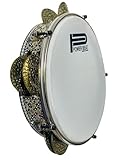
Not every riq purchase is a technique decision. This FAMA.store instrument is built around a mosaic inlaid mother-of-pearl shell, which is a decorative tradition with deep roots in Middle Eastern instrument making: small cut pieces of shell set into the wood to form geometric patterns. The result is an object that looks like a piece of furniture as much as an instrument, and it belongs in the budget tier precisely because the money went into the inlay rather than into tuning hardware.
- Decoration: mosaic mother-of-pearl inlay across the shell
- Type: professional riq, 22 cm class frame
- Head: not specified in the listing name — describe by class; expect either a natural skin or a synthetic film
- Tuning: the listing emphasises decoration rather than tuning hardware, so treat tunability as unconfirmed
- Price tier: budget
What you get for the money is visual character. Mother-of-pearl inlay catches light differently at every angle, and the technique is genuinely skilled work — cutting and fitting dozens of small shell fragments flush into a curved wooden shell is not a machine process. On a wall, on a shelf, in a photograph, or on a stage where presentation matters, a riq like this earns its place.
What you should not assume is that it plays like a working instrument. Inlaid shell adds mass and can slightly damp the frame’s resonance, which usually means a drier, shorter head tone. More importantly, when a listing leads with decoration, the tuning system, jingle quality and rim finishing are often the entry-level options. That does not make it a bad drum — it makes it a drum with a different priority order. If you play a few times a month, lead a casual folk group, or want a riq for a specific visual role, it will do the job happily.
The jingles on decorative frames are typically stamped brass in a standard pair layout. They will sound bright and functional, though a player with a trained ear will notice less complexity than hammered cymbals produce. For most casual contexts that difference disappears into the room.
Grip comfort depends heavily on rim finishing at this tier. Decorative instruments sometimes have a rim that is beautiful but a little sharp at the playing edge, and shell inlay can create small ridges where the pieces meet the wood. Run your thumb along the rim when the drum arrives; if an edge is uncomfortable, a light sanding with fine paper or a wrap of tape fixes it permanently.
Pros
- Genuine mosaic mother-of-pearl inlay — strong visual presence
- Budget tier pricing for a decorative instrument
- Standard 22 cm class frame size
- Works as display piece, prop, or occasional-play instrument
- Distinctive enough to stand out in ensemble photos and video
Cons
- Head material and tuning hardware not specified — verify before purchase
- Inlay adds mass, which can damp frame resonance
- Jingle quality likely stamped brass rather than hammered
- Not the choice for a player who needs reliable tuning adjustment
Nearest alternative in this list: the 22 cm Egyptian tambourine with abalone star inlay. Both are budget, decoration-forward riqs with shell inlay and unconfirmed hardware, so the decision comes down to taste: mother-of-pearl mosaic reads as formal and geometric, abalone stars read as folk and colourful. If you actually want to play seriously at this price, the Emin Percussion EPS-005 is the better use of the same budget — less decoration, more instrument.
5. SALA MÜZIK ALETLERI Professional Riq Tef Tambourine Def Riqq TR-101 – Best mid-range Turkish all-rounder

The TR-101 is the sensible middle of this list. SALA MÜZIK ALETLERI builds in Turkey, the listing names it across the riq/tef/def/riqq family, and it sits at mid-range pricing with a tunable frame. That combination — professional intent, standard size, tuning hardware, mid-range tier — is what most players should be looking at after they outgrow a first instrument, or as a first instrument if they already know they will play regularly.
- Type: professional riq / tef / def, Turkish build
- Diameter: standard riq class (22 cm / ≈8.7 in range) — confirm exact figure on the listing
- Tuning: tunable frame
- Jingles: brass pairs in the standard layout
- Weight class: moderate — not marketed as ultra-light
- Price tier: mid-range
The value of a mid-range tunable frame is that it removes the two most common reasons a riq becomes unusable. First, an untunable head that drifts with the seasons. Second, hardware that will not hold tension once you start adjusting it. A tunable frame at this price generally has lugs and bolts that will accept repeated small adjustments without stripping or slipping, which is what you are paying for over a budget instrument.
The naming across riq, tef, def and riqq reflects a real overlap in Turkish and Arabic percussion. Riq and riqq usually denote the small, jingle-strung frame; tef is a broader Turkish term for frame drums, some with jingles and some without; def is a related frame-drum name. Instruments in this family share a shallow shell and a hand-held playing position, and a maker that builds across all of them tends to get the fundamentals right: a 22 cm class diameter, a shallow depth that keeps jingles near the fingers, and brass jingle pairs spaced for thumb-and-finger technique.
The sound profile is the traditional Turkish one: warm head tone with a clear, ringing jingle layer and enough frame body to sound like an instrument rather than a toy. With a tunable head you can push it toward a tighter, more articulate practice sound or ease it back for a rounder, more vocal tone. That range is exactly what makes it an all-rounder — the same drum works for a folk ensemble, a belly-dance accompaniment, a worship set, or a percussion workshop.
Grip comfort is typical of Turkish professional frames: a reasonably rounded rim, moderate weight, and a shell depth that gives the thumb somewhere to sit without strain. It is not the lightest drum here, so if you play very long sets, the ultra-light Pro Light 3 has the edge on fatigue. But moderate mass is also why this drum sounds fuller than an ultra-light frame, so the trade is real rather than one-sided.
Pros
- Tunable head — adapts to room and season
- Professional Turkish construction at mid-range pricing
- Standard 22 cm class size that fits most hands
- Traditional warm head tone with clear brass jingles
- Versatile across folk, dance and ensemble contexts
Cons
- Heavier than ultra-light alternatives — matters for marathon sets
- Exact diameter, depth and weight not stated in the listing name
- Stamped versus hammered jingle construction is not specified
- No case included at this tier in most listings
Nearest alternative in this list: the Ethnic Musical walnut riq with clear plastic skin and external tuning. Both are tunable, both sit near the middle of the market, and both aim at the same player. The walnut model’s advantage is external tuning hardware, which you can adjust by hand without a tool, plus a synthetic skin that ignores humidity. The TR-101’s advantage is a traditional Turkish voice and a more conventional skin-or-film head configuration. If you play outdoors or in changing venues, external tuning is the more practical feature; if you want the classic sound, the TR-101 is the safer bet. The DEL-303 is the step up from both: same concept, better jingles, internal tuning, case included.
6. Ethnic Musical Black Walnut Riq with Clear Plastic Skin, External Tuning – Best for fast tuning by hand

External tuning is the feature that separates this riq from most of the list. The tuning lugs sit on the outside of the shell, which means you can adjust head tension with your fingers, in seconds, without opening anything, without a tool, and without removing the drum from your hand. Combine that with a clear plastic skin that ignores humidity, and you get the most practical rehearsal-and-travel riq here — and it does it at budget pricing.
- Shell: black walnut — a dense hardwood favoured for tuning stability and warm resonance
- Head: clear plastic skin (synthetic film)
- Tuning: external, easy-tuning hardware — adjustable by hand
- Type: riq / tef / daf / tambourine family
- Diameter: standard riq class — confirm exact figure on the listing
- Price tier: budget
Walnut is a good choice of shell wood and worth explaining. Dense hardwoods resist the dimensional movement that comes with humidity, so a walnut frame tends to hold its shape and its tuning better than softer woods. They also resonate with a slightly darker, warmer character than light-coloured hardwoods. The practical effect on a riq is a head tone with a bit of body and a jingle layer that sits on top rather than fighting the shell.
The clear plastic head is the opposite of a natural skin in behaviour and in sound. It is dimensionally stable, so tuning holds through weather changes, and it is durable enough to survive an accidental knock that would split a skin. It produces a brighter, more percussive attack with less pitch bend and less of the low, breathy openness a skin gives. Under a microphone it is easy to work with, because it does not drift and does not pick up moisture. For players who rehearse in inconsistent spaces, teach, or travel, this is a lower-stress instrument than any skin-head riq here.
External tuning does have a cost. The hardware is visible on the shell, which means lugs and bolts where your hand sometimes wants to be, and on a budget frame the hardware is not always finished to a high standard. Check for sharp edges or protruding bolt ends and, if you find any, wrap or file them before they wear a hole in your palm during a fast passage. The upside — instant, tool-free adjustment — outweighs the downside for most players who perform in more than one room.
Grip comfort is good because the frame is a standard size and the hardware sits low on the shell rather than at the rim. The plastic head also means you can play harder without worrying about damaging a skin, which suits a beginner still learning how much force a riq actually needs. The answer, incidentally, is less than most beginners think — a riq is a small instrument and the jingles do most of the work.
Pros
- External tuning — adjust by hand in seconds, no tools
- Clear plastic head is stable, durable and humidity-proof
- Dense walnut shell supports tuning stability and warm resonance
- Budget tier pricing for a genuinely practical feature set
- Good choice for rehearsal rooms, teaching and travel
Cons
- Plastic head lacks the pitch bend and warmth of natural skin
- Visible external hardware can interfere with hand position
- Budget-tier hardware finishing needs an inspection on arrival
- Less traditional voice than a skin-head Turkish riq
Nearest alternative in this list: the Ethnic Musical DEL-303, which pairs a clear skin with hand-hammered brass cymbals and internal tuning, plus a case. The DEL-303 is the upgrade: better jingles, cleaner shell, protected in transit — at a higher tier. If your priority is cost and adjustability, the walnut external-tuning model wins. If you want the clear-head sound with better jingle complexity and a case, spend the extra. Against the SALA TR-101, this drum wins on tuning speed and weather resistance and loses on traditional tone.
7. Ethnic Musical Professional White Riq, Hand-Hammered Brass Cymbals, Tunable, 870 g – Best for sustain and stage projection

At 870 grams, this is one of the heaviest riqs in this guide, and that number is the whole story. The listing pairs that weight with hand-hammered brass cymbals and a tunable frame, which adds up to an instrument built for projection and a big, resonant sound rather than for featherweight handling. If you play seated, in short-to-medium sets, and you want the drum to carry a room without a microphone, this is the pick.
- Weight: 870 g — heavy class for a riq
- Cymbals: hand-hammered brass
- Tuning: tunable frame
- Colour/finish: white
- Diameter: standard riq class — confirm exact figure on the listing
- Price tier: mid-range
For reference on that weight figure: riq weights across the market run from very light builds well under 500 g up to around 900 g, so 870 g sits at the top of the normal range rather than outside it. Heavier shells tend to resonate longer and lower, which gives the head tone more body and the overall instrument more sustain. The trade is fatigue: 870 g held out in one hand for a two-hour program is a genuine workout, and players who do that regularly often choose a lighter drum for exactly this reason.
Hand-hammered brass cymbals are the other half of the value here. Hammering work-hardens the metal and leaves an irregular surface, which produces a more complex, slightly drier shimmer than stamped brass. The difference is subtle in a noisy room and obvious in a quiet one: hammered jingles have more texture, less of a uniform “shhh”, and they blend better with other acoustic instruments. For recording or for a solo passage, that texture is worth having.
Tunability means you can compensate for the heavier shell’s tendency to sit at a lower pitch — bring the head up for a tighter, more cutting tone, or ease it off for depth. Combined with the white finish, this is an instrument with a strong stage presence, both visually and sonically.
Grip comfort is the compromise. A heavier frame demands a firmer hold, and a firmer hold makes it harder to keep the jingles ringing freely. Expect to spend some time finding the balance, and expect your hand to tire faster than it would on an ultra-light frame. Many players use a strap or a different hold for longer sets with heavier drums, which is a normal and accepted adaptation in the tradition.
Pros
- 870 g heavy shell for sustain and projection
- Hand-hammered brass cymbals — more complex than stamped brass
- Tunable head for pitch and room adjustment
- Strong stage presence, visually and acoustically
- Mid-range tier for a hammered-cymbal instrument
Cons
- 870 g is heavy — wrist fatigue over long sets is likely
- Heavier hold can inhibit free jingle ringing
- Exact diameter not stated in the listing name
- Not the best choice for standing performance or travel
Nearest alternative in this list: the SALA Pro Light 3. That drum is the direct opposite — tunable, ultra-light, built for endurance. Choose the white 870 g riq if you want maximum body and sustain from a seated position; choose the Pro Light 3 if you stand, tour, or play long programs. The DEL-305 sits between them in philosophy: premium build, hammered brass, internal tuning, case included, with a weight that is not marketed as extreme in either direction.
8. Remo Riq 9″, Tunable, Glen Velez (Package of 2) – Best for teachers, studios and matched pairs

Two identical tunable 9-inch Remo riqs in one package is a specific answer to a specific problem: you need more than one drum, and you need them to behave the same way. Teachers, workshop leaders, studios and percussionists who double parts all run into this. Buying two of the same model at the same time means matched tone, matched response and matched tuning behaviour — something you cannot guarantee by buying two instruments separately, even from the same maker.
- Quantity: two riqs in one package
- Diameter: 9 in (≈22.9 cm) — standard riq class
- Tuning: tunable — the key difference from the fixed-head Remo model
- Head: Remo synthetic film
- Signature model: Glen Velez
- Price tier: mid-range
Glen Velez is one of the players most responsible for bringing frame drum technique to a wide audience, and a signature model bearing his name is aimed at players who care about hand technique and tonal control rather than volume alone. The tunable frame is what makes this version more versatile than a fixed-head riq: you can set one drum slightly tighter for a cutting, articulate tone and the other slightly looser for a rounder, warmer sound, then swap between them within a single performance. That is a legitimate professional technique, not a gimmick — pitch contrast between two frame drums is a standard arranging device in frame-drum repertoire.
The synthetic head brings the same advantages it does across Remo’s world percussion line: stability across humidity and temperature, durability, and a bright, focused response. For a teaching situation this is close to ideal, because students can pick up a drum that is in tune, hand it back, and the next student gets the same instrument. No one has to learn head-seating before they learn a pattern.
Grip comfort matches the other Remo riqs here — a 9-inch rim and a shallow shell that suits most adult hands, with no protruding hardware to catch the palm. The pair also gives you a spare, which is worth more than it sounds: a riq with a torn head or a dropped frame ends a session, and having a second identical instrument means the session continues.
Cost per drum is the practical consideration. A two-pack at mid-range pricing is usually better value per instrument than buying two singles, but it is still a larger single outlay than one budget riq. If you only need one drum, this is the wrong purchase — buy the single Layne Redmond model or the SALA TR-101 instead.
Pros
- Two matched tunable riqs — ideal for teaching and studios
- Tunable frames allow deliberate pitch contrast between the pair
- Synthetic heads need no humidity management
- Standard 9″ (≈22.9 cm) size, comfortable for most hands
- Signature model aimed at serious hand technique
Cons
- Higher upfront outlay than a single instrument
- Redundant if you only need one riq
- Synthetic head lacks natural skin character
- Exact depth and weight not stated in the listing name
Nearest alternative in this list: the single Remo Layne Redmond riq. Same diameter class, same synthetic-head philosophy, one