Key takeaways
- Find the best harness for racing seats with our guide to 4-point and 5-point belts, strap width, buckles, SFI ratings, seat fit, mounting, and install tips.
A racing seat does half the job of holding you in place. The other half belongs to the harness. The best harness for racing seats keeps your shoulders and hips planted through hard braking, cornering, and rough surfaces, while still letting you reach the controls and get out fast when you need to. A standard three-point belt cannot do that job the same way, because it was designed for a stock seat and everyday driving, not for a deep-bolstered bucket seat on a track or trail.


This guide compares multi-point harnesses built for racing seats, explains what each specification means in plain language, and helps you match a harness to your seat, your vehicle, and the kind of driving you do. Every pick below is a genuine multi-point racing harness with shoulder straps, lap belts, and hardware made to anchor to a roll bar, harness bar, or reinforced mounting points.
Quick Picks
Our Short List of 3
All 4 Picks at a Glance
| Product | Specs | Action |
|---|---|---|
| 50 Caliber Racing 4-Point Harness, 3-Inch (B0G4NVRYKG) | Check price on Amazon | |
| 50 Caliber Racing 4-Point Harness, Ultra Kush (B079BHJ73X) | Check price on Amazon | |
 50 Caliber Racing 4-Point Harness, 3-Inch Red (B079B9WNDF) | Check price on Amazon | |
 50 Caliber Racing 4-Point Harness with Pass-Through Bezels (B0F9BJL62M) | Check price on Amazon |
How to Choose
Point Count: 4-Point, 5-Point, or 6-Point
The point count tells you how many straps connect you to the vehicle. A 4-point harness has two shoulder straps and two lap belts. A 5-point harness adds a submarine strap that runs between your legs and stops your body from sliding forward under the lap belt, a movement known as submarining. A 6-point harness uses two sub straps instead of one, spreading that load further. For track days and casual competition in a racing seat, a 4-point harness is the common first choice for track days and casual competition in a racing seat, because it installs easily and feels familiar. Drivers who run faster sessions, race wheel to wheel, or drive on rough off-road terrain often step up to a 5-point or 6-point setup for the extra hold. Match the point count to the demands of your driving, and confirm that your seat has the correct slots for the straps you plan to run. A 5-point sub strap needs a seat with a sub-strap opening, and forcing one through a seat that lacks it is a poor idea.
Strap Width: 2-Inch or 3-Inch Webbing
Strap width affects both comfort and load distribution. Three-inch shoulder straps spread force across a wider area of your chest and shoulders, which most drivers find more comfortable during long sessions. Two-inch straps are lighter, easier to route through narrow harness slots, and common on harnesses aimed at smaller drivers or tighter cockpits. Lap belts are often 2 inches wide even on harnesses with 3-inch shoulders, because a narrower lap belt sits lower and tighter across the hips. There is no universal right answer here. If your seat has wide harness slots and you plan to spend long stints belted in, wider straps are usually the comfortable choice. If your seat slots are narrow or your cockpit is tight, measure the slots before choosing and pick a width that passes through cleanly without bunching or folding.
Buckle Style: Camlock, Latch and Link, or Push-Button Release
The buckle is the part you will touch every time you get in and out, so its feel matters. A camlock buckle uses a central rotary or lever mechanism that releases all straps with one motion and is the standard in serious competition. A latch-and-link buckle uses a lever that locks the lap belts together and is simple, rugged, and widely used in club racing. A push-button release works like a familiar automotive buckle and is the easiest style for passengers and new drivers to understand. All three styles hold securely when installed correctly. Camlock buckles are the fastest to release in an emergency, latch-and-link buckles are the most mechanically simple, and push-button buckles are the most intuitive for occasional use. Choose the style that matches who will use the harness and how quickly they need to exit.
Certification: SFI 16.1 and FIA Labels
Motorsport sanctioning bodies require harnesses that carry a recognized certification, most commonly SFI 16.1 in the United States or an FIA homologation label. A certified harness has been built and labeled to a published standard, and the tag on the belts carries an expiry date, usually two years from manufacture. If you plan to compete in sanctioned events, check your rulebook first and buy a harness whose certification and date tags satisfy it. If you only drive track days or off-road trails, certification is still a useful quality signal, because it means the webbing, stitching, and hardware were made to a tested standard. Keep in mind that a racing harness is generally not certified for highway use, and it does not replace the factory belt system on a street-driven car. Check local regulations before using a harness on public roads.
Padding and Comfort
Padding sits between the webbing and your body, and it makes a real difference over a long session. Shoulder pads spread pressure across the collarbone and chest, reduce chafing where straps cross the shoulders, and keep the webbing from digging in under braking. Some harnesses include thick sewn-in pads, while others use removable sleeves you can slide to the right spot. Look for padding that stays put when you tighten the belts, because a pad that slides out of position is no help at all. A sternum strap, which links the two shoulder belts across your chest, also improves comfort by keeping the shoulder straps from sliding outward. If you drive in warm weather, ventilated or mesh-backed padding helps airflow and reduces sweat buildup against the webbing.
Seat Fit and Mounting: Harness Slots, Roll Bar, and Harness Bar
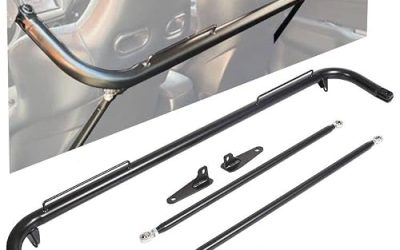
A harness only works correctly when it is mounted at the right angles. Shoulder straps should run from the seat slots to an anchor point roughly level with your shoulders, never steeply downward, because a steep angle can compress your spine in an impact. Lap belts should anchor low and to the sides so they pull across your hip bones, not your stomach. Most racing seats have slots for the shoulder straps and an opening for a sub strap, and most installations anchor the shoulder straps to a roll bar or a dedicated harness bar behind the seat. Before ordering, measure your seat width, check the slot positions, and confirm you have solid mounting points at the correct height. A harness that cannot be anchored at the right angles is the wrong harness for that seat, no matter how good its other specifications look.
Adjustability and Hardware
A harness that cannot be adjusted to fit your body is a harness you will not wear correctly. Shoulder straps should adjust across a wide range so the same harness fits different drivers, and the adjusters should move smoothly but hold firm once set. Pull-up lap adjusters let you tighten the lap belt by pulling the free end upward, while pull-down adjusters work in the opposite direction. Either style works, so choose the one that feels natural in your seating position. Check what hardware comes in the box. Some harnesses ship with bolts, eye bolts, and mounting plates, while others expect you to supply your own. Buying a harness with hardware included saves a separate shopping trip and removes the guesswork about thread sizes and bolt grades.
The Best Harness for Racing Seats Reviewed
50 Caliber Racing 4-Point Harness, 3-Inch (B0G4NVRYKG)
The 50 Caliber Racing 4-point harness with 3-inch straps is a strong all-around pick for drivers fitting out a racing seat for track days, off-road runs, or UTV use. Its wide shoulder straps spread load across the chest, and the sewn-in Ultra Kush padding keeps the webbing comfortable against the shoulders during long sessions. A quick-release latch lets you exit fast, and the sternum strap keeps the shoulder belts in position instead of drifting toward your arms. The listing covers ten color choices, so you can match the harness to your seat and interior.
This harness suits drivers who want a comfortable, easy-to-install 4-point setup with wide straps and visible padding. The shoulder straps adjust across a broad range, which helps when more than one driver shares the same seat. Mounting hardware is included in the box, so installation does not require a separate hardware run.
Drivers who need a certified harness for sanctioned competition should skip this one and choose a harness with an SFI or FIA tag instead, since this listing does not carry that certification. Drivers whose seats have narrow harness slots should also measure first, because 3-inch straps need slots wide enough to pass through without folding.
50 Caliber Racing 4-Point Harness, Ultra Kush (B079BHJ73X)
This 50 Caliber Racing 4-point harness pairs the brand’s Ultra Kush padding with a quick-release latch-lock buckle and a complete mounting hardware kit. The shoulder straps adjust from 20 inches to 70 inches, a range that covers small-framed drivers and larger drivers alike, and the harness is sized for standard bucket seats roughly 17 to 22 inches wide. High-strength polyester webbing and steel adjusters handle the loads of aggressive driving, and the push-button style release makes getting out straightforward even for passengers who have never used a racing harness.
This harness suits buyers who want everything in one box: padded straps, a quick-release buckle, a sternum strap, and the bolts and brackets needed to install it. It works well in race cars, UTVs, and off-road vehicles with bucket seats, and the wide adjustment range makes it a practical choice for shared vehicles.
Drivers who need a 5-point or 6-point configuration should skip this one, since it is a 4-point design with no sub strap. Drivers competing under a rulebook that requires an SFI or FIA tag should also look elsewhere, because this listing does not carry that certification.
50 Caliber Racing 4-Point Harness, 3-Inch Red (B079B9WNDF)
This red 4-point harness from 50 Caliber Racing uses 3-inch polyester webbing for the shoulder and lap straps, giving it the wide, load-spreading feel that many drivers prefer in a racing seat. The quick-release latch and sewn-in padding follow the same pattern as the brand’s other 4-point harnesses, and the kit includes mounting hardware for installation. The bold red webbing suits drivers who want their harness to stand out against a dark seat and interior.
This harness suits drivers who want the widest strap option in the lineup and like a high-visibility color in the cockpit. The 3-inch webbing spreads pressure well, and the included hardware keeps the installation simple. It fits the same range of bucket seats as the other 50 Caliber 4-point harnesses.
Drivers with narrow harness slots should measure before ordering, since 3-inch webbing needs room to pass through cleanly. Drivers who need a certified harness for sanctioned racing should skip this one, because it does not carry an SFI or FIA certification tag.
50 Caliber Racing 4-Point Harness with Pass-Through Bezels (B0F9BJL62M)
This 50 Caliber Racing 4-point harness is the pick for drivers who need to route straps through a stock seat, because it includes pass-through bezels that guide the shoulder straps through the seat back in the correct position. It also includes a bypass plug for the factory speed restriction on certain Polaris RZR models, a feature aimed squarely at side-by-side owners. Beyond those extras, it shares the familiar 50 Caliber formula: Ultra Kush padding, a quick-release latch, a sternum strap, and mounting hardware in the box.
This harness suits side-by-side and UTV owners, especially Polaris RZR drivers, who want a racing harness that routes cleanly through their stock seats. The bezels solve a real fitment headache, and the bypass plug addresses a quirk that RZR owners will recognize immediately.
Drivers with a dedicated racing seat and a roll bar should skip this one, because the pass-through bezels and bypass plug add features they will never use. Note the partial fit: this harness is designed around UTV and side-by-side seating, so confirm your seat width and slot layout before ordering it for a car-based racing seat.
What to Check Before You Buy
Begin with your seat. Measure the seat width, the harness slot width, and the distance from the slots to your planned anchor points. Shoulder straps should anchor roughly level with your shoulders, and lap belts should anchor low at your hips. If your seat lacks a sub-strap opening, do not buy a 5-point harness and hope for the best.
Next, check your rulebook if you compete. Sanctioned events usually require a current SFI or FIA tag, and expired belts will fail inspection. For track days and recreational use, certification is still worth having as a quality marker, but it is not always mandatory.
Then confirm the mounting hardware. Some harnesses include bolts and brackets, others do not, and the thread sizes vary between vehicles. Make a list of what your installation needs before you order, and check that the harness kit covers it.
Finally, sit in the seat with the harness on before your first drive. Tighten the lap belt first, then the shoulder straps, and check that the buckle sits flat against your body and the straps do not twist. A harness that feels awkward in the paddock will feel worse at speed, so fix the fit now rather than after your first session.
FAQ
Is a 4-point harness enough for a racing seat?
For track days, autocross, and recreational off-road driving, a 4-point harness is enough for most drivers. It holds the shoulders and hips firmly and installs easily. Drivers who race wheel to wheel, run high speeds, or drive very rough terrain often prefer a 5-point or 6-point harness because the sub strap stops the body from sliding forward under the lap belt.
Can I use a racing harness on the street?
A racing harness is generally not certified for highway use, and it does not replace the factory belt system on a street-driven car. Some jurisdictions restrict harness use on public roads, and a harness can make it harder for rescuers to remove you after a crash. Check local regulations and your insurance terms before using one on the street.
What is the difference between a camlock and a latch-and-link buckle?
A camlock buckle releases all straps with a single lever or rotary motion and is the standard in serious competition. A latch-and-link buckle uses a locking lever to join the lap belts and is simple and rugged. Both hold securely when installed correctly. Camlock buckles release faster, while latch-and-link buckles have fewer moving parts.
How long does a racing harness last?
Certified harnesses carry a tag with an expiry date, usually two years from the date of manufacture, and sanctioning bodies enforce that date. Even without a rulebook requirement, webbing degrades with sun exposure, abrasion, and repeated loading. Inspect your harness regularly for fraying, faded webbing, bent hardware, and stiff adjusters, and replace it if any of those appear.
Do I need a harness bar to install a racing harness?
You need a solid anchor point behind the seat at roughly shoulder height. A roll bar or a dedicated harness bar provides that anchor in most installations. Never anchor shoulder straps to the floor or to a point far below your shoulders, because a steep downward angle can compress your spine in an impact.
Bottom Line
The best harness for racing seats is the one that fits your seat, mounts at the correct angles, and matches the demands of your driving. For most drivers fitting out a racing seat for track days or off-road use, the 50 Caliber Racing 4-point harness with 3-inch straps and Ultra Kush padding is the most balanced choice, combining wide comfortable webbing, a quick-release buckle, and hardware in the box. Drivers who share a seat between drivers of different sizes should look at the Ultra Kush model with its wide adjustment range, while side-by-side owners will get the most from the version with pass-through bezels. Whatever you choose, measure your seat, confirm your anchor points, and sit in the harness before your first drive.
Disclosure: As an Amazon Associate, we may earn from qualifying purchases.
More from Amazon
Programs that pair well with the guide above. Offers and eligibility are set by Amazon and may change.
Set up recurring deliveries of everyday items on eligible products. Terms and savings are set by Amazon.
Explore Subscribe & SaveFree shipping on eligible items, Prime Video and more. Eligible new members can start with a free trial.
Start a Prime free trialAudiobooks and podcasts to listen to on the go. Eligible new members can start with a free trial.
Try Audible freeRead from a large library of eBooks and audiobooks on any device. Check Amazon for current plans.
Explore Kindle UnlimitedAs an Amazon Associate we earn from qualifying purchases.