Key takeaways
- Standard galvanized steel: suitable for many inland garden projects with normal rainfall. The zinc coating gradually wears at cut edges and points where wires rub.
- Heavily galvanized steel: better for persistently damp ground, frequent rain, and longer ownership. Look for a stated zinc coating specification rather than an unexplained phrase such as “rust resistant.”
- PVC-coated galvanized wire: the plastic layer adds a barrier against moisture and salt and can provide a darker, less industrial appearance. Inspect cuts carefully because exposed steel beneath damaged coating can become a corrosion starting point.
The best gabion wall kits are the ones whose wire gauge, mesh opening, basket depth, stone size, and corrosion coating match your wall height and site conditions—not simply the kit with the largest basket.
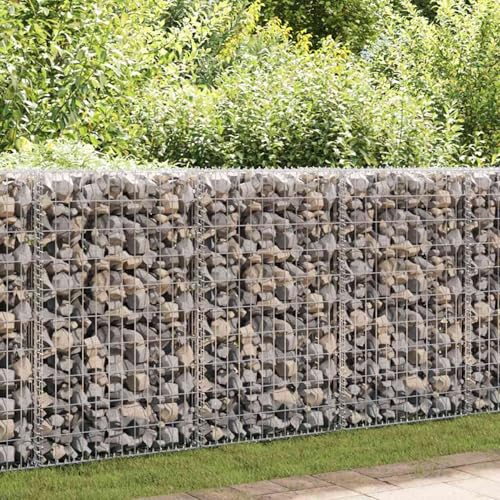
For most garden edging, raised beds, privacy features, and low retaining walls, choose a modular kit made from at least 4 mm galvanized steel wire, with 75–100 mm mesh and baskets 300–500 mm deep. For a retaining wall over about 1 m high, on a slope, beside a driveway, or near a building, use an engineer-approved system rather than relying on a decorative DIY kit.
Our top picks



As an Amazon Associate we earn from qualifying purchases at no extra cost to you. Ratings are shown as listed on Amazon.
Best gabion wall kits by project
| Project situation | Recommended basket specification | Suitable fill | Why this works |
|---|---|---|---|
| Garden edging or raised bed, up to 300 mm high | 3–4 mm wire, 50–75 mm mesh, 200–300 mm deep | 50–100 mm angular stone | Compact, easy to assemble, and economical for decorative work |
| Freestanding garden divider, 300–900 mm high | 4 mm wire, 75–100 mm mesh, 300–500 mm deep | 75–150 mm stone | Offers a useful balance of stability, appearance, and manageable weight |
| Low retaining wall on firm, level ground | 4–5 mm wire, 75–100 mm mesh, 500–1,000 mm deep | 100–200 mm angular rock | Deeper baskets resist tipping better and provide more drainage space |
| Wet, salty, or coastal environment | 4–5 mm wire with heavy galvanizing or PVC coating | Rounded or angular stone matched to the mesh | Extra coating helps slow corrosion where moisture and salt accelerate damage |
| Wall above 1 m, steep slope, or surcharge nearby | Engineered gabion system; commonly 4–6 mm wire or heavier | Specified by the design | Drainage, foundation, setbacks, and reinforcement matter as much as the basket |
What to check before choosing a kit
Wire gauge and wire diameter
Gabion listings may describe wire as gauge, millimeters, or both. Millimeter diameter is easier to compare: 3 mm wire is light-duty, 4 mm is a practical minimum for many residential walls, and 5 mm or more is better for larger or more exposed structures. A thicker wire resists deformation during filling and tolerates accidental impacts from rocks, wheelbarrows, and garden tools.
Do not compare wire diameter alone. Ask whether the stated measurement applies to the main mesh wire, spiral connectors, stiffening diaphragms, and lacing wire. A basket with 4 mm mesh wire but very thin connectors may still become loose or bulge during filling.
Mesh opening and stone size
The stone must be substantially larger than the mesh opening. As a practical rule, choose fill with a minimum dimension at least 1.5 times the opening. For a 75 mm mesh, stone should generally be at least 100–125 mm across; for a 100 mm mesh, use roughly 125–200 mm rock.
Small stones can escape through the face, while oversized rocks leave large voids and make the basket difficult to close. Angular, durable stone usually interlocks better than smooth rounded gravel. Attractive face stone can be placed by hand, with less expensive compatible rock used in the interior.
Basket depth and wall stability
Depth is not just a capacity specification. A deeper basket places more weight behind the wall and generally gives a freestanding or retaining structure a wider base. Narrow 200 mm baskets suit edging and decorative panels; 300–500 mm baskets are more versatile; 1,000 mm-deep baskets are substantial retaining components.
For a retaining wall, the required depth depends on soil, drainage, height, slope, foundation, and loads at the top. A wall supporting a lawn is not subjected to the same forces as one beside a parking area or patio. Never treat a manufacturer’s maximum stack height as a structural design approval.
Corrosion protection
There are three common protection levels:
- Standard galvanized steel: suitable for many inland garden projects with normal rainfall. The zinc coating gradually wears at cut edges and points where wires rub.
- Heavily galvanized steel: better for persistently damp ground, frequent rain, and longer ownership. Look for a stated zinc coating specification rather than an unexplained phrase such as “rust resistant.”
- PVC-coated galvanized wire: the plastic layer adds a barrier against moisture and salt and can provide a darker, less industrial appearance. Inspect cuts carefully because exposed steel beneath damaged coating can become a corrosion starting point.
Coating is not a substitute for drainage. Standing water, trapped soil, fertilizer, and salt can shorten the life of any wire basket. Keep the wall’s drainage path clear and avoid burying unprotected cut ends.
Decision matrix: which kit fits your priorities?
| Priority | Best choice | Trade-off |
|---|---|---|
| Lowest initial cost | Standard galvanized, 3–4 mm wire, modular 200–300 mm baskets | Less impact resistance and less tolerance for damp or salty conditions |
| First DIY project | Pre-cut panels with spiral connectors, internal diaphragms, and clear instructions | Usually costs more than loose mesh but reduces fitting mistakes |
| Long-term wet-climate ownership | Heavy galvanizing or PVC-coated galvanized wire, plus geotextile and drainage aggregate | Higher purchase cost and careful handling needed to avoid coating damage |
| Limited garden space | 200–300 mm-deep baskets or a professionally designed stepped wall | Narrow baskets provide less resistance to overturning |
| Large retaining wall | Engineered, interconnected baskets with specified foundation and drainage details | May require excavation, equipment, and professional design |
Worked calculation: estimating stone and kit quantity
Gabion fill is often sold by weight, while baskets are measured by volume. A useful early estimate is that one cubic meter of gabion rock weighs about 1.5–1.8 tonnes, depending on the stone type and voids.
Suppose you are building a wall 6 m long, 600 mm high, and 300 mm deep:
- Volume: 6 × 0.6 × 0.3 = 1.08 m³
- Estimated stone: 1.08 × 1.6 tonnes = about 1.7 tonnes
- Allowing for selection, breakage, and spillage: order roughly 1.8–1.9 tonnes
If the kit uses 2 m-long panels, you would normally need three 2 m sections, plus end panels, connectors, and internal diaphragms. Confirm the manufacturer’s stated dimensions because usable internal volume may be slightly smaller than the nominal outside measurement.
How to assemble a DIY gabion wall correctly
1. Prepare a level, compact base
Remove organic soil and soft mud. For a small decorative wall, compacted crushed stone may be sufficient; a taller retaining wall may need a designed foundation. A level base prevents the panels from twisting and reduces uneven loading.
2. Build the empty basket and inspect every connection
Lay panels flat, join corners with spirals or approved clips, and install diaphragms before filling. Check that the mesh is square and that the base sits flat. Do not improvise with thin craft wire or plastic ties as primary structural connections.
3. Place the first visible face carefully
Hand-place the best-looking stones against the outside faces. This limits visible gaps and reduces the chance that small pieces will press through the mesh. Fill the center with compatible rock rather than loose soil or construction debris.
4. Fill in lifts and use internal bracing
Fill in layers of about 300 mm, checking the face after each layer. Install supplied bracing wires or tie rods at the specified intervals. Without bracing, the front and back panels can bulge even when the wire is thick enough.
5. Close the lid without forcing it
The lid should meet the frame naturally. If it will not close, remove and rearrange stones rather than pulling aggressively on the mesh. Excessive force can permanently deform the panel or damage a PVC coating.
Ownership realities and common mistakes
- Rock is the costly part: the baskets may be relatively inexpensive, but delivery of 1–2 tonnes of stone can dominate the project budget. General residential material ranges vary widely, from roughly $25–$80 per square meter for simple basket components before stone and delivery.
- Cut edges are vulnerable: use manufacturer-approved repairs or compatible corrosion-protection paint on exposed steel, and avoid cutting coated wire unless necessary.
- Weeds and soil reduce drainage: use geotextile behind a retaining wall where appropriate, but do not block the designed drainage outlet.
- Uneven filling causes bulges: alternate between the front, back, and center instead of filling one side to the top first.
- Pets need safe edges: inspect for protruding wire, sharp stone points, and unstable top layers if dogs or children will walk beside the wall. Cap or repair any exposed sharp ends.
- Movement is not always failure: gabions can tolerate minor settlement, but leaning, spreading joints, blocked drainage, or soil pushing through the face warrants prompt professional inspection.
Bottom line
For most garden projects, the best gabion wall kits combine 4 mm galvanized or PVC-coated wire, 75–100 mm mesh, 300–500 mm basket depth, compatible angular stone, internal diaphragms, and proper bracing. Choose a lighter 200–300 mm system only for low edging, and move to an engineered design when height, slope, water, traffic, or nearby structures increase the load. Matching the kit to those conditions will matter far more than choosing the most attractive product photo.