Key takeaways
- Dies: At minimum, look for 1/2, 3/4, 1, 1-1/4, 1-1/2, and 2-inch sizes if those match your work.
- Draw studs: The kit should include studs sized for both small and large dies. A short stud may not provide enough thread engagement for thick material.
- Spacers and thrust bearings: These reduce friction and help prevent the cylinder or die from binding.
- Hydraulic cylinder: Verify its rated capacity and maximum stroke. A higher tonnage rating does not automatically mean the die set can cut every material.
- Case: A molded case with labeled recesses is preferable to a soft bag for protecting sharp dies and preventing missing spacers.
- Replacement availability: Confirm that draw bolts, seals, dies, and hydraulic oil can be purchased separately.
The best hydraulic knockout punch kits are the ones that cover your regular conduit sizes without forcing you to carry an oversized pump, incomplete die set, or fragile case: choose a compact 1/2–2-inch kit for routine electrical work, a 1/2–4-inch hydraulic set for larger panels and feeders, or a battery-powered system when repeated holes make hand pumping impractical.
Our top picks
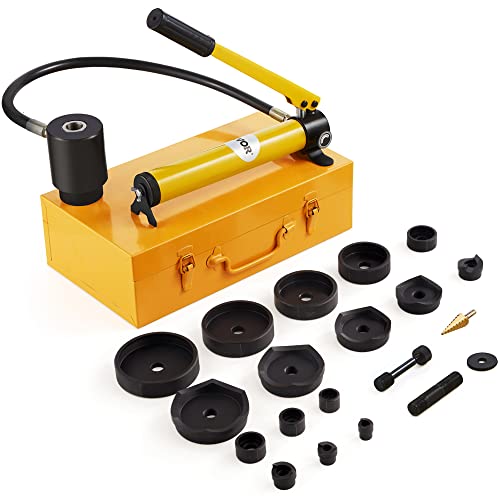

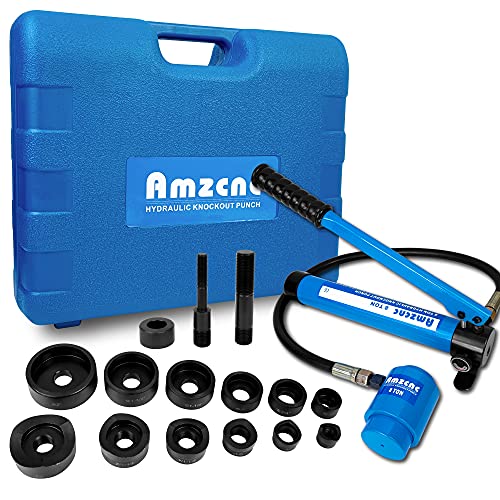

As an Amazon Associate we earn from qualifying purchases at no extra cost to you. Ratings are shown as listed on Amazon.
Best hydraulic knockout punch kits by work situation
| Best for | Recommended kit type | Typical capacity | What to prioritize | Typical 2026 market range |
|---|---|---|---|---|
| Occasional home, farm, or small-panel work | Manual hydraulic hand-pump kit | 1/2–2 in. conduit | Complete common-size dies, compact case, replacement parts | $150–$350 |
| Regular commercial electrical work | Professional hand-pump kit | 1/2–2 in. or 1/2–3 in. | Fast ram retraction, hardened dies, reliable hydraulic seals | $300–$700 |
| Large disconnects, switchgear, and feeder work | Large-capacity hydraulic kit | 1/2–4 in. | High-tonnage cylinder, long draw studs, large dies and spacers | $700–$1,500+ |
| High-volume installation crews | Battery-powered knockout tool | 1/2–4 in., depending on model | Speed, battery ecosystem, die availability, service support | $1,000–$3,000+ |
Top choices in the hydraulic knockout category
Greenlee hydraulic kits: the broadest professional ecosystem
Greenlee is a strong choice when dies, draw studs, replacement parts, and service support matter as much as the initial kit. Its hydraulic knockout systems range from compact sets for 1/2–2-inch conduit to larger systems designed for holes up to approximately 4 inches, depending on the specific kit and die series.
A compact Greenlee set is usually the better match for electricians who mainly install conduit in panel boxes, junction boxes, and disconnect enclosures. A larger set costs and weighs more, but it avoids buying a second hydraulic cylinder and oversized dies later. Check whether the package includes trade-size dies or only a limited selection; “1/2–2 inches” generally refers to conduit trade size, not the exact diameter of the cut opening.
Klein Tools hydraulic kits: practical sets for common panel work
Klein Tools offers hydraulic knockout kits aimed at electricians who want a self-contained case with familiar conduit sizes. These are appealing for service work because the included die range commonly focuses on sizes used in residential and light-commercial panels rather than unusual large openings.
Before choosing a Klein kit, inspect the listed die sizes and the maximum material thickness. A kit may handle 1/2–2-inch conduit but still be intended for mild-steel enclosures of a particular thickness. Stainless steel, layered panels, and thick backplates can require more force and may exceed the tool’s recommended application.
Milwaukee M18 FORCE LOGIC: best when speed outweighs portability
Milwaukee’s M18 FORCE LOGIC knockout tools are battery-powered rather than conventional hand-pump kits. They are worth considering for crews making many holes per day, especially when working overhead or inside crowded enclosures where repeated pumping is awkward. Depending on the model and included set, the system covers common 1/2–2-inch sizes, while larger configurations extend farther.
The main trade-off is cost and battery dependence. A battery tool is faster and less tiring, but the bare tool may not include enough dies, batteries, or a charger. Confirm whether the package is a complete kit and whether its dies are compatible with the sizes your crew already owns.
Generic hydraulic sets: useful value, but inspect the consumables
Less expensive hydraulic kits can make sense for occasional work. Many include a hand pump, cylinder, draw studs, spacers, and dies for 1/2, 3/4, 1, 1-1/4, 1-1/2, and 2-inch conduit. The limitation is often not the hydraulic principle itself but inconsistent die hardness, rough threads, weak cases, or difficulty obtaining replacement seals and studs.
For a kit used only a few times per year, the lower purchase price may be reasonable. For paid installation work, downtime from a damaged draw bolt or leaking pump can erase the savings quickly.
Capacity is about conduit trade size, not just hole diameter
Knockout dies are normally labeled by the conduit trade size they accommodate. A 2-inch conduit knockout produces a hole substantially larger than 2 inches because the conduit must pass through it. Always compare the manufacturer’s die chart with the fitting or connector you intend to install.
| Nominal conduit size | Approximate knockout diameter | Common use |
|---|---|---|
| 1/2 in. | About 0.88 in. | Small branch-circuit fittings |
| 3/4 in. | About 1.11 in. | General junction boxes and panels |
| 1 in. | About 1.38 in. | Larger branch circuits |
| 1-1/4 in. | About 1.72 in. | Feeders and larger conductors |
| 1-1/2 in. | About 1.97 in. | Commercial feeder and equipment connections |
| 2 in. | About 2.45 in. | Large equipment and feeder connections |
These figures are useful planning approximations, but the die manufacturer’s chart should control. Connector dimensions and regional conduit standards can differ slightly.
Hydraulic hand pump or battery operation?
A hand-pump kit is mechanically simple: the pump pressurizes a hydraulic cylinder, the cylinder pulls a draw stud through the metal, and the cutting die shears the slug. It needs no charged battery and is easy to store for years, provided the hydraulic seals and oil remain in good condition.
Battery-powered tools deliver quicker, more repeatable cycles. They are particularly useful when making ten, twenty, or more holes in a shift. Their disadvantages include higher cost, battery weight, electronic controls, and the need to keep compatible batteries charged. For two or three holes a month, the speed advantage rarely justifies the price.
What should be included in a complete kit?
- Dies: At minimum, look for 1/2, 3/4, 1, 1-1/4, 1-1/2, and 2-inch sizes if those match your work.
- Draw studs: The kit should include studs sized for both small and large dies. A short stud may not provide enough thread engagement for thick material.
- Spacers and thrust bearings: These reduce friction and help prevent the cylinder or die from binding.
- Hydraulic cylinder: Verify its rated capacity and maximum stroke. A higher tonnage rating does not automatically mean the die set can cut every material.
- Case: A molded case with labeled recesses is preferable to a soft bag for protecting sharp dies and preventing missing spacers.
- Replacement availability: Confirm that draw bolts, seals, dies, and hydraulic oil can be purchased separately.
A simple cost-per-use calculation
Suppose a compact kit costs $240 and you expect to make 120 knockouts over five years. The equipment cost is $2 per knockout before maintenance. A $1,200 battery-powered kit used for 1,200 holes over the same period costs the same $1 per knockout, but it may save substantial labor time.
For only 20 lifetime holes, the compact kit costs about $12 per hole, while the battery system costs $60 per hole. This is why frequency of use matters more than maximum capacity for many buyers.
Durability and maintenance realities
The parts most likely to wear are draw-stud threads, cutting edges, thrust bearings, hydraulic seals, and the pump’s release valve. Keep the dies lightly oiled, wipe away metal chips after every job, and store the sharp cutting edges so they cannot strike one another. Do not use a damaged or mushroomed draw stud; replacing it is cheaper than repairing a seized cylinder or cracked die.
Make the pilot hole the correct size for the draw stud, align the die squarely with the enclosure, and avoid side-loading the cylinder. A crooked setup can produce an incomplete cut and place abnormal stress on the stud. Use cutting lubricant where the manufacturer allows it, particularly in thicker steel, but remove residue before installing electrical components.
For hydraulic hand pumps, inspect for oil leaks and spongy operation before important work. If the ram will not retract fully, the system may need bleeding or seal service. Never exceed the rated material thickness or attempt to punch hardened steel, reinforcing ribs, or multiple layers unless the manufacturer specifically permits it.
Final buying recommendation
For most occasional and light-commercial users, a complete 1/2–2-inch manual hydraulic kit with clearly labeled dies and a rigid case offers the best balance of price, storage, and capability. Choose a professional Greenlee or Klein Tools set when replacement parts and frequent use are important. Move to a 1/2–4-inch system only when your actual fittings require those sizes, and choose a Milwaukee M18 FORCE LOGIC or comparable battery tool when labor savings from repeated holes justify the larger investment.