Our Short List of 3

- Best for: Small crews doing finish, trim, and indoor work in occupied homes, where a larger tank and quiet operation matter more than the lightest carry weight.

- Best for: Crews that need higher CFM for framing, roofing, and heavier air tools, and that value a durable oil-lubricated pump.
- Best for: Small crews that want a balance of tank size, airflow, and portability for mixed trim, finish, and framing work.
All 3 Picks at a Glance
| Product | Specs | Action |
|---|---|---|
| California Air Tools 8010 Ultra Quiet Oil-Free Air Compressor, 8 Gallon |
| Check price on Amazon |
| Makita MAC700 Big Bore Air Compressor, 2.6 Gallon Hot Dog |
| Check price on Amazon |
| DEWALT D55151 Twin Hot Dog Compressor, 4 Gallon |
| Check price on Amazon |
Key takeaways
- Find the best hot dog air compressors for small contractor crews, with CFM, tank size, portability, and duty cycle for jobsite nailers and air tools on the job.
A hot dog air compressor — a horizontal twin-tank or single-tank unit with a long, low profile — is a familiar sight on small job sites for a reason. It carries enough air for finish nailers, brad nailers, and trim work, it fits in a truck bed or a van without taking the space of a large vertical unit, and a two-person crew can move it from room to room without a dolly. For a small contractor crew, the right hot dog compressor is the one that keeps up with the tools, survives daily transport, and does not leave the crew waiting for the tank to refill.
The decision is not about the largest tank or the highest headline figure. It is about delivered airflow at working pressure, how quickly the tank recovers, how the unit handles being loaded and unloaded every day, and whether it can run a second tool when a second crew member picks one up. This guide focuses on hot dog compressors for small contractor crews: units with enough CFM for crew work, tanks that balance run time against portability, and builds that tolerate jobsite dust, bumps, and shared use.
Disclosure: As an Amazon Associate, we earn from qualifying purchases.
How to Choose Hot Dog Air Compressors for Small Contractor Crews
Airflow, CFM, and duty cycle
CFM at 90 PSI is the number that decides whether a compressor keeps up with your tools. Check the CFM requirement for each air tool you use and add the requirements together if two tools may run at the same time. Choose a compressor whose delivered CFM at 90 PSI covers the largest tool you use regularly, with margin for a second tool on intermittent work. A compressor with a low duty cycle needs rest periods between runs and will wear quickly if it runs continuously through a long shift.
Tank size and portability
Hot dog tanks usually run from 1 gallon to 8 gallons in the portable range. A larger tank gives longer runs between motor cycles and steadier pressure for tools that use air in bursts, while a smaller tank is lighter and easier to carry up stairs. For a small crew, a 4-gallon twin-stack or an 8-gallon wheeled hot dog unit is a practical middle ground: enough stored air for trim and finish work, still movable by one or two people. Weight, handles, and wheels decide how the unit moves on site. A hand-carry unit with a balanced handle suits stairs and tight rooms, while a wheeled unit with a pull handle suits flat ground and longer carries.
Power, noise, and jobsite conditions
Most portable hot dog compressors in this guide run on standard 120-volt power and need a 15-amp circuit. Check the amp draw, because a compressor that trips a breaker on start-up wastes more time than it saves. A long extension cord can drop voltage and make starting harder, so use a short, heavy-gauge cord where possible and keep the compressor close to the outlet. Noise is a jobsite reality: a compressor rated around 60 dBA can run in an occupied home without forcing the crew to shout, while a unit rated around 80 dBA needs hearing protection nearby and may disturb clients in the next room.
Durability and maintenance
A crew compressor lives in a truck, on dusty floors, and in rain. Look for a steel tank, a protected pump, a sturdy frame, and gauges and regulators that are not exposed to the first knock. Cast-iron cylinders and oil-lubricated pumps tend to last longer under heavy use, while oil-free dual-piston pumps need less daily attention and no oil changes. Daily maintenance is simple but worth doing: drain the tank at the end of the day to remove moisture, check the oil level on oil-lubricated models, clean or replace the air filter, and inspect the hose and fittings for leaks.
Our Top Picks
The compressors below were chosen for small contractor crews that need portable hot dog units with real jobsite airflow. Each one offers a different balance of tank size, CFM, noise, and weight, so match the pick to the tools your crew runs most.
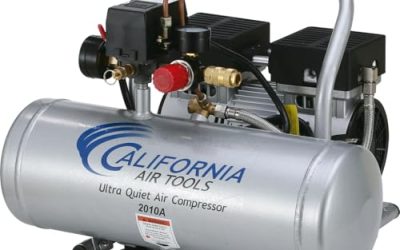
California Air Tools 8010 Ultra Quiet Oil-Free Air Compressor, 8 Gallon
- Best for: Small crews doing finish, trim, and indoor work in occupied homes, where a larger tank and quiet operation matter more than the lightest carry weight.
Small crews doing finish, trim, and indoor work in occupied homes, where a larger tank and quiet operation matter more than the lightest carry weight.
The California Air Tools 8010 is the largest-capacity pick in this guide, with an 8-gallon steel tank, a 1.0 HP oil-free pump, and a wheeled hot dog layout that a crew can roll across a site. It delivers 2.2 CFM at 90 PSI, with a maximum pressure of 120 PSI, and a noise level of 60 dBA, which makes it one of the quieter crew-sized options. The oil-free dual-piston pump needs no oil changes, and the wheels and handle make the 8-gallon tank manageable on flat ground. Key features include the 8-gallon steel tank, oil-free operation, a manual tank drain, a 1.0 HP motor with low amp draw, and a lightweight wheeled frame. The larger tank gives longer runs between motor cycles for finish nailers and brad nailers, and the quiet operation suits occupied homes and indoor trim work.
Pros: 8-gallon tank gives long runs between cycles; 60 dBA operation suits indoor and occupied sites.
Cons: The 8-gallon wheeled unit is heavier and bulkier to lift into a truck than a 2-gallon hand-carry model; 2.2 CFM at 90 PSI suits finish tools better than high-demand continuous tools..
Makita MAC700 Big Bore Air Compressor, 2.6 Gallon Hot Dog
- Best for: Crews that need higher CFM for framing, roofing, and heavier air tools, and that value a durable oil-lubricated pump.
Crews that need higher CFM for framing, roofing, and heavier air tools, and that value a durable oil-lubricated pump.
The Makita MAC700 is a contractor-grade hot dog compressor built around a Big Bore oil-lubricated pump. It has a 2.6-gallon hot dog tank, a 2.0 HP motor, and delivers 3.3 CFM at 90 PSI and 3.8 CFM at 40 PSI, with a maximum pressure of 130 PSI. That airflow is the highest in this guide and suits crews that run framing nailers, roofing nailers, and other tools that use more air than a finish nailer. The pump runs at 1,720 RPM, which the maker describes as giving quieter operation for its class, at 80 dB, with thermal overload protection. Key features include the cast-iron Big Bore cylinder, an oil-lubricated pump for durability, a 2.6-gallon tank, a 12.4-amp motor, and a compact hand-carry frame weighing about 52 lb.
Pros: 3.3 CFM at 90 PSI is the highest airflow in this guide; oil-lubricated cast-iron pump suits heavy daily use.
Cons: The 2.6-gallon tank cycles more often than an 8-gallon tank under continuous use; oil-lubricated pumps need regular oil checks and changes.
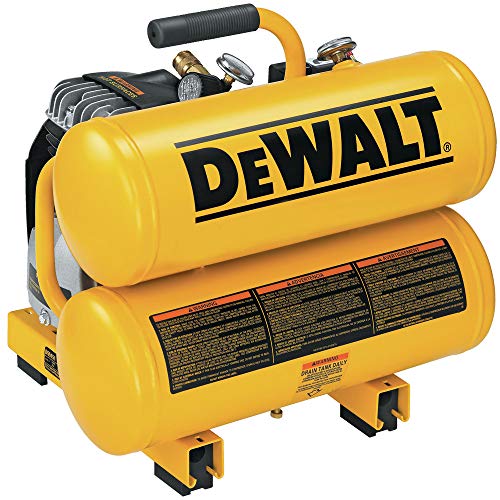
DEWALT D55151 Twin Hot Dog Compressor, 4 Gallon
- Best for: Small crews that want a balance of tank size, airflow, and portability for mixed trim, finish, and framing work.
Small crews that want a balance of tank size, airflow, and portability for mixed trim, finish, and framing work.
The DEWALT D55151 is a 4-gallon twin-stack hot dog compressor with an oil-lubricated cast-iron cylinder and a 14-amp motor. It delivers 3.2 CFM at 100 PSI, which gives quick recovery between nailer bursts and suits crews that run finish and framing tools in turn. The twin-stack tank design keeps the unit low and stable, and the hand-carry frame suits stairs and tight rooms where a wheeled unit would be awkward. Key features include the 4-gallon twin-stack tank, an oil-lubricated pump, a high-flow regulator, dual soft-start valves to assist cold-weather starting, overload protection, and an initial fill of synthetic compressor oil included.
Pros: 3.2 CFM at 100 PSI gives quick recovery; 4-gallon twin-stack tank balances run time and portability.
Cons: Oil-lubricated maintenance is needed, including oil checks; the unit is heavier than a 1-gallon or 2-gallon hand-carry compressor.
Small Contractor Crew Considerations
A crew compressor is shared equipment, so the way the crew treats it decides how long it lasts. Agree on a simple end-of-day routine: drain the tank, coil the hose without kinks, check the oil on oil-lubricated models, and store the unit upright in the truck so it does not roll or tip. A crew that runs mostly brad and finish nailers can use a quieter, larger-tank unit, while a crew that runs framing nailers, roofing nailers, and impact wrenches needs higher CFM first, and noise second.
Frequently Asked Questions
What CFM does a small contractor crew need?
It depends on the tools. A brad nailer needs modest airflow, a finish nailer needs more, and a framing nailer or impact wrench needs more still. Add the CFM at 90 PSI for the tools that may run together, and choose a compressor that covers the largest tool with margin. For mixed trim and framing work, a unit delivering around 3 CFM at 90 PSI or more gives a crew more headroom than a unit delivering around 2 CFM.
Can one hot dog compressor run two nailers at once?
It can, if the combined CFM demand fits the compressor’s delivered airflow and the tank has enough reserve for short bursts. Two finish nailers on intermittent work are easier to support than two framing nailers running continuously. Use a manifold with separate regulators where the tools need different pressures, and keep hose lengths short.
Is an oil-free or oil-lubricated compressor better for a crew?
Oil-free pumps need less routine maintenance and no oil changes, which suits crews that want a simple daily routine and quieter operation. Oil-lubricated pumps with cast-iron cylinders tend to last longer under heavy, continuous use, but they need regular oil checks and changes. Choose oil-free for lighter, indoor crew work and oil-lubricated for heavier, all-day framing and roofing work.
Conclusion
The best hot dog air compressor for a small contractor crew is the one that matches the crew’s tools. The California Air Tools 8010 suits finish and indoor crews that want a large tank and quiet operation, the Makita MAC700 suits crews that need the highest CFM for framing and heavier tools, and the DEWALT D55151 balances tank size, airflow, and portability for mixed crew work. Check the CFM your tools need at 90 PSI, measure your truck storage, and choose the unit whose duty cycle and maintenance routine your crew will actually follow.
More from Amazon
Programs that pair well with the guide above. Offers and eligibility are set by Amazon and may change.
Set up recurring deliveries of everyday items on eligible products. Terms and savings are set by Amazon.
Explore Subscribe & SaveFree shipping on eligible items, Prime Video and more. Eligible new members can start with a free trial.
Start a Prime free trialAudiobooks and podcasts to listen to on the go. Eligible new members can start with a free trial.
Try Audible freeRead from a large library of eBooks and audiobooks on any device. Check Amazon for current plans.
Explore Kindle UnlimitedAs an Amazon Associate we earn from qualifying purchases.