Our Short List of 3

- Best for: A single cockatiel or a bonded pair of parakeets, canaries, or finches that need genuine horizontal flight room in a classic flight cage.
- Best for: Cockatiels, conures, and parakeets that need a wide flight cage on a rolling stand, with slightly wider spacing than a finch cage.

- Best for: A small flock or a pair of medium birds that need the widest flight room in this guide, in a large indoor space with a clear floor path.
All 3 Picks at a Glance
| Product | Specs | Action |
|---|---|---|
| Prevue Hendryx Wrought Iron Flight Cage with Stand F040, Black |
| Check price on Amazon |
| Yaheetech 52-Inch Wrought Iron Standing Large Flight Cage |
| Check price on Amazon |
| Topeakmart X-Large Parrot Cage with Rolling Stand, 60.5 Inches |
| Check price on Amazon |
Key takeaways
- Find the best large flight bird cages for large indoor pet spaces, with horizontal flight room, bar spacing and perch guidance for finches and small parrots.
A flight cage is built around one idea: birds fly sideways. Finches, canaries, budgies, and cockatiels do not climb straight up a tall tower the way a parrot climbs a branch. They hop, flutter, and take short flights from perch to perch, and they need horizontal room to do it. A large flight cage gives them that room. It is wider than it is tall inside, with perches placed at either end, so a bird can move across the cage in a few wingbeats instead of circling in a narrow column.
In a large indoor pet space, that width changes the cage from a perch with walls into a small aviary. It also changes how you choose. Total height can be misleading, because much of it may be stand. Interior width, depth, and bar spacing matter more. The best large flight bird cages for large indoor pet spaces give small and medium birds at least 30 inches of usable width, spacing that keeps heads and toes safe, and a layout that lets you add perches, toys, and feeders without blocking the flight path.
Disclosure: As an Amazon Associate, we earn from qualifying purchases.
How to Choose Large Flight Bird Cages for Large Indoor Pet Spaces
Horizontal Flight Room
Start with interior width. A cage that is 31 inches long inside gives a finch or budgie room for a short flight between perches. A cage that is 37 inches long gives even more room, and suits a small flock. Depth matters too: at least 20 inches gives a bird room to turn and land without hitting the back bars. Place perches at different heights near each end, with a clear flight path between them. Avoid filling the middle with large toys, swings, or feeders that block the route. A flight cage should feel open in the centre, with activity at the edges.
Bar Spacing and Bird Safety
Bar spacing is the main safety check for a flight cage, because these cages are often used for small birds. Finches, canaries, and budgies generally need spacing around 1/2 inch or less. Cockatiels and small conures often suit 1/2 to 5/8 inch. Spacing that is too wide lets a small bird push its head through or escape. Spacing that is too narrow restricts airflow and can trap toes. Check the stated spacing for the model, measure it on arrival, and choose it for the smallest bird in the cage. Horizontal bars help birds climb, while vertical bars suit birds that mainly fly.
Size, Flock, and Species
A flight cage can house a single bird, a bonded pair, or a small flock, but the right size depends on the birds. A single cockatiel can use a 31-inch flight cage well. A pair of budgies needs similar width, with perches and feeders for both birds. A small flock of finches needs a wider cage, with multiple perches so birds can spread out and avoid crowding. Do not mix species of very different sizes in one flight cage, and do not house a large parrot in a flight cage designed for small birds, because the bar strength and spacing will not match.
Material, Cleaning, and Access
Powder-coated wrought iron is common for flight cages, because it is strong and cleans well. Check welds for sharp edges, and avoid peeling paint or exposed zinc. For cleaning, look for a slide-out tray and a removable grate, so waste can be removed without disturbing the birds. Large front doors make it easy to place and remove birds, while smaller side doors let you change food, water, and nesting boxes without opening the main door. A seed skirt helps contain scattered seed in a large indoor room.
Our Top Picks
These three flight cages cover different widths and flocks: a classic 31-inch flight cage, a wide 37-inch flight cage, and a compact 31-inch standing flight cage.
Prevue Hendryx Wrought Iron Flight Cage with Stand F040, Black
- Best for: A single cockatiel or a bonded pair of parakeets, canaries, or finches that need genuine horizontal flight room in a classic flight cage.
A single cockatiel or a bonded pair of parakeets, canaries, or finches that need genuine horizontal flight room in a classic flight cage.
The Prevue F040 measures 31 inches long, 20.5 inches wide, and 53 inches high, with 1/2-inch wire spacing. The interior measures 30.25 by 20.25 by 40 inches. It includes three wood perches, four plastic double cups, a pull-out grille and tray, and a rolling stand with a storage shelf. Two large front doors and six smaller side doors give easy access for birds, food, water, and nesting boxes. It is listed for parakeets, canaries, and finches.
Pros:
– 31-inch width with a clear horizontal flight path
– 1/2-inch spacing suits small birds
– Pull-out grille and tray for easy daily cleaning
– Rolling stand and storage shelf for moving and supplies
Cons:
– Interior height is 40 inches, so tall toys need careful placement
– 1/2-inch spacing is not suited to large parrots
– Four cups and three perches may need adding for a larger flock
Yaheetech 52-Inch Wrought Iron Standing Large Flight Cage
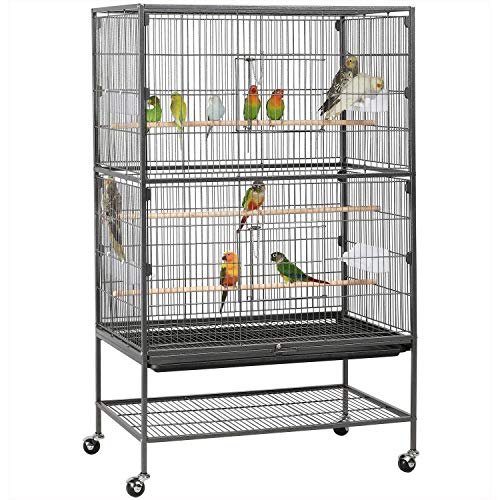
- Best for: Cockatiels, conures, and parakeets that need a wide flight cage on a rolling stand, with slightly wider spacing than a finch cage.
Cockatiels, conures, and parakeets that need a wide flight cage on a rolling stand, with slightly wider spacing than a finch cage.
This Yaheetech flight cage measures 30.8 by 20.5 by 52 inches, with 5/8-inch bar spacing. It includes perches, feeders, a pull-out tray, a slide-out floor grid, and four swivel casters on a rolling stand. The wide footprint gives cockatiels, conures, parakeets, and budgies room to fly from perch to perch, and the large front doors make it easy to place and remove birds. The stand includes extra storage underneath.
Pros:
– 30.8-inch width for horizontal flight room
– 5/8-inch spacing suits cockatiels and small conures
– Four swivel casters for moving between rooms
– Slide-out tray and floor grid for cleaning
Cons:
– 5/8-inch spacing is too wide for very small finches
– Flight room depends on perch placement, so keep the centre clear
– Rolling stand needs a level floor for stability
Topeakmart X-Large Parrot Cage with Rolling Stand, 60.5 Inches
- Best for: A small flock or a pair of medium birds that need the widest flight room in this guide, in a large indoor space with a clear floor path.
A small flock or a pair of medium birds that need the widest flight room in this guide, in a large indoor space with a clear floor path.
This Topeakmart cage measures 36.81 by 22.24 by 60.24 inches overall, with a cage section listed at 37 by 22.5 by 44.5 inches. It is a wide, extra-large flight-style cage on a rolling stand, listed for medium birds including cockatiels, quakers, green cheek conures, and African greys. The wide interior gives room for multiple small to medium birds to spread their wings, flap, and climb, with space for perches, toys, and feeders at either end.
Pros:
– 37-inch width gives the most horizontal room here
– Wide interior suits multiple small to medium birds
– Rolling stand for moving between rooms
– Room for perches and toys without blocking the flight path
Cons:
– Largest footprint here, so it needs a wide, clear space
– Bird fit needs checking, because it is listed for medium birds
– Heavier and wider than the other flight cages, so moving needs care
Large Indoor Pet Space Considerations
A flight cage needs a clear flight path, not just a clear floor. Place it against a wall with no furniture blocking the front, and leave room for the doors to open and the tray to slide out. Perches should be placed at either end, at different heights, with a clear route between them. Add a variety of perch diameters and materials, including natural wood, to support foot health. Place food and water near the ends, not in the middle, so birds do not have to cross the flight path to eat.
Light and air matter for flight birds. A spot near a window gives daylight, but avoid direct sun through glass for long periods, and keep the cage away from draughts, radiators, and kitchen fumes. Finches and canaries are sensitive to draughts and fumes, so a stable, warm room is better than a bright but draughty one. Keep the cage in a room where the birds can hear and see people during the day, and move it to a quiet, darkened spot at night if that is part of your routine.
Frequently Asked Questions
What is a flight bird cage?
A flight bird cage is a wide cage, rather than a tall narrow one, that gives birds room to hop and take short flights from perch to perch. It is designed for finches, canaries, budgies, cockatiels, and other birds that move sideways, rather than for large parrots that mainly climb.
How wide should a flight cage be?
For a single small bird or a pair, look for at least 30 inches of interior width. For a small flock of finches or budgies, look for 36 inches or more, with multiple perches so birds can spread out. Depth of at least 20 inches helps a bird turn and land safely.
What bar spacing is safe for a flight cage?
Finches, canaries, and budgies generally need around 1/2 inch or less. Cockatiels and small conures often suit 1/2 to 5/8 inch. Always check the stated spacing, measure it on arrival, and choose it for the smallest bird in the cage.
Can I keep finches and budgies together in a flight cage?
It depends on the species, the individual birds, and the cage size. Some small birds can share a large flight cage, while others need separate housing. Introduce birds gradually, watch for aggression or food guarding, and house birds separately if there is stress or chasing.
Conclusion
The best large flight bird cage for a large indoor pet space puts width first. Check the interior width and depth, not just the total height, and choose bar spacing for the smallest bird that will use it. A 31-inch flight cage suits a single cockatiel or a bonded pair. A wider 37-inch cage suits a small flock or a pair of medium birds. Keep the centre clear, place perches at either end, and give your birds a bright, draught-free room where they can fly, hop, and rest.
More from Amazon
Programs that pair well with the guide above. Offers and eligibility are set by Amazon and may change.
Set up recurring deliveries of everyday items on eligible products. Terms and savings are set by Amazon.
Explore Subscribe & SaveFree shipping on eligible items, Prime Video and more. Eligible new members can start with a free trial.
Start a Prime free trialAudiobooks and podcasts to listen to on the go. Eligible new members can start with a free trial.
Try Audible freeRead from a large library of eBooks and audiobooks on any device. Check Amazon for current plans.
Explore Kindle UnlimitedAs an Amazon Associate we earn from qualifying purchases.