Key takeaways
- Textured plastic: light and easy to wash, but some patterns become slippery when worn smooth.
- Rubberized tread: generally quiet and comfortable, though it may crack or peel after prolonged outdoor exposure.
- Carpet or fabric: familiar to many pets and replaceable on some ramps, but it can hold moisture, hair, mud, and odors.
- Perforated metal: durable and weather resistant, but openings must be small enough that paws, wheels, or toes cannot catch.
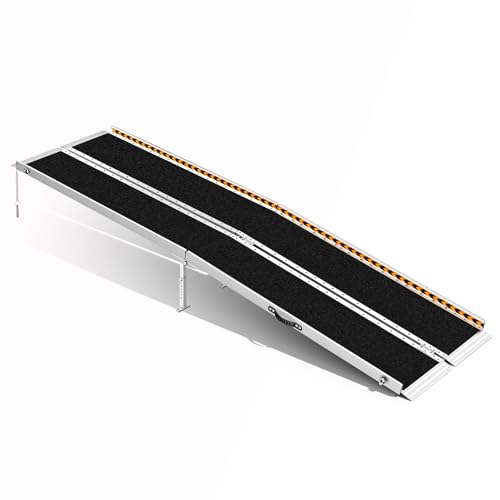
The best wheelchair ramps for safer access are long enough to keep the incline manageable, strong enough for the user and equipment together, and covered with a grippy surface that remains secure when wet.
For most homes, choose a ramp with a slope of about 1:12 to 1:8: a 12-inch rise needs roughly 12 to 18 feet of ramp. Shorter ramps may fit a doorway or vehicle better, but they create a steeper climb and require more control. Before buying, measure the rise, available run, doorway or vehicle opening, and the combined weight of the pet, wheelchair, carrier, or handler.
Our top picks


As an Amazon Associate we earn from qualifying purchases at no extra cost to you. Ratings are shown as listed on Amazon.
Best wheelchair ramp choices by situation
| Situation | Most suitable ramp type | Useful target specifications | Main compromise |
|---|---|---|---|
| Low doorstep or threshold | Threshold ramp | 1–4 inches high, 24–36 inches wide, 600–1,000 lb capacity | Not suitable for stairs or tall vehicle floors |
| Car, hatchback, or minivan | Folding or telescoping vehicle ramp | 6–10 feet long, 24–30 inches wide, 250–600 lb capacity | Longer models take more storage space |
| One or two porch steps | Single-fold or modular ramp | 6–12 feet long, 28–36 inches wide, 600–1,000 lb capacity | May need a landing area at the top and bottom |
| Frequent travel | Telescoping ramp | 5–8 feet long when extended, under 35 lb, carry handle | Moving sections can collect grit and need cleaning |
| Permanent home access | Modular or fixed ramp | 12–20 feet for a 12–18 inch rise, 30–36 inches wide | Requires more floor space and careful anchoring |
How long should a wheelchair ramp be?
Ramp length is the most important safety decision. Calculate it by dividing the vertical rise by the desired slope. A 1:12 slope means one inch of rise for every 12 inches of horizontal ramp length; a 1:8 slope means one inch of rise for every eight inches.
For example, suppose a vehicle floor is 24 inches above the ground. At a 1:12 slope, the ramp needs about 24 feet of horizontal run. That is usually impractical for a car, so a portable vehicle ramp may use a steeper 1:6 to 1:8 angle, provided the user can manage it and the manufacturer permits that setup. A 6-foot ramp at a 24-inch rise has a 1:3 slope, which is very steep and should not be treated as a general-purpose solution.
Pets using wheelchairs may have limited traction, balance, or pushing strength. A rehabilitation professional or veterinarian can help determine a manageable angle for an individual animal. Do not assume that a ramp safe for a strong, confident dog will suit a small dog, cat, senior animal, or pet with neurological or orthopedic limitations.
Weight limits: calculate the real load
Never size a ramp to the pet’s body weight alone. Add the wheelchair, harness, carrier, or any equipment that will travel on the ramp. A practical calculation is:
Required capacity = pet weight + equipment weight + safety margin.
For a 75-pound dog in a 15-pound wheelchair, a 25% margin produces a minimum target of 113 pounds. In practice, selecting a ramp rated for at least 250 pounds is sensible because dynamic loads are higher when a user starts, stops, turns, or shifts weight. For a person assisting alongside the pet, check whether the ramp’s capacity includes that person. Some products are designed for a wheelchair or mobility device but not for two users side by side.
Capacity also depends on support. A ramp spanning a vehicle doorway should sit securely on the ground and have a stable upper lip. A ramp that flexes noticeably may still be under its stated static limit, but repeated flexing can loosen hinges and fasteners over time.
Surface grip matters more than appearance
A smooth plastic or painted metal surface can become hazardous from rain, mud, condensation, or wet paws. Look for a full-length textured surface rather than small grip patches. Coarse carpet, rubberized tread, perforated metal, and molded traction patterns are common options.
- Textured plastic: light and easy to wash, but some patterns become slippery when worn smooth.
- Rubberized tread: generally quiet and comfortable, though it may crack or peel after prolonged outdoor exposure.
- Carpet or fabric: familiar to many pets and replaceable on some ramps, but it can hold moisture, hair, mud, and odors.
- Perforated metal: durable and weather resistant, but openings must be small enough that paws, wheels, or toes cannot catch.
Choose raised side rails when steering is difficult or the ramp will be used beside a drop. Rails should guide rather than pinch the wheelchair or harness. A ramp should also have a level, non-sliding contact point at both ends; excellent tread cannot compensate for a ramp that shifts.
Threshold fit: measure the obstacle, not the label
A “door ramp” or “threshold ramp” may be designed for only a small lip. Measure the exact height from the approach surface to the top of the threshold, including uneven flooring, door tracks, mats, and weather strips. Then measure the available depth. A short wedge may fit a 1-inch threshold but be too steep at 3 or 4 inches.
Check the clear width as well. The ramp should be wider than the wheelchair’s wheels or the pet’s natural path, with extra room for corrections. For many household setups, 28 to 36 inches is more forgiving than a narrow 20- to 24-inch model. Confirm that the door can open without striking the ramp, and remove loose mats that can slide under the approach.
Portability and storage: folding versus telescoping
Folding ramps are usually quicker to deploy and have fewer sliding tracks. They can be bulky when folded, particularly at lengths above 8 feet. Telescoping ramps often pack into a narrower shape and allow length adjustment, making them useful for different vehicles or heights. Their channels, latches, and end caps need more frequent inspection because grit can interfere with locking.
For regular travel, favor a ramp that one person can carry without twisting, has a positive locking mechanism, and includes a handle or strap. A ramp that is technically portable but too heavy to position safely may remain unused. If the ramp goes into a vehicle, measure the storage compartment before purchasing; folded length and folded thickness can matter more than the advertised extended length.
Setup checklist for safer use
- Measure the rise and calculate the slope. Do this at the actual location, since a curb, uneven ground, or vehicle suspension can change the angle.
- Inspect both contact points. The upper lip should sit fully on a strong surface, and the lower end should rest flat without rocking.
- Lock every hinge, latch, and telescoping section. Test the mechanism before placing weight on it.
- Prevent sideways movement. Use manufacturer-approved stabilizers or position the ramp against a secure structure; do not improvise with loose blocks.
- Practice at a low height. Allow the pet to walk across while supervised before using the ramp at a vehicle or staircase.
- Keep the path clear. Remove toys, loose rugs, ice, standing water, and anything that encourages a sudden stop.
Guide rather than pull a pet up the ramp. A properly fitted harness may provide control, but it should not be used to drag an animal that is frightened, fatigued, or unable to bear weight. Stop if the pet slips, refuses repeatedly, shows distress, or appears weaker afterward, and ask a veterinarian or qualified rehabilitation professional for advice.
Durability and ownership realities
The parts that usually wear first are fabric tread, rubber edge caps, hinge rivets, telescoping tracks, and non-slip feet. Inspect them weekly if the ramp is used daily, and before every trip if it is used occasionally. Look for loose fasteners, bent side rails, peeling tread, cracked plastic, corrosion, and end caps that no longer grip the ground.
Clean fabric or rubber surfaces according to the manufacturer’s instructions, using mild soap and water rather than harsh solvents. Dry the ramp fully before folding it to limit mildew and corrosion. Brush grit from telescoping channels and hinges; do not add lubricant unless the manufacturer specifies one, because oily residue can transfer to the traction surface. Store the ramp out of prolonged direct sunlight when possible, since ultraviolet exposure can make some plastics and fabrics brittle.
What is a reasonable price?
General market ranges in 2026 are approximately $30–$100 for small threshold ramps, $80–$250 for basic folding vehicle ramps, $150–$400 for longer telescoping ramps, and $300–$1,000 or more for heavy-duty modular systems. Price should reflect the required length, capacity, grip, and construction—not just the folding mechanism. Replacing a worn traction surface or adding a proper stabilizer can also be part of the ownership cost.
For occasional low thresholds, a correctly sized wedge is usually the simplest choice. For vehicle use, prioritize secure end support and manageable weight. For daily home access, a longer modular or fixed ramp is often more stable and comfortable than repeatedly deploying a short, steep portable model. The best wheelchair ramps are the ones that fit the measured rise, remain stable in real weather, and match the user’s strength, balance, and frequency of use.