Key takeaways
- Read the manual first. Heaters differ in how long to wait after placement before plugging in. Many makers advise waiting about 15 to 30 minutes so the glass can adjust to water temperature, but follow your model’s instructions.
- Place near flow. A filter outlet or powerhead helps spread warmth evenly.
- Use a GFCI outlet or protected circuit, and use a drip loop on the cord so water can’t run to the outlet. If you are unsure, ask a qualified electrician.
- Use a heater guard in tanks with large or aggressive fish.
- Unplug before maintenance and never run a heater out of water unless the maker states it is designed for it.
- Replace old heaters if they show cracks, corrosion or inconsistent temperature, because aging units can fail.
- Raise temperature slowly after a power outage or heater failure to avoid stressing animals.
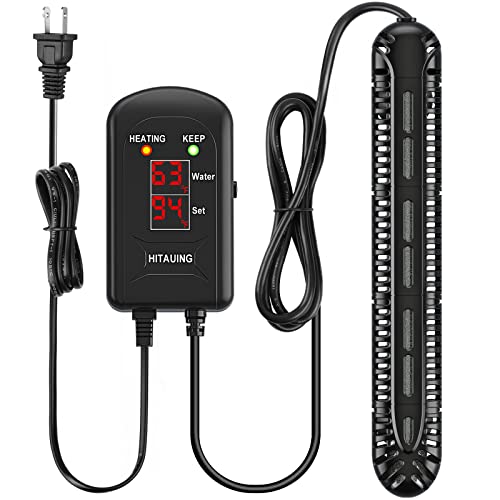
For a large aquarium, the best heater is usually a reputable adjustable-thermostat model from a brand such as Eheim Jager, Fluval, Cobalt Aquatics or Hydor, sized to your tank volume and ideally used as two smaller heaters rather than a single big one, so the tank keeps some warmth if one unit fails. Buyers with 75 to 125 gallons or more should pair the heater with an independent thermometer and read the maker’s manual before first use.
Large tanks hold heat well, but they also take longer to recover if a heater fails or the room gets cold. The aim is stable water temperature for your fish and invertebrates, not simply maximum wattage. Because heaters combine electricity and water, follow the manufacturer’s instructions closely and speak with a qualified electrician if you have any concerns about outlets, circuits or GFCI protection.
Our top picks


As an Amazon Associate we earn from qualifying purchases at no extra cost to you.
At a Glance: Heater Types for Large Tanks
| Model | Best for | Key stated points | Limits |
|---|---|---|---|
| Eheim Jager (adjustable thermostat) | General freshwater and saltwater tanks where a long-established design is preferred | The maker lists a built-in thermostat and a range of wattages; a long track record among hobbyists | Separate thermometer recommended; confirm current model and wattage options |
| Fluval M or E series | Buyers who want an external display or a compact submersible | The maker lists a shatter-resistant design on some models and a digital temperature readout on others | Not all models come in large wattages; check the tank-size chart |
| Cobalt Aquatics Neo-Therm | Reef and planted tank owners who want accurate temperature control | The maker lists a computer-controlled thermostat and an adjustable range | Mid-range to premium tier |
| Hydor in-line heater | Tanks with a canister filter or sump where heaters should not be in the tank | The maker describes an external heater that connects to filter hoses | Requires matching hose size and flow rate; installation is more involved |
| Inkbird or similar external controller with a heater | Owners wanting an independent safety backup | A separate thermostat controller can switch the heater off at a set temperature | Adds equipment and cost; correct wiring and setup matter |
How to Size a Heater
Many heater makers publish a rule of thumb of roughly 3 to 5 watts per gallon, with the lower end for rooms that stay warm and the higher end for cold rooms. For a 75-gallon tank, this works out to around 225 to 375 total watts, and for a 125-gallon tank around 375 to 625 watts. Use the maker’s chart for your specific model, since manufacturers publish their own sizing tables.
For large tanks, many hobbyists split the load between two heaters placed at opposite ends or in different flow areas. This helps spread warmth, reduces cold spots and gives you redundancy: if one heater sticks on or fails, the other one still provides some heat, and a stuck-on heater is less likely to overheat the whole tank because each one produces less output.
Features to Compare
Thermostat accuracy
Built-in thermostats can drift. Reviewers commonly advise running a separate digital thermometer, ideally on the opposite side of the tank, and adjusting the heater based on the real reading. A heater with a dial and no display is fine, as long as you check the temperature regularly.
Build and material
Heaters are usually glass, titanium or plastic-coated. Glass models are common and inexpensive but can break if bumped, especially in tanks with large fish or boisterous cichlids; many makers sell protective guards. Titanium and shatter-resistant designs are often chosen for rough tanks, though they may sit in a higher cost tier.
Auto shut-off and safety features
Several brands list features such as dry-run shut-off, thermal cut-out or automatic shut-off if the heater is out of water or overheats. Only rely on the specific protections the maker states for your exact model, and never assume a heater has them. Always unplug the heater before water changes and let it cool before removing it.
In-tank vs in-line
Submersible heaters sit in the tank, take up some room, and are visible. In-line heaters connect to a canister filter hose, removing the heater from view and protecting it from fish and decor, but they depend on a steady flow and good connections. For sumps, a heater placed in the sump chamber is common among reef keepers, again following the maker’s instructions.
Wattage options and length
Large tanks are tall or long, and the heater must fit. Submersible heaters should typically be fully underwater in a position with flow; a long, slim model can be installed diagonally in a tank that is shallow in height. Check the maker’s guidance on mounting and minimum water level.
Setup and Safety Notes
- Read the manual first. Heaters differ in how long to wait after placement before plugging in. Many makers advise waiting about 15 to 30 minutes so the glass can adjust to water temperature, but follow your model’s instructions.
- Place near flow. A filter outlet or powerhead helps spread warmth evenly.
- Use a GFCI outlet or protected circuit, and use a drip loop on the cord so water can’t run to the outlet. If you are unsure, ask a qualified electrician.
- Use a heater guard in tanks with large or aggressive fish.
- Unplug before maintenance and never run a heater out of water unless the maker states it is designed for it.
- Replace old heaters if they show cracks, corrosion or inconsistent temperature, because aging units can fail.
- Raise temperature slowly after a power outage or heater failure to avoid stressing animals.
Budget Tiers
| Tier | What you typically get | Trade-offs |
|---|---|---|
| Budget | Glass submersible with dial thermostat | Simple and effective; accuracy can drift; fragile |
| Mid-range | Branded adjustable heater with better thermostat, protective guards or digital display | More consistent; check wattage options for large tanks |
| Premium | Titanium or controller-based systems, in-line heaters, or dual heater setups | Higher cost; extra setup but better control and redundancy |
Pick X If… Decision Table
| Pick this | If your situation is |
|---|---|
| Eheim Jager | You want a proven, adjustable submersible for a general freshwater or saltwater tank |
| Fluval M or E series | You want a compact heater with a display or a shatter-resistant design |
| Cobalt Aquatics Neo-Therm | You run a reef or planted tank and want precise temperature control |
| Hydor in-line heater | You use a canister or sump and prefer a heater out of the tank |
| External controller plus heater | You want a backup layer against a stuck-on heater |
Alternatives
- Substrate heating cables. Used in some planted tanks; follow the maker’s instructions and consider whether they suit your layout.
- Room heating. In a fish room, heating the air can reduce the load on tank heaters, but it is a larger project and not a substitute for a thermometer.
- Multiple smaller heaters. Two or three moderate heaters across the tank offer redundancy and evenness.
Common Mistakes With Large-Tank Heaters
The most frequent problem is undersizing: a heater that is too weak runs constantly, never reaches the target in winter, and wears out sooner. The second is trusting the dial setting without checking against a thermometer, since the numbers printed on many dials are approximate. A third is placing the heater in a dead spot behind rockwork where water barely moves, which causes the thermostat to read a local temperature that does not represent the tank. Keep the heater in a clear area with flow, and keep decor from touching the glass.
Seasonal changes matter as well. A tank in a basement or garage can lose heat quickly on cold nights, so a heater that was fine in summer may need a second unit in winter. If you keep sensitive species such as discus or reef inhabitants, ask the livestock supplier or an experienced hobbyist about their temperature tolerance and how quickly changes can safely be made. Insulating the back and sides of the tank with foam sheets, as some hobbyists do, can reduce heat loss, but keep any insulation away from electrical parts and follow the tank maker’s advice.
Finally, plan for power cuts. Large tanks cool slowly, so a short outage is usually manageable if the lid stays on and the room is not freezing. For longer outages, hobbyists often wrap the tank in blankets and avoid feeding heavily until power returns.
Frequently Asked Questions
How many watts do I need for a 75-gallon tank?
Many makers suggest roughly 3 to 5 watts per gallon, which means around 225 to 375 watts, depending on room temperature and the temperature you want. Check the specific sizing chart for your heater, and consider splitting the load over two units.
Is it better to use two heaters?
Many hobbyists prefer two heaters for large tanks because they spread heat and provide a backup. Each one can be smaller, so a single failure is less likely to be a full loss of heat or an overheat.
How do I know the heater is working correctly?
Use an independent thermometer and watch the temperature over several days. If the reading is steadily above or below your target, adjust the dial or ask the maker for guidance. Replace the heater if it behaves erratically.
Can I leave a heater plugged in during water changes?
Most makers advise unplugging the heater and letting it cool before taking it out of the water. Leaving it on while the water level falls can damage the unit or create a safety risk.
Are in-line heaters better than submersible ones?
They keep equipment out of the tank and away from fish, but they need compatible filter hoses and enough flow. Submersible heaters are simpler and cheaper, so the better choice depends on your filter system.
When should I replace a heater?
Replace it if it has cracks, rusted parts, a faulty thermostat or inconsistent output. Many hobbyists replace heaters every few years as a precaution, though the right interval depends on the model and the maker’s guidance.