Key takeaways
- Ask your vet about portion sizes, feeding frequency and any special diet. Do not guess calorie needs.
- Never leave cats solely dependent on a machine for more than a day or two; arrange a person to check in.
- Wash bowls and parts regularly to reduce bacteria. Throw away old food.
- Keep cords out of reach, and follow the manual for batteries and power.
- Watch for weight changes, appetite changes or vomiting, and tell your vet if they occur.
- Cats on medical diets should be monitored closely; a feeder does not replace vet supervision.
For households with several cats, the best smart feeder is a microchip- or tag-recognizing model, such as the Sure Petcare SureFeed Microchip Pet Feeder, because it opens only for the cat it is programmed for; timed multi-meal dispensers from Petlibro, Whisker and Petkit suit homes where cats eat the same food, and separate feeders per cat are the fallback when diets differ. The right choice depends on whether your cats share a diet, whether one cat steals food, and whether you need app control.
This guide compares the main kinds of smart feeders for multi-cat homes, what to look for in specifications, and the trade-offs by budget tier. Feature lists reflect what makers typically publish; models and apps change often, so confirm current details on the maker’s page before buying. Talk to your vet about portion sizes and any special diet.
Our top picks


As an Amazon Associate we earn from qualifying purchases at no extra cost to you.
At a Glance: Smart Feeder Types for Multiple Cats
| Type | Best for | Typical stated features | Limits |
|---|---|---|---|
| Microchip or tag feeder (Sure Petcare SureFeed) | Cats on different diets, food thieves, medical diets | Opens for registered microchip or collar tag, wet or dry bowls | One cat per bowl; manual filling; premium tier |
| Multi-meal app feeder (Petlibro, Petkit, Whisker Feeder-Robot) | Cats sharing a diet, busy owners | Scheduled portions, app control, some with cameras | Cannot tell cats apart; fastest eater may take the food |
| Dual-bowl or multi-tray timed feeder | Wet food with several cats | Compartments open on a timer | Limited capacity; cleaning is more work |
| Gravity feeder | Free-feeding households | No electronics, large capacity | No portion control; poor choice for cats that overeat |
| Multiple individual smart feeders | Different diets without microchip | One feeder per cat, individual schedules | Space and cost; cats may swap bowls |
The Core Problem With Several Cats
Most automatic feeders dispense into a bowl that any cat can reach. In homes with two or more cats, a quick eater can take another’s meal, and a cat on a prescription diet can sneak a neighbor’s food. Feeders that recognize an individual cat solve this, but they cost more and typically feed one cat each. Multi-meal schedule feeders solve the timing issue but not the competition. The right type depends on how serious the mismatch between your cats is.
What to Look For
Cat recognition
Microchip readers and collar tags allow the feeder to open only for registered cats. The Sure Petcare SureFeed is the best-known example, with the maker describing a lid that opens for programmed microchips or a compatible tag. Check whether your cats’ existing microchips are compatible, and whether the feeder supports your cats’ sizes and habits.
Portion control and scheduling
Look for adjustable portion sizes and the number of daily meals. App-based models let you change schedules remotely, which is useful for travel. Make sure the unit handles the kibble size your cats eat; some feeders jam on large or irregular pieces.
Wet versus dry food
Dry food feeders use hoppers and rotating mechanisms. Wet food feeders rely on sealed trays, microchip lids or insulated compartments. Wet food should not sit out for long, so check what the maker states about how long food stays fresh and how often to refill.
Capacity
Larger hoppers mean fewer refills but greater risk that stale food remains inside. Cats eating from a shared hopper will deplete it faster, so match capacity to the number of cats and the length of your trips.
Power and backup
Many feeders use mains power plus batteries as backup. If the power or Wi-Fi fails, a good feeder continues its schedule from onboard memory. Check what the maker says about backup behavior, and never rely on one device for a long absence without a plan for a helper.
App and connectivity
Wi-Fi apps provide scheduling, feeding history and alerts. Reviewers often point to app stability and long-term support as real concerns, so look at recent feedback. Some brands offer optional cloud features or cameras.
Cleaning and materials
Stainless steel or ceramic bowls are generally easier to keep clean than plastic, which can retain odors and scratch. Look for removable parts that can be washed and dried. Clean the feeder regularly according to the manual.
Cat behavior
Some cats paw at lids, tip feeders or try to break in. A heavy, stable unit and a lid that locks reduce the problem. If your cats learn to wait by the feeder, expect some stress if the schedule changes.
Options in More Detail
Sure Petcare SureFeed Microchip Pet Feeder
This is the usual recommendation when cats have different diets. The maker describes a feeder that reads a cat’s microchip or a compatible collar tag and opens the bowl lid only for registered pets. Reviewers generally praise its ability to stop food theft but note that it holds a small amount of food, needs refilling, and is more expensive than timed feeders. A Wi-Fi connected version is also sold by the maker.
Petlibro feeders
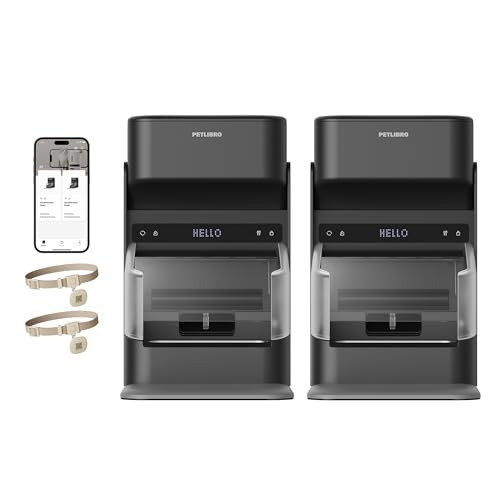
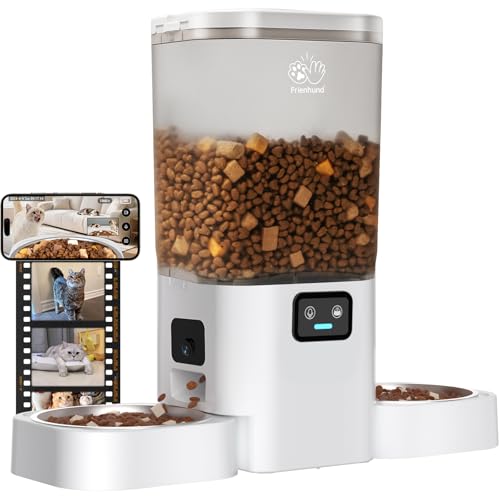
Petlibro offers a range of app-controlled dry food feeders, some with cameras and some with dual-hopper designs. They are generally mid-range, and are usually better for homes where cats share one diet than for homes with competing or restricted cats.
Whisker Feeder-Robot
The Feeder-Robot is a Wi-Fi feeder with a rotating compartment system, designed to portion meals through an app. The maker describes multi-meal scheduling and compatibility with its app. It is aimed at owners who want scheduling, not individual recognition.
Petkit feeders
Petkit sells app-connected feeders across several price points, some with dual-tray or camera options. As with other schedule-only feeders, they do not identify individual cats.
Gravity and basic timed feeders
Basic dispensers cost the least and suit cats that self-regulate. They give poor control for cats that overeat, so they are a risky choice for multi-cat homes with weight concerns.
Budget Tiers
| Tier | What you typically get | Trade-offs |
|---|---|---|
| Budget | Gravity feeders, basic timed dispensers | No cat recognition; limited portion control |
| Mid-range | Wi-Fi app feeders with schedules, some with cameras | Cannot tell cats apart; app quality varies |
| Premium | Microchip or tag-recognizing feeders | One cat per bowl, refilling, higher cost |
Pick X If… Decision Table
| If your situation is… | Pick |
|---|---|
| Cats on different diets or one on a prescription diet | Microchip or tag feeder, one per cat |
| One cat steals food | Microchip feeder for the thief and the victim |
| Cats share the same food and eat politely | Mid-range app feeder with a multi-meal schedule |
| You travel and want remote control | Wi-Fi feeder with a camera and backup power |
| Wet food only | Timed wet food feeder or microchip wet-food model |
| Tight budget, cats self-regulate | Gravity feeder, with supervision |
Safety and Health Notes
- Ask your vet about portion sizes, feeding frequency and any special diet. Do not guess calorie needs.
- Never leave cats solely dependent on a machine for more than a day or two; arrange a person to check in.
- Wash bowls and parts regularly to reduce bacteria. Throw away old food.
- Keep cords out of reach, and follow the manual for batteries and power.
- Watch for weight changes, appetite changes or vomiting, and tell your vet if they occur.
- Cats on medical diets should be monitored closely; a feeder does not replace vet supervision.
Alternatives
- Separate feeding rooms: Feed cats in different rooms with doors closed during meals. No gadget needed.
- Puzzle feeders and slow bowls: Slow eaters and food-motivated cats benefit, and it can reduce competition.
- Pet sitter or neighbor: For longer trips, a human check is the most reliable backup.
Introducing a New Feeder to Your Cats
Cats are creatures of routine, so introduce a feeder gradually. Run it empty for a day or two so the sounds become familiar, then place a few treats in the bowl while the lid is open. If the model uses a microchip or tag, follow the maker’s registration steps for each cat and keep the lid open at first. Keep the old bowl nearby during the transition, and avoid moving the feeder to a new spot once cats learn it. Place feeders away from litter boxes and loud appliances, and give timid cats a quiet corner so bolder cats cannot guard the area. Watch each cat’s appetite and weight over the first few weeks and tell your vet about any changes.
Frequently Asked Questions
Can one smart feeder feed two cats on different diets?
Not reliably unless it recognizes each cat. A microchip or tag feeder can open for one registered cat only, so use one per cat. Schedule-only feeders cannot tell which cat is eating.
Do microchip feeders work with any cat microchip?
Makers generally state compatibility with common microchip standards, but you should confirm that your cats’ chips are supported before buying. If a chip is not readable, a collar tag option may be available.
How do I stop one cat eating another’s food?
Options include microchip feeders, feeding in separate rooms, or supervised mealtimes. Timed feeders alone do not solve the problem when cats share a bowl.
Are smart feeders safe to rely on while I travel?
They help, but they can fail from jams, power cuts or Wi-Fi problems. For anything longer than a short trip, arrange a backup person and test the feeder well before you leave.
Can smart feeders handle wet food?
Some models do, using sealed trays or microchip lids, but wet food spoils quickly, so follow the maker’s stated time limits. Dry food is easier for multi-day automation.
How often should I clean a feeder?
Wash removable parts regularly, often several times a week for wet food and at least weekly for dry, depending on the maker’s guidance. Dry fully before reassembling to prevent mold.