Key takeaways
- Tube length and diameter. A longer tube reaches deep tanks. A wider tube moves water faster but can pull up fine sand or small fish and shrimp. Many makers sell several tube lengths for different tank heights.
- Hose length. Check the maker’s listed hose length against the distance from your tank to the nearest drain.
- Faucet adapter fit. Faucet-driven systems rely on an adapter that fits standard threaded faucets. Many sinks have pull-out, non-threaded or specialty faucets that need a different adapter.
- Substrate type. Gravel is easy to vacuum. Sand needs a lower flow or a technique of hovering above the surface. Planted tanks need gentle cleaning to avoid uprooting plants.
- Flow control. A valve or squeezable bulb helps start or pause the siphon.
- Debris screens. Some models include a screen or guard to help keep gravel, shrimp and small fish from being pulled up.
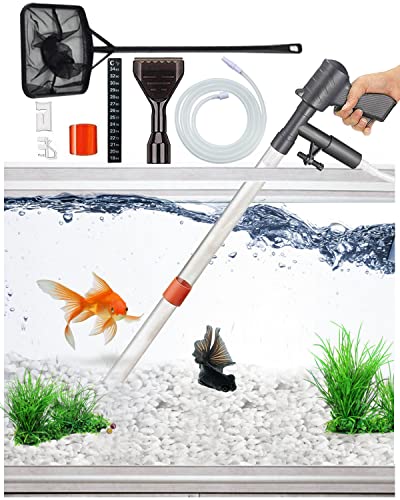
For large tanks, a hose-based siphon vacuum that connects to a faucet or a long drain hose, such as the Python Pro-Clean line, suits owners who want fast water changes, while a standalone gravity siphon with a wide tube suits tanks that sit far from a sink, and a battery or electric vacuum suits people who cannot lift buckets. The best choice depends mainly on tank depth, water volume, substrate type and how you plan to move the old water out of the house.
Our top picks



As an Amazon Associate we earn from qualifying purchases at no extra cost to you.
What changes when the tank is large
A gravel vacuum is a tube that draws debris from the substrate while the water flows out. On a small tank, a short siphon and a bucket are enough. On a large tank, typically from roughly the 75 gallon range upward, three problems appear. The tube must reach the bottom of a deep tank without making you submerge your arm to the shoulder. The flow must be fast enough to clean a wide substrate in reasonable time. And you need a way to move dozens of gallons of water without carrying heavy buckets.
That is why large-tank owners usually choose between a tube plus long hose that drains to a sink, toilet, tub or outdoor area, and a hose system that both drains and refills through a faucet adapter. Both are covered below, along with a few simpler alternatives.
Key features to check
- Tube length and diameter. A longer tube reaches deep tanks. A wider tube moves water faster but can pull up fine sand or small fish and shrimp. Many makers sell several tube lengths for different tank heights.
- Hose length. Check the maker’s listed hose length against the distance from your tank to the nearest drain.
- Faucet adapter fit. Faucet-driven systems rely on an adapter that fits standard threaded faucets. Many sinks have pull-out, non-threaded or specialty faucets that need a different adapter.
- Substrate type. Gravel is easy to vacuum. Sand needs a lower flow or a technique of hovering above the surface. Planted tanks need gentle cleaning to avoid uprooting plants.
- Flow control. A valve or squeezable bulb helps start or pause the siphon.
- Debris screens. Some models include a screen or guard to help keep gravel, shrimp and small fish from being pulled up.
At a glance: options for large tanks
| Option | Best for | Key stated traits | Limits |
|---|---|---|---|
| Python Pro-Clean gravel washer and siphon kits | Large tanks near a sink, frequent big water changes | The maker lists a gravel tube, a long hose and a faucet-connected system for draining and refilling, in several hose lengths | Needs a compatible faucet; some sinks need extra adapters; hose storage is bulky |
| Long-tube gravity siphon kits from Aqueon, Fluval and similar brands | Tanks away from a sink, owners who prefer bucket or drain hose draining | Makers list several tube lengths and a bulb or pump to start the siphon | Slower for very large tanks; needs a lower drain point or bucket |
| Laing and other wide-tube professional style siphons | Wide, deep tanks with sturdy substrate | Makers list larger tube diameters for faster flow | May pull sand or livestock; confirm tube length for your tank height |
| Battery or electric gravel cleaners | Owners with limited lifting ability, small to medium large tanks | Makers list a motor-driven pump that removes water without siphon priming | Battery life, filter bag capacity and reach vary; often less suited to very large volumes |
| Combination kits with sand-vac tubes | Mixed or sand-substrate tanks | Makers list adjustable flow or sand-friendly tube designs | Higher cost; check maker’s compatibility with your hose |
Budget tiers and trade-offs
Budget: A basic gravity siphon kit with a bulb starter is the entry point. It works well on shallow tanks and lighter cleaning, but the narrow tubes and short hoses are slow on large tanks. You will likely carry buckets.
Mid-range: Longer tubes and longer hoses, often sold separately by brand, give the best balance for most large-tank owners. You can run the hose to a drain without carrying anything.
Premium: Faucet-driven systems and electric models cost more, but they cut the time and effort of water changes substantially. Reviewers tend to rate faucet systems highly for convenience, while noting that adapter fit is the common failure point.
Safety, water and care notes
- Follow the maker’s instructions on faucet adapters. Never leave a faucet-driven system unattended during a refill, because the tank can overflow if the flow is not shut off.
- Use a water conditioner that removes chlorine and chloramine when refilling, and match the temperature of new water to the tank, as aquarium care guides suggest.
- Turn off heaters and filters during large water changes if the water level will drop below their minimum, following the manufacturer’s manual. Exposed heaters can be damaged.
- Keep electrical cords and plugs dry and use drip loops. If you use a battery or electric cleaner, make sure it is rated for use around water, as the maker states.
- Avoid vacuuming deeply into every inch of substrate at once in an established tank. Many aquarists clean part of the substrate each time to preserve beneficial bacteria, a common recommendation from hobby sources.
- Rinse tools in clean water only and keep them separate from household cleaning chemicals.
How to match the tool to the tank
Deep tanks and tall tanks
Choose the longest tube the maker offers and check that the hose is long enough. Some tall tanks, such as those over two feet deep, need extension tubes. A good trick is to measure from the top rim to the substrate before buying.
Sand substrate
Sand lifts easily into the tube. Choose a model with adjustable flow or a narrower tube, or hover the tube above the surface and let debris rise into the siphon. Makers of sand-focused tools list designs that reduce sand loss.
Planted tanks
Planted tanks benefit from partial cleaning and gentle flow. Avoid deep plunging into root zones, and consider cleaning only open areas.
Tanks with shrimp or small fish
Wide tubes may draw livestock. Use a mesh guard or a smaller tube, or chase fish away before vacuuming.
Pick X if …
| If you … | Pick | Why |
|---|---|---|
| Change big volumes often and have a compatible faucet | Python Pro-Clean style faucet system | Drain and refill without buckets |
| Are far from a sink or cannot use a faucet adapter | Long-tube gravity siphon with a long drain hose | Simple, no plumbing connection |
| Have a wide, deep tank with gravel | Wide-tube professional siphon | Faster flow across a large area |
| Have difficulty lifting or bending | Battery or electric cleaner | Removes priming and reduces lifting |
| Keep sand or shrimp | Narrower tube or sand-specific model | Less loss of substrate and livestock |
Alternatives worth considering
- Pump-style water change systems. A small submersible pump with a long hose can move water without a siphon, which suits tanks above or below the drain level.
- Manual hand-held siphons with a bulb. These are inexpensive and adequate for spot cleaning between larger changes.
- Bottom-feeding clean-up crew. Snails or bottom-feeding fish can help, but they do not replace regular substrate cleaning and water changes.
- Substrate with a lower waste trap. Some aquarists use larger, smoother gravel that traps less waste, though this is a longer-term change.
Frequently Asked Questions
How often should I vacuum the gravel in a large tank?
Many hobby guides suggest cleaning part of the substrate during each regular water change, often weekly or every two weeks, depending on stocking and feeding. Heavily stocked tanks may need it more often. Follow what suits your tank’s waste load and avoid cleaning the entire substrate at once in an established tank.
Will a gravel vacuum remove beneficial bacteria?
Some bacteria live in the substrate, but most of the biological filtration is in the filter media. Cleaning part of the gravel at a time is the common way to reduce disturbance. If you ever replace filter media, do so gradually and test water as the maker and hobby guides suggest.
Can I use a gravel vacuum on a sand tank?
Yes, with care. Use lower flow or a narrower tube and keep the tube above the sand surface so only debris lifts. Some makers sell sand-focused tubes for this reason.
What hose length do I need?
Measure from the tank to the drain or sink and add some extra for slack. Makers sell several hose lengths, and a faucet-driven system must also reach the faucet. Longer hoses move water more slowly, so a hose that is far longer than necessary can lengthen the job.
Is it safe to leave a faucet-connected refill running?
Do not leave it unattended. Faucet systems can overflow a tank if you forget to switch the valve or turn off the water. Follow the maker’s instructions and stay nearby until the refill is done.
Do I need to turn off the heater and filter?
If the water level drops below the minimum for either device, turn it off first, as most manuals advise. Turn them back on only after the water has been refilled. Always check the specific manual for your equipment.