Key takeaways
- Measure with the dog standing or supported in a natural stance. Follow the specific maker’s measuring guide, because each company uses its own points.
- Check the saddle or support ring. It should hold the pelvis without pressing on the belly, spine or groin. Look for any pinching when the dog sits or lies down in the cart.
- Look at wheel size and tire type. Larger or air-filled wheels roll more smoothly over grass, gravel and uneven ground. Small hard wheels suit smooth floors and short walks.
- Confirm the cart leaves room for toileting. Many designs are meant to let dogs urinate and defecate without removing the cart, but a veterinarian can advise on hygiene and skin care.
- Watch the dog’s posture. The back should stay roughly level. If the dog hunches, drags the front feet or leans hard to one side, stop and get the fit reviewed.
For most large dogs with weak or paralyzed back legs, a custom-measured cart from an established maker such as Walkin’ Wheels, Eddie’s Wheels or Best Friend Mobility is the safer choice, while an adjustable off-the-shelf cart suits owners who need a short-term or lower-cost option and a dog that is already comfortable with a harness. The right pick depends on your dog’s weight, which legs are affected, how the dog’s body is shaped, and whether a veterinarian or rehabilitation specialist has cleared the dog for a cart.
A wheelchair, also called a mobility cart, is a medical-adjacent device. It should not be chosen on size alone. Large and giant breeds put a lot of load on the frame, the axle and the harness points, so poor fit can cause rubbing, pressure sores, or strain on joints that are already compromised. Before buying anything, talk to your veterinarian or a canine rehabilitation practitioner about whether a cart is appropriate, which type (rear support, front support or four-wheel), and how long each session should be.
Our top picks


As an Amazon Associate we earn from qualifying purchases at no extra cost to you.
At a Glance: Dog Wheelchair Options for Large Breeds
| Option | Best for | Key stated features | Limits |
|---|---|---|---|
| Walkin’ Wheels (Walkin’ Pets) | Large and giant dogs needing a custom rear-support or full-support cart | The maker offers measured-to-fit frames in lightweight aluminum, with options for rear, front and four-wheel designs | Premium tier; ordering takes measuring and lead time |
| Eddie’s Wheels | Dogs with long-term paralysis, amputation or degenerative conditions | The maker describes custom-built carts based on owner-supplied measurements and photos, with rear, front and quad styles | Premium tier; made to order, so no quick swap |
| Best Friend Mobility | Owners who want a custom option with adjustable features and a wide range of sizes | The maker lists custom-fit carts for different mobility needs including rear and quad designs | Mid-range to premium tier; measuring accuracy matters |
| Adjustable rear-support carts from general pet brands | Short-term use, recovering dogs, or a trial before committing to custom | Typically a height-adjustable aluminum frame with a hip or saddle support and two wheels | Budget to mid-range tier; weight ratings and fit vary a lot by model |
| Support or lifting harnesses | Dogs that are weak but still use their legs | Handle-equipped harnesses help you assist a dog on stairs or when standing up | Not a wheelchair; you carry part of the weight |
Understanding the Types of Cart
Rear-support carts
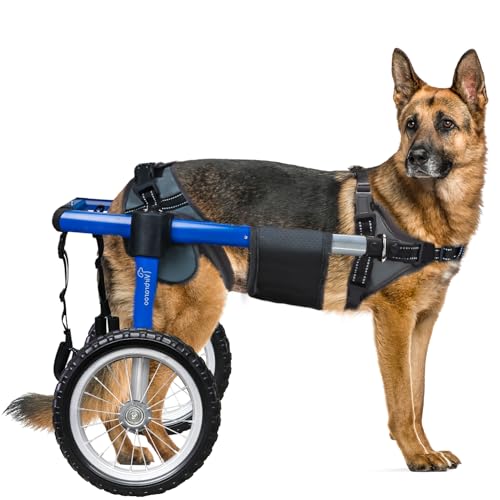
These are the most common. The dog’s hind end rests in a saddle or ring while the front legs walk normally, and the wheels carry the back. They suit dogs with hind-limb weakness, paralysis from spinal conditions, or after surgery, provided the front legs and shoulders are strong. Large dogs with healthy front legs often do well, but dogs with elbow or shoulder problems can struggle.
Front-support carts
A front-support cart lifts the chest and takes pressure off weak front legs. These are less common and are usually custom-built, so they are most often offered by the specialist makers rather than general pet brands.
Four-wheel (quad) carts
Dogs with weakness in all four limbs may need a quad cart that supports both ends. These are more complex, heavier and almost always custom. Most large dogs that need one will have been assessed by a veterinary specialist first.
Custom vs Adjustable: The Main Trade-off
Custom carts are built from measurements you take at home, which usually include body length, height from the floor to the hip or shoulder, chest and body width, and sometimes photos. Makers such as Walkin’ Wheels, Eddie’s Wheels and Best Friend Mobility publish measuring instructions on their own websites and typically offer support staff to review them. The benefit is a frame matched to your dog’s proportions, which matters for deep-chested breeds, long-bodied dogs and animals with unusual limb lengths. The cost is a higher price tier and a wait while the cart is built.
Adjustable carts are built in a few standard sizes with sliding or telescoping parts so one frame can cover a range of body sizes. They are a reasonable fit for dogs with a conventional build, and they can be a practical choice when the condition is temporary, such as recovery after surgery, or when you want to see how your dog reacts to wheels before spending more. For giant breeds, read the weight rating carefully: a frame designed for medium dogs and stretched to its limit can flex, wobble or tip.
How to Measure and Check Fit
- Measure with the dog standing or supported in a natural stance. Follow the specific maker’s measuring guide, because each company uses its own points.
- Check the saddle or support ring. It should hold the pelvis without pressing on the belly, spine or groin. Look for any pinching when the dog sits or lies down in the cart.
- Look at wheel size and tire type. Larger or air-filled wheels roll more smoothly over grass, gravel and uneven ground. Small hard wheels suit smooth floors and short walks.
- Confirm the cart leaves room for toileting. Many designs are meant to let dogs urinate and defecate without removing the cart, but a veterinarian can advise on hygiene and skin care.
- Watch the dog’s posture. The back should stay roughly level. If the dog hunches, drags the front feet or leans hard to one side, stop and get the fit reviewed.
Safety and Care Notes
Start with short sessions on a flat, supervised surface. Many rehabilitation practitioners advise gradually extending time as the dog builds strength and confidence. Never leave a dog unattended in a cart, and do not use it near stairs, pools, or steep slopes unless the maker states it is designed for that.
Inspect the dog’s skin after each use, especially around the inner thighs, belly, armpits and anywhere a strap or pad touches. Dogs with reduced sensation may not show discomfort, so redness, hair loss or raw spots need prompt attention from your veterinarian. Keep the harness and padding clean and dry, tighten any hardware according to the maker’s manual, and replace worn padding or tires. Dogs that cannot control their bladder or bowels need extra hygiene care whether or not they use a cart.
A cart does not treat the underlying condition. It can help a dog stay active and maintain muscle in its working limbs, but the decision about whether and how much to use one belongs with your veterinary team.
Budget Tiers Compared
| Tier | What you typically get | Trade-offs |
|---|---|---|
| Budget | Adjustable rear-support frame, basic padding, fixed wheel type | Check the weight limit; fit may be approximate; fewer replacement parts |
| Mid-range | Better adjustability, sturdier aluminum, upgraded padding or wheel choices | Still a standard shape, so unusual builds may not fit well |
| Premium | Custom-measured frame, choice of cart type, support from the maker, replaceable parts | Highest cost and lead time; best fit for large breeds and long-term use |
Pick X If… Decision Table
| Pick this | If your situation is |
|---|---|
| Walkin’ Wheels | You have a large or giant dog and want a custom-fit aluminum cart, possibly with options beyond rear support |
| Eddie’s Wheels | Your dog has a long-term condition and your veterinarian wants a carefully fitted device from a long-established specialist |
| Best Friend Mobility | You want a custom cart and appreciate adjustable features as your dog’s needs change |
| Adjustable general-brand cart | You need a short-term or trial option and your dog has a standard build within the stated weight range |
| Support harness | Your dog can still bear weight and mainly needs help standing or climbing steps |
Alternatives to a Wheelchair
- Lifting and support harnesses. Rear-end or full-body harnesses with a handle, such as those from Ruffwear and Help ‘Em Up, let you take some weight off a wobbly dog on walks and stairs.
- Ramps and non-slip flooring. Runners, mats and pet ramps reduce slips and the strain of climbing into cars or onto furniture.
- Rehabilitation therapy. Underwater treadmill work, guided exercises and laser or acupuncture services, where a veterinarian approves them, can complement mobility aids.
- Orthopedic beds and joint-support braces. For arthritis or mild instability, a veterinarian may suggest a brace or supportive bedding before a cart.
Frequently Asked Questions
How do I know if my large dog needs a wheelchair?
Dogs that drag their hind feet, collapse when walking, or cannot stand without help should see a veterinarian promptly. The veterinarian can say whether the cause is reversible, whether a cart is appropriate, and which type would fit.
Can a very heavy dog use a cart?
Many makers offer sizes for large and giant breeds, but each model has its own weight rating. Read the stated limit, measure precisely, and ask the maker if your dog is near the top of the range.
How long can a dog stay in the cart?
There is no universal time. Veterinary and rehabilitation professionals commonly advise short sessions at first and building up as the dog tolerates it. Stop if the dog tires, pants heavily or shows skin irritation.
Is a custom cart worth it compared with an adjustable one?
For long-term use, giant breeds, or unusual body shapes, a custom cart usually fits better and is easier to adjust over time. For short-term recovery or a standard build, an adjustable cart can be enough.
Can my dog go to the toilet in the cart?
Most carts are designed so the dog can pass urine and stool while supported, but the exact design varies. Clean the dog and the saddle area after toileting, and ask your veterinarian about skin care if the dog is incontinent.
Will my dog get used to wearing it?
Many dogs adapt within days to weeks when introduced slowly with treats and short sessions. If a dog is frightened or refuses to move, pause and speak with a veterinarian or trainer before continuing.