Key takeaways
- Best all-around freshwater spinning reel: a 2500–3000-size reel such as the Shimano Stradic FM 2500 or 3000.
- Best value for freshwater and occasional saltwater: a sealed or well-protected 3000–4000-size reel such as the Penn Battle IV.
- Best surf and inshore saltwater choice: a corrosion-resistant 4000–6000-size spinning reel such as the Daiwa BG or Penn Spinfisher VII, selected according to target species.
- Best for serious surf and boat use: a Van Staal VR or VS-series sealed spinning reel when water exposure and durability matter more than low weight.
- Best baitcaster for bass and freshwater lure fishing: a low-profile reel such as the Shimano Curado 150 MGL or Daiwa Tatula 100.
The best fishing reels depend on where you fish and what you are targeting: choose a spinning reel for versatility, a baitcaster for controlled casting and lure accuracy, a conventional reel for heavy saltwater work, and a fly reel for lightweight presentation.
Our top picks
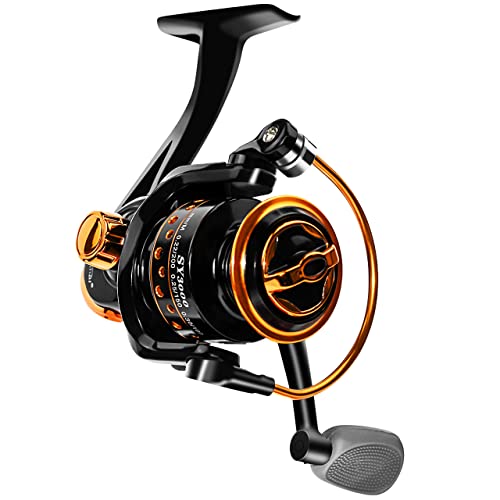


As an Amazon Associate we earn from qualifying purchases at no extra cost to you. Ratings are shown as listed on Amazon.
Quick picks by fishing situation
- Best all-around freshwater spinning reel: a 2500–3000-size reel such as the Shimano Stradic FM 2500 or 3000.
- Best value for freshwater and occasional saltwater: a sealed or well-protected 3000–4000-size reel such as the Penn Battle IV.
- Best surf and inshore saltwater choice: a corrosion-resistant 4000–6000-size spinning reel such as the Daiwa BG or Penn Spinfisher VII, selected according to target species.
- Best for serious surf and boat use: a Van Staal VR or VS-series sealed spinning reel when water exposure and durability matter more than low weight.
- Best baitcaster for bass and freshwater lure fishing: a low-profile reel such as the Shimano Curado 150 MGL or Daiwa Tatula 100.
How to choose the best fishing reels
1. Match the reel type to the fishing style
Spinning reels are the safest choice for beginners and for anglers who switch between live bait, small lures, and light line. They cast light presentations well, tolerate minor casting errors, and work with monofilament, fluorocarbon, and braided line. A 1000–2500 size suits panfish, trout, and finesse bass; 3000–4000 covers general bass, walleye, redfish, and inshore use; 5000–8000 is more appropriate for larger saltwater fish.
Baitcasting reels provide excellent thumb control, direct power, and accurate lure placement. They are especially effective for bass, pike, muskie, and heavier freshwater lures. The trade-off is a learning curve: incorrect spool tension or braking can produce a backlash. They are usually a poor first choice for very light lures unless specifically designed for bait finesse.
Conventional reels are built for heavy line, substantial drag, and high-capacity applications such as trolling, bottom fishing, and offshore work. Star-drag models are mechanically simple; lever-drag models make it easier to adjust pressure while fighting a fish. Their size and casting technique make them less convenient for casual freshwater fishing.
Fly reels primarily store line and provide drag. The rod and fly line do most of the casting. Choose one that balances the rod and holds the stated weight of backing plus fly line, rather than selecting it by maximum drag alone.
2. Choose gear ratio for lure speed and control
Gear ratio describes how many times the spool or rotor turns with one handle revolution. A low ratio, roughly 4.9:1 to 5.4:1, increases cranking power and helps retrieve deep-diving crankbaits, heavy rigs, and large bait. A middle ratio around 5.6:1 to 6.4:1 is the most versatile choice for general bass and multispecies fishing. High-speed reels, commonly 7.0:1 to 8.5:1 in baitcasters, pick up line quickly for topwater, flipping, and taking up slack after a long cast.
High speed does not automatically mean a faster lure. Spool diameter and the amount of line remaining on the spool also affect inches of line recovered per handle turn. For an all-purpose reel, prioritize smooth operation and adequate torque over the highest printed ratio.
3. Size the drag to the fish and the line
Maximum drag is not a target setting. Most fish are fought with substantially less pressure so the line, knots, hooks, and rod are not overloaded. A useful rule is to begin around one-quarter to one-third of the line’s rated strength, then adjust for current, structure, hook size, and the fish’s behavior.
For example, 20-pound braided line does not mean the reel must deliver 20 pounds of drag. If the leader, knot, or rod is rated lower, that component becomes the limiting factor. A reel advertised with 15–25 pounds of maximum drag is generally adequate for many inshore applications, while large offshore reels may offer 30 pounds or more. Smooth startup is often more valuable than an impressive maximum number.
4. Check line capacity rather than reel size alone
Braid has a smaller diameter than monofilament of the same breaking strength, so a spool may hold considerably more braid than the printed mono capacity suggests. Look for a capacity listing that includes braid diameter or a braid-specific rating.
Typical freshwater examples include 100–150 yards of 6–10-pound braid on a 2000–2500 spinning reel and 120–150 yards of 20–30-pound braid on a 100–150-size baitcaster. For inshore saltwater, 200–300 yards of 20–30-pound braid on a 4000–5000 spinning reel provides useful reserve when a fish runs or when fishing around current. Heavy surf and offshore species may require 300 yards or more.
Comparison of useful reel categories
| Reel category | Typical size | Typical weight | Useful line capacity | Typical drag range | Best application |
|---|---|---|---|---|---|
| Light spinning | 1000–2500 | 7–10 oz | 100–150 yd of 6–10 lb braid | 6–20 lb maximum | Trout, panfish, finesse bass |
| General spinning | 2500–4000 | 8–12 oz | 150–250 yd of 10–20 lb braid | 10–25 lb maximum | Bass, walleye, redfish, inshore use |
| Large spinning | 5000–8000 | 12–24 oz | 250–400 yd of 20–40 lb braid | 20–40 lb maximum | Surf, striped bass, larger inshore fish |
| Low-profile baitcaster | 70–200 | 6–9 oz | 100–150 yd of 12–30 lb braid | 10–25 lb maximum | Bass, pike, precise lure casting |
| Conventional offshore | 20–50 class | 18–45 oz | 300–800 yd of 30–80 lb braid | 20–60 lb maximum | Trolling, bottom fishing, offshore species |
These are planning ranges, not universal standards. Manufacturers measure capacity using different line diameters, and actual weight varies by model, handle, spool, and sealing system.
Freshwater versus saltwater construction
Saltwater reels need more than a corrosion-resistant nameplate. Look for sealed or shielded bearings, protected drag components, anodized aluminum where appropriate, stainless hardware, and a body that limits water entry. A fully sealed reel can be heavier and more expensive, but it is valuable for surf spray, wading, kayak fishing, and repeated exposure.
Do not assume a saltwater-capable reel is maintenance-free. After saltwater use, tighten the drag, rinse the exterior gently with fresh water, wipe it dry, and let it air-dry before loosening the drag for storage. Avoid forcing high-pressure water into the body, bearings, or line roller. The line roller is a common failure point because salt and sand collect where the line passes through.
For occasional saltwater trips, a protected reel such as the Penn Battle IV or Daiwa BG can offer a practical balance of price, capacity, and durability. For frequent surf or wading use, sealed designs such as the Penn Spinfisher VII or Van Staal VR make more sense when their added weight fits your rod and fishing style.
Best fishing reels by budget and experience
| Angler profile | Recommended direction | What to prioritize | What to avoid |
|---|---|---|---|
| Beginner, under $100 | 2500–3000 spinning reel | Simple drag, replacement parts, moderate weight | Oversized reels and very high gear ratios |
| Frequent freshwater angler, $100–$250 | Quality 2500–4000 spinning reel or 100–150 baitcaster | Low startup resistance, line lay, comfortable balance | Buying maximum drag instead of correct sizing |
| Occasional inshore saltwater angler | 4000–5000 protected spinning reel | Sealing, braid capacity, corrosion-resistant hardware | Using a freshwater reel without rinsing and servicing |
| Frequent surf or offshore angler | 5000–8000 sealed spinning or conventional reel | Reserve capacity, durable drag, serviceability | A reel too heavy for the rod and casting routine |
Ownership details that affect value
The parts that commonly wear first are the line roller bearing, bail spring, drag washers, handle knobs, and spool lip. Braid can expose rough edges that might go unnoticed with monofilament, so inspect the spool lip and guides whenever you feel unexplained line damage. Replace worn line rather than trying to compensate with a tighter drag.
Spool the line under firm tension and fill a spinning reel to roughly 1/8 inch below the spool lip. Underfilling reduces casting distance; overfilling encourages loops and wind knots. For baitcasters, fill slightly below the spool edge and set the mechanical tension only tight enough to remove side-to-side play. Use the reel’s magnetic or centrifugal braking system for casting control instead of tightening spool tension excessively.
When two reels meet the same capacity and drag requirement, choose the lighter one only if it balances the rod. A reel that is two ounces lighter can still make a setup uncomfortable if its foot, handle, or body creates poor balance. The best fishing reels are the ones whose capacity, drag, gear ratio, corrosion protection, and weight match the conditions you actually fish—not the model with the largest specification on the box.
Frequently asked questions
Is a spinning reel or baitcaster better?
A spinning reel is better for light lures, live bait, beginners, and changing conditions. A baitcaster is better for accurate casting, heavier lures, and direct control once the angler is comfortable managing the spool.
Can a freshwater reel be used in saltwater?
It can be used occasionally if it is rinsed and dried properly, but repeated saltwater exposure calls for a reel designed with corrosion protection and easier maintenance access.
How much drag do I need?
Choose a smooth drag with reserve capacity, then set it according to the weakest part of the system. Line strength, leader, knots, hooks, rod power, and nearby cover all matter more than maximum drag alone.