Key takeaways
- Follow the maker’s manual for submersion depth and placement near water flow so heat disperses evenly.
- Unplug the heater and let it cool before water changes or maintenance, and never run a glass heater out of water.
- Use a separate thermometer. A heater’s dial is not a measurement of actual temperature.
- Consider an external controller as a backup for valuable or heavily stocked tanks, as one guide suggests.
- Keep cords and plugs off the floor and in drip loops. Use a ground-fault protected outlet where local electrical guidance recommends it, and consult a qualified electrician if you are unsure about wiring.
- If fish show stress or temperatures swing, stop and diagnose before adding more equipment.
For most aquariums, the Eheim Jager is the proven, adjustable all-rounder; the Cobalt Neo-Therm suits nano tanks and boisterous fish because its flat body is shatter-resistant; and the Fluval E-series suits owners who want a readable display and out-of-range alerts. Whichever you choose, the heater must match your tank volume and room temperature, and a separate thermometer is a good habit.
Review sites in 2026 are mostly affiliate-style roundups rather than lab tests, so treat their rankings as guidance. The recurring themes are consistent, though: glass versus electronic construction, wattage sizing, controller accuracy, and what happens when something fails. This guide organises those themes and names current models, without prices.
Our top picks

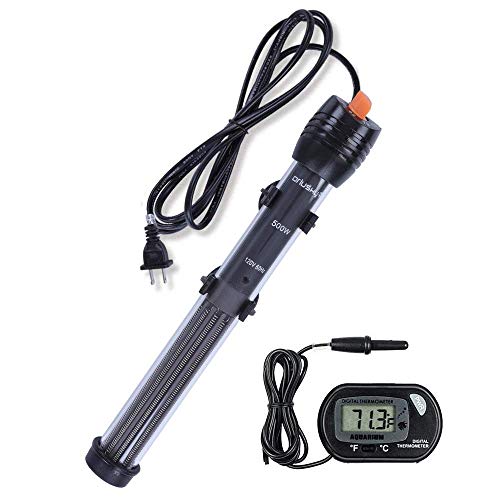
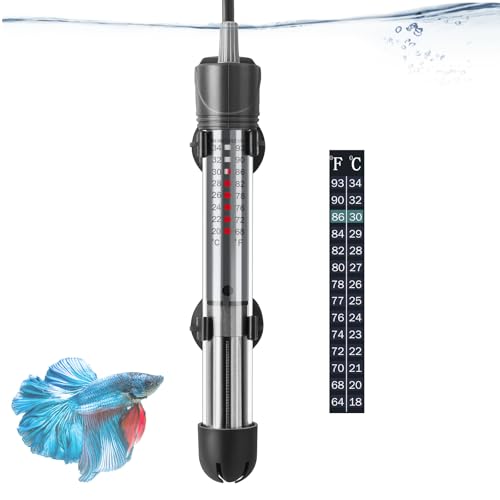
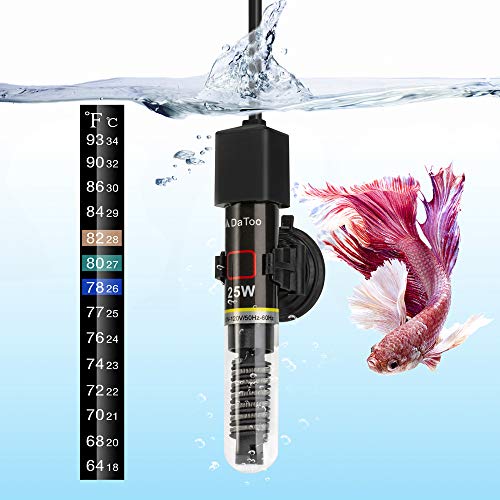
As an Amazon Associate we earn from qualifying purchases at no extra cost to you.
Aquarium Heaters at a Glance
| Model | Type | Best for | Stated or reported specs | Limits |
|---|---|---|---|---|
| Eheim Jager | Glass, adjustable thermostat | Most tanks, value buyers | One guide lists a range from 25W to 300W; a retailer table lists the 150W for roughly 53 to 79 gallons with plus or minus 0.5F accuracy | Long body; glass can crack if run dry |
| Cobalt Neo-Therm | Flat, shatter-resistant, electronic | Nano and rimless tanks, active fish | Neo-Therm Pro covers 68 to 94F with an LED showing set and actual temperature, plus auto-shutoff, per reviewers | Smaller wattage range; availability varies |
| Fluval E-series | Electronic with display | Owners wanting visible set point and alerts | Reviewers cite a readable controller and out-of-range alerts | Premium tier |
| Fluval T50 | Compact preset-style heater | Small tanks around 10 gallons | Named best overall for 10 gallons by one guide | Small wattage; not for large tanks |
| Inkbird-style external controller | Backup controller | Valuable or heavily stocked tanks | Recommended by one guide as a safety layer | Extra setup |
How to Size a Heater
Makers publish tank-size ranges for each wattage, and they are the best starting point. A general rule used in many guides is to size the heater to your tank volume and the gap between room temperature and your target water temperature. A cold room needs more wattage than a warm one. For larger tanks, many hobbyists use two smaller heaters at opposite ends instead of one large one, so a single failure does not leave the tank without heat and the warmth spreads more evenly. Check the maker’s chart for your specific model, and move up a size if your room is cold or drafty.
Glass vs Electronic Heaters
Glass heaters
Glass models like the Jager have long been the default. They are widely available, offer a broad wattage range and usually include an adjustable dial. One guide warns that glass heaters can crack if run dry, so unplug them before water changes and let them cool before removing them. They also tend to be longer than electronic designs, which matters in small or rimless tanks.
Electronic heaters
Electronic designs like the Neo-Therm and Fluval E-series use sealed, compact bodies and digital or LED controls. Reviewers describe the Neo-Therm as accurate and unlikely to shatter if a fish or an object bumps it. The trade-off is cost and, for some models, a narrower wattage range. The Fluval E-series is recommended by one guide specifically for the visible set point and alerts.
Detailed Picks
Eheim Jager: best all-rounder
One 2026 guide names the Jager best for most tanks, citing its precise thermostat, durable glass and wide wattage range, and another recommends it for most aquariums when paired with a separate thermometer. Its limitations are size and fragility. If you keep large or rowdy fish, shield or guard the heater according to the maker’s instructions.
Cobalt Neo-Therm: best for nano tanks and active fish
Reviewers describe it as one of the most compact heaters, with accurate control and a design that resists breakage. It is generally at the higher end of the budget scale and comes in smaller wattages, so larger tanks may need more than one. One guide notes that Cobalt listings and wattages change, so confirm the specific variant for your tank from the maker’s documentation.
Fluval E-series: best for display and alerts
One guide picks the E100 as the best electronic-control heater for a 20-gallon tank, praising the readable display and alerts but noting its premium pricing. If you want to see temperature without a separate thermometer, this is the type to consider.
Fluval T50: small-tank pick
For 10-gallon setups, the T50 appears as a best overall pick in one guide. Its low wattage keeps it appropriate for small volumes, but do not use it for larger tanks.
Budget Tiers
| Tier | Examples | Trade-off |
|---|---|---|
| Budget | Preset or basic adjustable glass models | Less precise control; fragile |
| Mid-range | Eheim Jager, Fluval T50 | Proven and adjustable; glass fragility |
| Premium | Cobalt Neo-Therm, Fluval E-series | Compact or display features, higher cost |
Safety and Care Notes
- Follow the maker’s manual for submersion depth and placement near water flow so heat disperses evenly.
- Unplug the heater and let it cool before water changes or maintenance, and never run a glass heater out of water.
- Use a separate thermometer. A heater’s dial is not a measurement of actual temperature.
- Consider an external controller as a backup for valuable or heavily stocked tanks, as one guide suggests.
- Keep cords and plugs off the floor and in drip loops. Use a ground-fault protected outlet where local electrical guidance recommends it, and consult a qualified electrician if you are unsure about wiring.
- If fish show stress or temperatures swing, stop and diagnose before adding more equipment.
Pick X If… Decision Table
| Pick this | If you… |
|---|---|
| Eheim Jager | want a proven, adjustable heater at a fair cost |
| Cobalt Neo-Therm | keep a nano tank, rimless tank or boisterous fish |
| Fluval E-series | want a visible display and alerts |
| Fluval T50 | run a small tank around 10 gallons |
| External controller plus heater | want a safety layer for valuable livestock |
Alternatives
- Preset betta heaters. Some guides discuss preset versus adjustable heaters for betta tanks. Presets are simpler but less flexible.
- Two smaller heaters. Splitting capacity across two units adds redundancy in larger tanks.
- Inline or external heaters. Used with canister filters on bigger setups; follow the maker’s installation instructions.
Buying Checklist
Before you buy, confirm your tank’s actual water volume, because substrate, rock and equipment reduce the real figure compared with the label on the tank. Note the lowest temperature your room reaches in winter and the temperature your species needs. Compare those with the maker’s wattage chart rather than a general rule. Decide whether you prefer an adjustable dial, a preset or a digital controller, and whether the heater will sit in a sump, hang inside the tank or run inline with a canister filter. Think about where the cord will run and whether you have a drip loop. Finally, plan how you will monitor the result: a quality thermometer placed at the opposite end of the tank from the heater gives the most useful reading, and many hobbyists check it daily for the first week after installing a new heater.
Common Mistakes
- Choosing a heater that is too small for a cold room, so it runs constantly and still struggles.
- Placing the heater in a dead-flow corner, which creates hot and cold zones.
- Switching the heater on before it is fully submerged, which can damage glass models.
- Trusting the dial instead of a thermometer.
- Ignoring the maker’s instructions about waiting after water changes before plugging back in.
Replace heaters that show cracks, moisture inside the body, a damaged cord or inconsistent behaviour. Heaters are consumables, and many keepers replace them on a schedule suggested by the maker or when performance changes. If you are unsure about electrical safety around water, ask a qualified electrician.
Frequently Asked Questions
How many watts do I need?
Use the maker’s tank-size chart for each model, then adjust for how cold your room gets. Larger gaps between room and target temperature require more wattage. When in doubt, step up one size or use two smaller heaters.
Why do glass heaters crack?
Running a glass heater while it is out of water, or exposing it to sudden temperature changes, can crack it. Unplug and cool it before water changes. If a heater is cracked, stop using it and replace it.
Do I need a separate thermometer?
Yes, most guides advise it. A dial setting shows a target, not the actual water temperature. A second reading helps you catch a stuck or failing heater early.
Can one heater warm a large tank?
It can if it is sized correctly, but two smaller heaters at opposite ends spread warmth better and give redundancy. Follow the maker’s instructions for placement.
Is an electronic heater worth the extra cost?
If you keep small tanks, active fish or want a display, many reviewers think so. For standard tanks, a well-sized glass heater plus a thermometer is widely used.
What temperature should my tank be?
It depends on the species. Research the needs of your fish or consult an aquatic vet or a local fish store before setting the temperature, and change settings gradually.