Key takeaways
- Small dog, limited space: Start with a compact dog treadmill, but measure the dog’s walking stride first. A short belt can make a small dog shorten its steps unnaturally.
- Medium or large dog: Prioritize belt length and width over top speed. A longer belt may be more useful than a higher maximum speed, particularly if the dog will mostly walk.
- First-time treadmill user: Look for a low minimum speed, simple controls, side guards that help prevent stepping off, and an emergency stop you can reach while standing beside the dog.
- Frequent use: Favor a sturdy frame, a belt that can be aligned and tensioned, accessible cleaning points, and replacement parts the manufacturer actually supplies.
- Very limited storage: Check the folded dimensions and machine weight, not just the belt size. A treadmill that folds may still be awkward to move or store.
- Dog easily startled by sound: A quieter motor alone may not solve the problem. Belt movement, beeps, vibration, and a hollow floor can also cause concern; introduce the machine switched off before testing it running.
Best Dog Treadmills: Picks by Dog Size, Space, and Training Needs
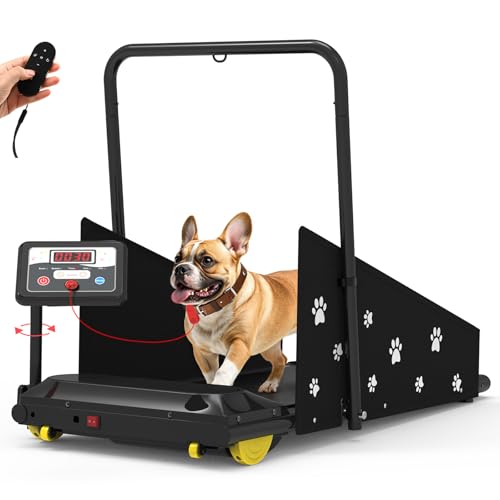
The best dog treadmill is one that gives your dog enough belt length to walk naturally, adjusts to a genuinely slow starting speed, and has an emergency stop you can reach quickly. For most homes, choose a purpose-built dog treadmill sized to your dog’s stride; consider a human treadmill only if its belt, controls, and safety setup suit your dog and you can supervise every session.
Specifications vary by model and may change, so confirm the current manufacturer’s measurements before buying. The ranges below are practical comparison points, not guaranteed specifications for every treadmill in a category.
Our top picks



As an Amazon Associate we earn from qualifying purchases at no extra cost to you. Ratings are shown as listed on Amazon.
Compare the main options
| Option | Typical usable belt | Typical speed range | Incline and noise | Best fit | Setup and trade-offs |
|---|---|---|---|---|---|
| Compact dog treadmill | About 30–40 in. long × 12–16 in. wide | About 0.5–7 mph | Often flat or a few manual incline positions; motor noise varies | Small dogs with shorter strides | Usually easier to place and assemble; too short or narrow for many medium and large dogs |
| Full-size dog treadmill | About 40–60 in. long × 16–20 in. wide | About 0.5–10 mph | Some offer adjustable incline; belt and motor noise depend on construction | Medium and large dogs, depending on stride | Needs more floor space; heavier frames and longer assembly are common |
| Slat-mill style | Varies by model; assess each slat’s width and track length | Dog-powered; no fixed motor-speed range | Usually no powered incline; sound comes from moving slats and frame | Experienced handlers who want a dog-powered option | Requires careful supervision and training; check belt or slat maintenance and safe stopping method |
| Human treadmill used for a dog | Commonly about 48–60 in. long × 18–22 in. wide | Often starts around 0.5–1 mph; model-dependent | Incline is common; motor and cooling-fan noise can be noticeable | Only dogs that fit the belt and tolerate its controls and sound | May offer good adjustability, but rails, buttons, and emergency-stop placement may not suit dogs |
“Usable belt” means the moving surface, not the full machine footprint. Allow extra room around the frame for access, ventilation, and safe supervision. Noise has no dependable category-wide decibel figure: motor type, belt tension, flooring, and the individual dog all matter. If noise sensitivity is a concern, ask the manufacturer for a sound measurement or a return policy that lets you assess the machine at home.
Choose by your dog and your home
- Small dog, limited space: Start with a compact dog treadmill, but measure the dog’s walking stride first. A short belt can make a small dog shorten its steps unnaturally.
- Medium or large dog: Prioritize belt length and width over top speed. A longer belt may be more useful than a higher maximum speed, particularly if the dog will mostly walk.
- First-time treadmill user: Look for a low minimum speed, simple controls, side guards that help prevent stepping off, and an emergency stop you can reach while standing beside the dog.
- Frequent use: Favor a sturdy frame, a belt that can be aligned and tensioned, accessible cleaning points, and replacement parts the manufacturer actually supplies.
- Very limited storage: Check the folded dimensions and machine weight, not just the belt size. A treadmill that folds may still be awkward to move or store.
- Dog easily startled by sound: A quieter motor alone may not solve the problem. Belt movement, beeps, vibration, and a hollow floor can also cause concern; introduce the machine switched off before testing it running.
Measure for fit before comparing speed
Have your dog walk at a natural pace on level ground while you observe a full stride. Choose a belt long and wide enough that the dog can walk without reaching for the front or drifting toward an edge. As a practical starting point, aim for visible clearance at both ends of the dog’s normal walking position; do not rely on body weight or breed labels as a substitute for measuring. If the manufacturer publishes a dog-size guide, compare it with your measurements and ask how it defines size.
Speed ranges can be misleading. A machine with a high top speed is not automatically suitable for beginners; the minimum speed and how smoothly it changes matter more for early sessions. Likewise, incline adds effort and can change footing. It is optional for ordinary indoor walking, not a must-have feature.
Safety features worth checking
- Emergency stop: Confirm that the stop cord, clip, or button is reachable to the handler and works as described. Keep the cord secured to the handler, not attached in a way that could pull or startle the dog.
- Side guards: These can help discourage stepping off the belt, but they should not trap paws or restrict a natural stride.
- Accessible controls: You should be able to start, slow, and stop the belt without reaching across or over a moving dog.
- Stable frame and level placement: Rocking, sliding, or vibration can undermine confidence and create a hazard. Follow the manual’s floor and clearance requirements.
- Secure leash policy: Never assume a leash should be attached to the treadmill. Follow the machine’s instructions and use a setup that cannot snag on the belt or frame.
Introduce the treadmill gradually: let the dog inspect it while it is off, reward calm interest, then run it briefly at its lowest setting with the dog nearby but not on the belt. Only progress when the dog is relaxed. Supervise continuously; never leave a dog running unattended. Stop if the dog appears distressed, unsteady, or reluctant. For dogs with health conditions, mobility concerns, or a history of injury, ask a veterinarian or qualified canine rehabilitation professional whether treadmill exercise is appropriate.
Assembly and ownership: plan beyond delivery day
Compact units may arrive partly assembled, while larger frames can require two people to position and assemble them. Before ordering, check the packed and assembled dimensions, shipping weight, required tools, and whether the belt needs manual alignment or tension adjustment. A large treadmill can be difficult to maneuver through doorways even if it fits the room once assembled.
Belts and rollers are the parts most likely to need attention. Dust, fur, and grit can collect around the belt and motor area; follow the manual’s cleaning instructions and never spray liquid into electrical components. Check belt tracking and tension at the intervals the manufacturer recommends. Slipping, rubbing, unusual noise, or a belt drifting to one side are reasons to stop using the machine and inspect it before another session.
Also account for consumables and service: ask whether the belt, stop cord, and other wear parts are sold separately, and whether lubrication is required. Some belts are designed to run dry; adding lubricant without checking can damage them. Keep paws and nails in suitable condition for safe footing, and don’t use the treadmill if the belt surface is damaged or the frame is unstable.
Bottom line
For a small dog or a tight room, a compact dog treadmill is the natural starting point if its moving surface fits the dog’s stride. For medium and large dogs, prioritize a longer, wider belt and stable construction. Choose a low minimum speed and reachable emergency stop for a beginner; treat incline and high top speed as secondary. Before paying, verify the exact belt dimensions, floor footprint, assembly requirements, noise information, and replacement-part availability for the specific model.