Key takeaways
- Indoor floors and smooth pavement: Small solid EVA or plastic wheels are light and turn tightly. They are suitable for short walks and errands.
- Sidewalk cracks and packed dirt: Wheels around 8–12 inches, especially with rubber tread, provide a noticeably smoother ride.
- Gravel, grass, and rough trails: Choose large rear wheels, pneumatic tires, and a front wheel that can lock straight. Small swivel wheels can catch in loose stones.
- Hills: A hand brake or reliable parking brake matters more than a high advertised weight limit. A three-wheel design usually tracks well, but it can tip more easily if the load is uneven.
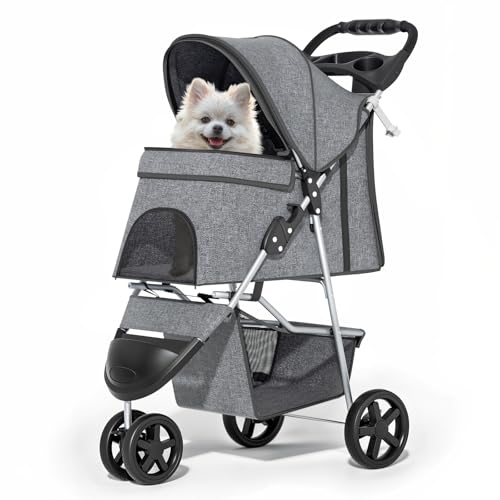
The best dog strollers for most everyday walks are the ones that fit your dog with room to turn around, roll smoothly on your usual surfaces, and fold small enough that you will actually use them: the Gen7Pets Promenade is a practical all-rounder, the Pet Gear Happy Trails Lite suits small dogs and tight storage, and a larger, air-filled-wheel stroller is better for bigger dogs or uneven paths.
Our top picks


As an Amazon Associate we earn from qualifying purchases at no extra cost to you. Ratings are shown as listed on Amazon.
Quick picks by dog and walking situation
| Best for | Recommended type or model | Useful target specifications | Why it fits |
|---|---|---|---|
| Small dog, errands, paved sidewalks | Pet Gear Happy Trails Lite | About 15 lb pet capacity; roughly 37.5 × 18 × 40 in assembled | Light, compact, and easy to maneuver in shops and on sidewalks |
| Small-to-medium dog, frequent daily walks | Gen7Pets Promenade | About 50 lb capacity; approximately 40 × 20 × 38 in assembled | More interior room and useful organizer storage than lightweight carriers |
| Large dog or two small dogs | Heavy-duty stroller with air-filled rear wheels | At least 28 × 18 in of interior floor space; 50–100 lb rated capacity | Better stability, wheel clearance, and weight distribution |
| Uneven paths and long outdoor walks | Three-wheel jogging-style pet stroller | 12–16 in rear wheels; front swivel lock; hand brake preferred | Larger wheels reduce vibration and resist cracks, gravel, and grass |
| Car travel and limited apartment storage | Compact folding stroller with removable carrier | Folded length under 32 in; folded width under 20 in | More likely to fit a closet, trunk, or entryway |
Capacity figures are not interchangeable with interior space. A stroller can be rated for 50 pounds while having a short or narrow cabin that is uncomfortable for a long-bodied dog. Measure the usable floor, not just the outside frame, before choosing.
What separates the best dog strollers from merely adequate ones?
Interior dimensions and the dog’s posture
Your dog should be able to stand without pressing its head into the canopy, turn around, and lie down naturally. Measure your dog from the floor to the top of the head while standing, then from the nose to the base of the tail. Add at least 3 inches to each measurement for usable interior length and height.
For example, a dog measuring 18 inches from nose to tail base needs roughly 21 inches of interior length for relaxed use. A dog with a 16-inch standing height should have approximately 19 inches of cabin height, allowing for the stroller’s floor padding and a slightly raised head. If the dog will share the compartment with another pet, choose by the combined floor area rather than the advertised weight limit.
Weight limits and center of gravity
Use the manufacturer’s pet-weight limit as a ceiling, not a target. A 35-pound dog in a stroller rated for 50 pounds may still make a lightweight frame difficult to push, particularly on slopes. Look for a reinforced floor, a low cargo compartment, and rear wheels positioned far enough back to prevent the handle from feeling heavy.
Do not count a lower basket toward pet capacity. The basket is designed for supplies, and loading it heavily can affect steering and braking. Keep dense items such as water bottles low and close to the axle.
Wheel performance on different surfaces
- Indoor floors and smooth pavement: Small solid EVA or plastic wheels are light and turn tightly. They are suitable for short walks and errands.
- Sidewalk cracks and packed dirt: Wheels around 8–12 inches, especially with rubber tread, provide a noticeably smoother ride.
- Gravel, grass, and rough trails: Choose large rear wheels, pneumatic tires, and a front wheel that can lock straight. Small swivel wheels can catch in loose stones.
- Hills: A hand brake or reliable parking brake matters more than a high advertised weight limit. A three-wheel design usually tracks well, but it can tip more easily if the load is uneven.
Air-filled tires absorb bumps better but need occasional inflation and can puncture. Solid tires eliminate punctures but transmit more vibration. For a dog that is sensitive to movement, pneumatic tires or substantial foam-filled wheels are usually the more comfortable choice.
Ventilation, shade, and weather protection
Prioritize mesh panels on at least three sides, not just a small front window. Ventilation is especially important when the canopy is fully closed. A removable or roll-up cover lets you balance airflow, shade, and protection from light rain.
Mesh should be securely stitched and fine enough to prevent paws from pushing through. A dark canopy can become hot in direct sun, so avoid leaving a dog inside a stationary stroller in warm weather. A stroller is a transport aid, not a substitute for temperature awareness or supervision.
Head-to-head: compact stroller versus full-size stroller
Compact models
A compact model such as the Pet Gear Happy Trails Lite is attractive for small dogs, cats, and owners who carry the stroller up stairs. Its approximately 15-pound pet limit and narrow footprint work well for toy breeds and short neighborhood trips. Small front wheels make it nimble around tables, doorways, and crowded sidewalks.
The trade-off is limited cabin length, less shock absorption, and reduced stability with a heavier pet. The lower basket is typically modest, so you may need a separate bag for food, water, and waste supplies.
Mid-size everyday models
The Gen7Pets Promenade occupies the useful middle ground. Its commonly listed capacity is about 50 pounds, with an assembled footprint of roughly 40 × 20 inches. That gives a small or medium dog more room to change position than a lightweight carrier, while the organizer-style storage is practical for regular walks.
It remains primarily a sidewalk stroller. For frequent gravel, grass, or badly broken pavement, its wheel and suspension design may be less comfortable than a true jogging-style model. Check the exact version before buying because dimensions and capacity can differ between sizes and generations.
Large or jogging-style models
A heavy-duty stroller with large rear wheels is the better choice for a long-bodied dog, two small dogs, or routes that include grass and uneven paths. The extra frame weight improves stability, but it also makes lifting and car storage more difficult. A wide base may not pass comfortably through narrow doors or fit in a small trunk.
For this category, prioritize interior floor dimensions, a tether for each pet, a front-wheel lock, and a parking brake. A high weight rating without those features does not make a stroller suitable for rough terrain.
Folding and storage: check the folded size, not just “folds easily”
Most everyday strollers use one of three mechanisms:
- One-hand trigger fold: Fast for errands, but hinges and release cables can collect grit. Confirm that the canopy does not need to be removed first.
- Collapsible frame fold: Often produces a flatter package and can be more secure, but may require two hands.
- Removable-carrier design: Convenient when transferring a resting dog from car to stroller, though the carrier can add weight and may have a smaller interior.
Measure the available storage space before ordering. A stroller that folds to 32 × 20 × 10 inches still needs clearance to lift into a closet or vehicle. If you use public transport, also check the folded weight; a 20-pound stroller plus a 30-pound dog is awkward on stairs even when the frame folds compactly.
Ownership details that product listings often omit
The parts most likely to wear first are wheel bearings, brake cables, zippers, mesh, and the foam or fabric around the cabin floor. Zippers can clog with sand, while mesh can tear if a dog repeatedly paws at the same corner. A removable, washable liner is more valuable than decorative padding.
After muddy walks, wipe the frame and rinse grit from the wheel area without soaking enclosed bearings. Let the cabin dry fully before folding it. Check tire pressure monthly on pneumatic wheels, tighten loose wheel hardware, and test the parking brake before every longer outing. Never attach a leash only to the canopy; use the built-in interior tether and keep enough slack for the dog to sit or lie down safely.
Budget for replacement liners, inner tubes if applicable, and possibly a rain cover. General market pricing is approximately $50–$120 for lightweight small-pet strollers, $120–$250 for sturdier everyday models, and $250–$600 or more for large, jogging, or premium suspension designs.
A practical decision rule
| Your priority | Minimum feature to seek | Feature to avoid compromising |
|---|---|---|
| Lowest cost and occasional use | Correct interior fit and a secure tether | Ventilation and brake quality |
| Daily paved walks | 8-inch or larger rear wheels and washable liner | Folded dimensions |
| Uneven outdoor surfaces | Large pneumatic or foam-filled tires | Front-wheel lock and parking brake |
| Small apartment or compact car | Folded size under your measured storage limit | One-hand or compact folding mechanism |
| Older, injured, or easily fatigued dog | Low entry, stable floor, and generous ventilation | Easy loading and gentle ride quality |
For most owners, the best dog strollers are not the lightest or the highest-capacity models. Choose the smallest stroller that gives your dog adequate standing and turning room, then match its wheels and brakes to the surfaces you actually walk on. If your dog has mobility or balance concerns, ask a veterinarian or qualified rehabilitation professional about safe transport and loading before regular use.