Key takeaways
- Total wattage: 30W is enough for one phone at full speed. 45W-67W lets you fast-charge a phone and a tablet or two phones simultaneously without splitting power too thin. 100W+ is only needed if you regularly charge a MacBook Air, Chromebook, or other USB-C laptop in the car.
- USB-C PD and PPS: Look for USB Power Delivery 3.0 with Programmable Power Supply (PPS). PPS is essential for Samsung Galaxy S-series Super Fast Charging (up to 45W) and helps Google Pixel and iPhone maintain peak speeds longer with less heat.
- Port configuration: Dual-port (1x USB-C + 1x USB-A) covers most use cases. Triple-port or dual USB-C is better for families or rideshare drivers who charge 3+ devices.
- Vehicle compatibility: Standard 12V cigarette lighter sockets are universal, but depth and tightness vary. Low-profile chargers sit almost flush and work better in shallow sockets found in many European and compact cars. Chargers with a wide 12-24V input range also work in trucks and SUVs.
- Cable management: Chargers with an integrated retractable USB-C cable (typically 2.6 ft / 80cm) reduce clutter, but fixed cables limit flexibility if you need longer reach to the back seat. A separate braided cable is more durable long-term.
- Heat and safety protection: Quality chargers list multi-protection: over-voltage, over-current, short-circuit, and over-temperature with automatic power reduction at around 60-70°C (140-158°F). An aluminum alloy shell or internal heatsink dissipates heat far better than all-plastic housings.
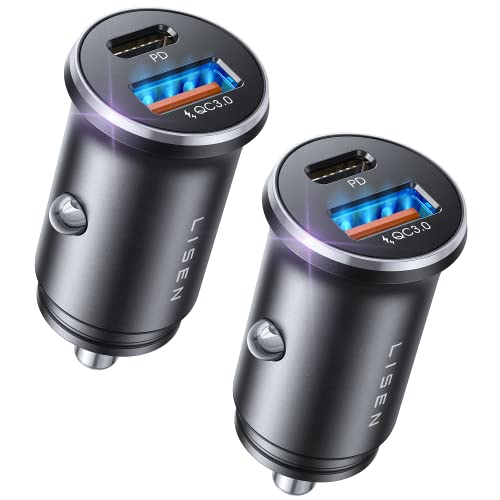
The best car chargers for fast, reliable charging in 2026 are 45W to 67W USB-C PD models with at least two ports, and for most drivers the sweet spot is a compact dual-port charger with 45W USB-C PD + 18W USB-A, PPS support, and built-in heat protection.
Our top picks


As an Amazon Associate we earn from qualifying purchases at no extra cost to you. Ratings are shown as listed on Amazon.
What Actually Makes a Car Charger Fast and Reliable
Fast charging in a car is not just about the wattage number on the box. It depends on the charging protocol your phone or tablet supports, whether the charger can sustain that output without overheating, and how the vehicle’s 12V socket delivers power. A reliable charger maintains stable voltage during engine start/stop cycles and protects against over-current and thermal throttling.
Key specs to compare before you buy
- Total wattage: 30W is enough for one phone at full speed. 45W-67W lets you fast-charge a phone and a tablet or two phones simultaneously without splitting power too thin. 100W+ is only needed if you regularly charge a MacBook Air, Chromebook, or other USB-C laptop in the car.
- USB-C PD and PPS: Look for USB Power Delivery 3.0 with Programmable Power Supply (PPS). PPS is essential for Samsung Galaxy S-series Super Fast Charging (up to 45W) and helps Google Pixel and iPhone maintain peak speeds longer with less heat.
- Port configuration: Dual-port (1x USB-C + 1x USB-A) covers most use cases. Triple-port or dual USB-C is better for families or rideshare drivers who charge 3+ devices.
- Vehicle compatibility: Standard 12V cigarette lighter sockets are universal, but depth and tightness vary. Low-profile chargers sit almost flush and work better in shallow sockets found in many European and compact cars. Chargers with a wide 12-24V input range also work in trucks and SUVs.
- Cable management: Chargers with an integrated retractable USB-C cable (typically 2.6 ft / 80cm) reduce clutter, but fixed cables limit flexibility if you need longer reach to the back seat. A separate braided cable is more durable long-term.
- Heat and safety protection: Quality chargers list multi-protection: over-voltage, over-current, short-circuit, and over-temperature with automatic power reduction at around 60-70°C (140-158°F). An aluminum alloy shell or internal heatsink dissipates heat far better than all-plastic housings.
Best Car Chargers Compared: Specs and Real-World Output
These categories represent the most common, well-supported product types available from established brands like Anker, UGREEN, Belkin, Spigen, and Aukey in 2026. This comparison focuses on what you get in practice, not just advertised peak wattage.
| Type / Example Spec | Total Output | Port Config | Max Single-Port Speed | Size & Weight | Key Safety / Build Feature |
|---|---|---|---|---|---|
| Compact Dual-Port 45W (e.g., Anker 323 / UGREEN 63W Mini style) | 45W-63W | 1x USB-C PD + 1x USB-A | 45W USB-C PD PPS | 1.8 x 1.2 x 0.9 in, ~0.9 oz / 25g | Aluminum shell, 60°C thermal cutoff |
| High-Power Dual USB-C 67W-68W (e.g., Belkin BoostCharge 67W) | 67W | 2x USB-C PD PPS | 67W USB-C | 2.1 x 1.3 x 1.0 in, ~1.3 oz / 37g | Dual PPS, independent port regulation |
| Retractable Cable 70W (e.g., UGREEN Retractable 69W type) | 69W-70W | 1x Retractable USB-C cable + 1x USB-C + 1x USB-A | 45W on cable, 30W on port | 3.2 x 1.5 x 1.1 in, ~2.8 oz / 80g | Built-in cable strain relief, 7000+ retract cycles |
| Laptop-Ready 100W+ (e.g., Anker PowerDrive III / Spigen 100W ArcStation type) | 100W-120W | 1x USB-C PD 100W + 1x USB-C/A 20-30W | 100W USB-C PD 3.1 | 2.8 x 1.6 x 1.2 in, ~2.2 oz / 62g | Gallium Nitride (GaN) design, 70°C auto-derating |
| Budget Triple-Port 30W | 30W-36W | 1x USB-C + 2x USB-A | 30W USB-C | 2.0 x 1.2 x 1.0 in, ~1.0 oz / 28g | Plastic housing, basic over-heat protection |
General market price ranges in 2026: compact 45W chargers typically run $13-$20, high-power 67W dual USB-C models $20-$35, retractable cable models $25-$40, and 100W laptop-grade chargers $35-$55. Cables with E-Marker chips for 60W+ are usually sold separately for $8-$15 unless integrated.
Decision Matrix: Which Charger Fits Your Situation
Match your driving habits and devices to the right category instead of just buying the highest wattage.
| Your Situation | Your Priority | Best Choice | Why |
|---|---|---|---|
| Solo commuter with iPhone 15/16 or Pixel 8/9 | Reliability and low heat | Compact 45W Dual-Port | Delivers full 27-30W fast charge to one phone with headroom, runs cooler than maxed-out 30W units |
| Samsung Galaxy S23/S24/S25 Ultra user | Fastest Samsung speed | 67W Dual USB-C with PPS | Only PPS-enabled 45W PD sustains Samsung 45W Super Fast Charging 2.0; non-PPS chargers drop to 15-25W |
| Family, rideshare, or road trip with pets – 2-3 devices at once | Multi-device output | Retractable 69W or Triple-Port 67W+ | Can charge two phones at 30W+30W or one phone + tablet without severe power splitting |
| Need to charge a laptop, portable fridge, or pet travel gear in car | High wattage | 100W GaN Single-Port Focused | Only 60W+ sustains a MacBook Air or Chromebook while driving; requires 12V socket rated to 10A minimum |
| Small car with shallow or tight 12V socket, minimalist setup | Fit and cable management | Low-Profile Mini 45W or Retractable | Flush fit prevents disconnects on bumpy roads; retractable cable eliminates loose cables around gear and pet carriers |
| Occasional use, tight budget | Value | Budget 30W Triple-Port | Adequate for single-device fast charging, but expect slower shared charging and more heat |
How Much Faster Is a Higher-Wattage Charger? A Worked Example
Understanding shared vs. dedicated power prevents disappointment. Here is how power splits in practice on a typical 67W dual-port charger:
Scenario: You have an iPhone 16 (supports up to 27W PD) and an iPad Air (supports up to 30W). Charger is a 67W unit rated as 45W + 22.5W when both ports are used.
- Charging iPhone alone on USB-C: Gets full 27W. 0-50% in about 30 minutes, 0-100% in roughly 75-90 minutes depending on battery health and temperature.
- Charging iPhone + iPad together: iPhone drops to 22.5W on the shared circuit, iPad gets 22.5W. That means about 15% longer to 50% compared to solo charging. Still fast, but not peak.
- Same two devices on a 30W total charger split as 18W + 12W: iPhone charges 33% slower, iPad charges at trickle speed. This is where a 45W+ charger pays off.
Rule of thumb: If you regularly charge two devices at once, add their desired watts together and buy a charger with at least that total. For one fast-charging phone, 30W dedicated is the minimum for true fast charging.
Durability and Ownership Realities
Car chargers fail from heat, vibration, and socket wear more than electronics failure. Knowing what wears first helps you avoid common mistakes.
- What wears first: The spring-loaded contacts and fuse element inside the 12V plug. Loose-fitting chargers that wiggle will arc slightly and build up carbon on the contacts. Low-profile chargers with a rubber retention ring stay put and last longer.
- Heat is the killer: A charger left in a hot parked car can reach 70°C before you even plug it in. Cheap plastic housings warp and internally throttle to 7-10W. Choose aluminum or GaN models and avoid covering the charger with bags or pet blankets that trap heat.
- Cable fatigue: On retractable models, the cable exit point is the weak spot. Pull straight out, not at an angle, and let it retract slowly. For separate cables, use 3.3 ft / 1m braided USB-C to USB-C with 60W E-Marker for 45W+ charging. Replace cables every 12-18 months if you bend them daily.
- Common mistakes: Using an old USB-A to USB-C cable on a PD port limits you to 7.5-12W even on a 45W charger. Using a 100W charger in a vehicle with a 8A-rated 12V socket (96W at 12V) can blow the car’s accessory fuse – check your owner’s manual; most cars need a 10A or 15A socket for 100W continuous. And never chain a cigarette splitter and a high-wattage charger without checking the splitter’s rating; many are limited to 60-80W total.
- Cleaning and maintenance: Unplug monthly and blow out the 12V socket with compressed air. Wipe charger contacts with a dry cotton swab. If the charger feels hot enough that you cannot hold it for 3 seconds, unplug it and let it cool before reuse.
Vehicle Compatibility Check Before You Buy
Nearly all cars, trucks, and vans sold after 2005 have a standard 12V accessory socket compatible with these chargers. Two exceptions to check:
- Some newer EVs and hybrids replace the cigarette lighter with a dedicated USB-C port in the console. That built-in port is often limited to 15-18W. A 12V adapter in the remaining 12V socket will still be faster.
- If your 12V socket is inside a covered armrest or has a tight cap, measure depth. Chargers longer than 2.5 inches may not allow the lid to close. A flush mini charger solves this.
If you drive with pets, a flush or retractable model is especially useful. It keeps cables off the floor where they can be chewed or tangled in carriers and prevents a protruding charger from being knocked loose by a dog moving in the cargo area.
Frequently Asked Questions
Do I need a 100W car charger for a phone?
No. Phones max out between 25W and 45W. A 100W charger will not charge a phone faster than a good 45W PPS charger. Buy 100W only if you charge a USB-C laptop or other high-draw gear.
Will a fast car charger damage my car battery?
Not during normal driving. The alternator or DC-DC converter easily handles 30-100W. Avoid charging at full speed for more than an hour with the engine off, as it can drain a small 12V battery, especially in cold weather.
Why does my phone say charging slowly with a fast charger?
Usually it is the cable or protocol mismatch. For iPhone, you need USB-C to USB-C or USB-C to Lightning with PD. For Samsung 45W, you need a PPS-enabled charger and a 5A cable. An older USB-A cable will cap speeds at 12W.
Are car chargers with built-in cables less reliable?
They add convenience but add a non-replaceable wear point. If you keep a car for 4+ years or share it with family, a separate high-quality cable is more serviceable. If you prioritize a tidy cabin for travel with pets and kids, the retractable convenience is worth it.