Key takeaways
- Fast IPS: The best all-round balance of viewing angles, color, response consistency and price. It is usually the default recommendation.
- OLED and QD-OLED: Near-instant pixel transitions, perfect black levels and excellent contrast. They are especially compelling for dark games, but static desktop elements can create burn-in risk over long periods, and text may appear less crisp on some layouts.
- VA: Strong contrast and often good value, particularly for curved ultrawides. Check reviews for dark-level smearing, which can be visible in fast dark scenes.
- TN: Still relevant for specialized, very-high-refresh competitive monitors. Viewing angles and image quality are weaker than modern IPS panels.
The best gaming monitors in 2026 depend on one practical match: pair your GPU and game type with the right panel, refresh rate, response time, screen size and ports—not simply the biggest number on the box.
Our top picks

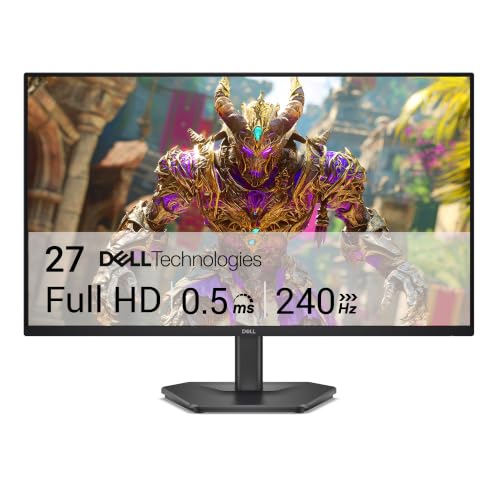


As an Amazon Associate we earn from qualifying purchases at no extra cost to you. Ratings are shown as listed on Amazon.
Quick picks by situation
| Situation | Best-fit monitor type | Target specification | Typical market range |
|---|---|---|---|
| Competitive 1080p gaming | 24–25-inch Fast IPS | 240–500Hz, 1ms-class response, DisplayPort | $180–$600 |
| Balanced PC gaming | 27-inch 1440p Fast IPS | 165–240Hz, Adaptive-Sync, 2–3 video inputs | $250–$650 |
| 4K single-player gaming | 32-inch 4K IPS, Mini-LED or OLED | 144–240Hz, HDMI 2.1, DisplayPort | $500–$1,500 |
| Small desk or mixed work | 27-inch 1440p IPS | 144–180Hz, height adjustment, USB hub | $220–$500 |
| Value upgrade from 60Hz | 24-inch 1080p or 27-inch 1440p IPS | 144–180Hz, FreeSync or G-SYNC Compatible | $150–$350 |
The best gaming monitors by use case
Best overall for most PC gamers: 27-inch 1440p Fast IPS
A 27-inch 2560×1440 Fast IPS monitor is the safest recommendation for a broad range of gaming PCs. It is sharper than 1080p without placing the extreme rendering load of 4K on the graphics card. Look for 165Hz to 240Hz, a stated 1ms gray-to-gray or MPRT figure, variable refresh support and a height-adjustable stand.
Models such as the Dell G2724D, LG 27GP850-B and ASUS TUF Gaming VG27AQML1A represent this category at different refresh-rate and feature levels. Exact panel tuning varies, so compare independent measurements of motion clarity and brightness rather than treating “1ms” as a guarantee.
Best for competitive play: 24–25-inch 1080p or 27-inch 1440p high-refresh
For esports games, a smaller 24–25-inch 1080p screen makes the whole image easy to track at close range and is relatively easy for a midrange GPU to drive above 240 frames per second. A 27-inch 1440p model is preferable if you also play visually demanding games or want more desktop workspace.
Competitive players should prioritize refresh rate, consistent pixel response and low input lag over HDR or extreme resolution. A 360Hz or 500Hz monitor can be worthwhile only when your system regularly produces the necessary frame rate. At 120 frames per second, a 500Hz display is not being used to its full potential.
Best for 4K gaming: 32-inch 4K high-refresh
Choose 4K when image detail, expansive worlds and single-player games matter more than maximum competitive speed. A 32-inch screen provides a comfortable scale for 3840×2160, while 27-inch 4K looks exceptionally sharp but can make menus and text feel small.
The Alienware AW3225QF is a 32-inch 4K QD-OLED with a high refresh rate and curved screen. The LG 32GS95UE offers a distinctive dual-mode approach, allowing a 4K mode and a lower-resolution high-refresh mode. These products are premium choices; an IPS or Mini-LED alternative may be better for bright rooms, long static desktop sessions or buyers who want to minimize OLED-specific maintenance.
For 4K at high refresh rates, confirm that your graphics card and monitor both support HDMI 2.1 or DisplayPort with the required bandwidth. Older HDMI connections may limit 4K to 60Hz or 120Hz.
Best budget choice: 24-inch 1080p 144–180Hz
A 24-inch 1080p IPS monitor remains the most cost-effective way to replace a 60Hz display. It suits modest gaming PCs, school desks and users who sit roughly 20–30 inches from the screen. Look for a real variable-refresh range beginning near 48Hz or 50Hz, DisplayPort for PC use and a stand that at least tilts.
Budget monitors often save money through weak speakers, limited stands, basic HDR labels and fewer USB ports. Those compromises are acceptable if the core panel delivers stable motion and the monitor can be positioned correctly.
Panel type: IPS, OLED, VA or TN?
- Fast IPS: The best all-round balance of viewing angles, color, response consistency and price. It is usually the default recommendation.
- OLED and QD-OLED: Near-instant pixel transitions, perfect black levels and excellent contrast. They are especially compelling for dark games, but static desktop elements can create burn-in risk over long periods, and text may appear less crisp on some layouts.
- VA: Strong contrast and often good value, particularly for curved ultrawides. Check reviews for dark-level smearing, which can be visible in fast dark scenes.
- TN: Still relevant for specialized, very-high-refresh competitive monitors. Viewing angles and image quality are weaker than modern IPS panels.
Do not choose OLED solely because it has the fastest advertised response time. If you use the display for eight hours of spreadsheets, browser tabs or game interfaces every day, IPS may be the easier ownership choice. If most use is varied gaming and video with automatic screen-protection features enabled, OLED can deliver a more dramatic picture.
Match refresh rate and resolution to your GPU
| Resolution | Pixels per frame | Useful GPU performance target | Best fit |
|---|---|---|---|
| 1920×1080 | 2.07 million | 144–500 fps | Competitive gaming and entry-level systems |
| 2560×1440 | 3.69 million | 100–240 fps | Most modern gaming PCs |
| 3840×2160 | 8.29 million | 80–240 fps | High-end GPUs and visual-quality-focused play |
These are planning ranges, not guarantees: ray tracing, game settings, upscaling and the particular title can change performance substantially. A 1440p 240Hz monitor is not automatically better than a 1440p 165Hz model if your GPU normally renders at 90–130 fps. Variable refresh smooths that range, but it cannot create extra frames.
A useful calculation illustrates the trade-off: 4K renders 8.29 million pixels per frame, compared with 3.69 million at 1440p. That is about 2.25 times as many pixels for the GPU to process. If your system produces 140 fps at 1440p, a comparable 4K workload might be far below 140 fps, depending on the game and settings.
Room size and desk distance matter
Measure viewing distance before choosing screen size. At about 20–30 inches, 24 inches is comfortable for focused competitive play, 27 inches is a versatile choice, and 32 inches works best when you can sit roughly 30–40 inches away. A large screen placed too close can require constant head movement, while a small 1080p screen viewed from far away loses much of its practical detail.
For a narrow desk, a 27-inch flat monitor with a compact stand is often more useful than a 32-inch curved model. Check the monitor’s total depth, not just its diagonal size: a large stand can consume valuable keyboard and mouse space. VESA mounting can recover desk area, but confirm the mounting pattern and the arm’s weight rating.
Ports that prevent future frustration
- DisplayPort: Usually the preferred connection for a desktop gaming PC and high refresh rates.
- HDMI 2.1: Important for 4K above 120Hz and useful for current consoles.
- USB hub: Convenient for a mouse, keyboard or headset receiver, but it does not replace a full docking station unless USB-C video and power delivery are explicitly supported.
- USB-C with video: Valuable for laptops; check the supported wattage if you want one-cable charging.
- 3.5mm audio: Helpful when the monitor receives sound over HDMI or DisplayPort.
Before buying, count your devices: gaming PC, console, work laptop and streaming device may require three or four inputs. Also verify whether the desired refresh rate works through each input; some monitors reserve their highest specification for DisplayPort.
Ownership details that product listings often omit
Pixel response is not the same as input lag. Response time describes how quickly pixels change color; input lag describes the delay before your action appears. Overshoot from an overly aggressive “fast” setting can create bright inverse trails. Start with the normal or medium overdrive mode and adjust only if motion tests show a benefit.
Clean the screen with a dry microfiber cloth for dust and a lightly dampened cloth for marks. Do not spray liquid directly onto the panel, and avoid household glass cleaner, which can damage coatings. Keep vents clear, especially on Mini-LED and OLED models that generate heat.
OLED owners should enable the manufacturer’s pixel-shift, panel-refresh and automatic dimming features. Vary static content, hide taskbars when practical and avoid leaving a paused game on screen for hours. OLED burn-in policies differ by manufacturer, so review the current warranty terms before purchasing.
A simple buying decision
- Under $300: Choose 24-inch 1080p at 144–180Hz, or a discounted 27-inch 1440p model if your GPU can sustain it.
- $300–$700: A 27-inch 1440p Fast IPS at 165–240Hz offers the broadest value, while a 32-inch 4K IPS is sensible for slower games.
- $700 and above: Consider 32-inch 4K OLED or Mini-LED, but first decide whether contrast, HDR and response speed outweigh static-content concerns.
- For an esports-first setup: Buy the refresh rate your PC can actually feed, favor a compact screen and spend less on HDR features you will rarely use.
- For mixed gaming and work: Prioritize ergonomics, text clarity, brightness control, USB connectivity and warranty support before chasing the highest refresh rate.
For most people, the best gaming monitor is a 27-inch 1440p Fast IPS display running at 165–240Hz. Move to 24-inch 1080p for competitive value, 32-inch 4K for high-end visual quality, or OLED when contrast and near-instant response are worth its ownership trade-offs.