Key takeaways
- Gas advantages: higher sustained flow, easy mobility away from outlets, strong performance on large surfaces, and compatibility with high-output pumps.
- Gas disadvantages: fuel storage, oil changes, carburetor or fuel-system issues, engine noise, exhaust, vibration, and winterization.
- Electric advantages: quiet operation, push-button starting, no engine exhaust, and fewer moving parts.
- Electric disadvantages: lower typical GPM, dependence on circuit capacity, cord management, and potential motor damage if water enters electrical components.
The best commercial pressure washer for most frequent, heavy-duty work is a gas-powered unit producing about 3,000–4,000 PSI and 3.5–4.5 GPM, while electric machines make more sense indoors, in noise-sensitive areas, or for lighter daily cleaning.
Pressure alone does not determine cleaning speed. PSI breaks the bond between dirt and a surface; GPM rinses away the loosened material. A 3,500-PSI, 4-GPM washer delivers substantially more practical cleaning capacity than a 4,000-PSI machine restricted to 2.5 GPM.
Our top picks
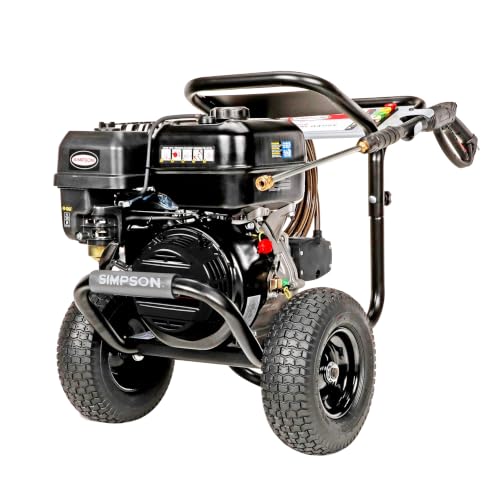


As an Amazon Associate we earn from qualifying purchases at no extra cost to you. Ratings are shown as listed on Amazon.
Best commercial pressure washers by situation
| Best for | Recommended configuration | Why it fits | Main compromise |
|---|---|---|---|
| Daily vehicle, equipment, or concrete cleaning | Gas; 3,000–4,000 PSI; 3.5–4.5 GPM | High area coverage and no dependence on a building circuit | Noise, exhaust, fuel, and engine maintenance |
| Indoor commercial cleaning | Electric; 1,500–2,000 PSI; 1.5–2.5 GPM | No exhaust and easier starting; suitable where ventilation is limited | Lower output and possible circuit limitations |
| Large flat surfaces | Gas; about 4,000 PSI; 4 GPM or more | Pairs well with a 16–20-inch surface cleaner | Heavier, costlier, and easier to damage delicate surfaces |
| Mobile contractors with stairs or uneven ground | Compact gas unit; 2,500–3,500 PSI; 2.5–3.5 GPM; pneumatic tires | More manageable than a large skid or trailer unit | Slower on extensive concrete and siding jobs |
| Long shifts or hot-water degreasing | Commercial hot-water gas unit; 2,000–4,000 PSI; 3–5 GPM | Heated water removes oil and grease more efficiently | Greater purchase price, weight, fuel use, and maintenance |
Our top commercial pressure washer categories
Best overall: a belt-drive gas washer with a commercial pump
For contractors and facilities teams using a washer several times per week, choose a belt-drive gas machine from an established commercial manufacturer such as Mi-T-M, Kärcher, Simpson, or BE Power Equipment. A Honda GX-series engine is a useful sign of a serviceable commercial package, but the pump, frame, and replacement-parts support matter just as much.
Look for 3,000–4,000 PSI, at least 3.5 GPM, a 50-foot hose, a welded steel frame, an unloader that can be serviced, and a triplex-plunger pump. Belt drive keeps engine vibration and heat away from the pump and often reduces pump speed, which can improve longevity during long operating periods. It adds a belt and guard to inspect, however.
Best for indoor work: a commercial electric cold-water washer
A commercial electric unit is the better choice for warehouses, kennels, workshops, loading bays, and other areas where engine exhaust is unacceptable. Models from Kärcher and other established commercial suppliers commonly sit around 1,500–2,000 PSI and 1.5–2.5 GPM.
Before buying, confirm the electrical requirement. A 120-volt machine may be convenient but can be limited to roughly 1.5–2 GPM. A 230-volt unit can provide more sustained output, but it needs a suitable circuit and is less flexible at different job sites. Avoid using a long, undersized extension cord: voltage drop can overheat the motor and reduce pump performance.
Best for oil, grease, and winter work: a hot-water washer
Hot-water machines cost more because they add a burner, coil, fuel system, temperature controls, and safety components. They are justified when the work involves cooking oil, vehicle grease, industrial grime, or frequent cold-weather cleaning. A cold-water washer can remove some of these soils with detergent and dwell time, but hot water usually reduces labor.
Choose a unit with a replaceable coil, accessible burner parts, a dependable thermostat, and local service support. Burner maintenance is a separate ownership responsibility: fuel filters, electrodes, nozzles, soot, and scale all require attention.
PSI and GPM: the numbers that determine productivity
Use cleaning units—often approximated as PSI multiplied by GPM—to compare output:
3,500 PSI × 4 GPM = 14,000 cleaning units.
That machine will generally move across a large dirty surface faster than a 4,000-PSI, 2.5-GPM machine producing 10,000 cleaning units, assuming the nozzles and surface are appropriate. Higher output is not automatically safer. Excessive pressure can etch concrete, remove paint, drive water behind siding, damage seals, or strip wood fibers.
For delicate surfaces, use a wider fan nozzle, greater working distance, lower pressure, and a detergent designed for the material. The pressure printed on the specification sheet is usually maximum pump pressure, not the pressure delivered at every nozzle or during every task.
Gas versus electric power
- Gas advantages: higher sustained flow, easy mobility away from outlets, strong performance on large surfaces, and compatibility with high-output pumps.
- Gas disadvantages: fuel storage, oil changes, carburetor or fuel-system issues, engine noise, exhaust, vibration, and winterization.
- Electric advantages: quiet operation, push-button starting, no engine exhaust, and fewer moving parts.
- Electric disadvantages: lower typical GPM, dependence on circuit capacity, cord management, and potential motor damage if water enters electrical components.
For occasional work in a garage or enclosed facility, electric is usually easier to live with. For a mobile business or several hours of exterior cleaning per day, gas normally provides better productivity.
Pump durability, duty cycle, and hose length
The pump is often the most expensive wear item. Axial-cam pumps are compact and economical, but a commercial triplex-plunger pump is preferable for repeated, long-duration use because it is designed to be serviced with valves, seals, and packings. CAT Pumps, Comet, General Pump, and AR are established names in commercial pump components, though the complete washer still needs proper cooling and filtration.
Duty cycle describes how long the machine can operate before it needs a break. A unit advertised for intermittent use is a poor choice for a crew running it continuously. Avoid leaving any pressure washer running while the trigger is released for more than a brief period. In bypass, the pump recirculates heated water, which can quickly damage seals and valves.
A 50-foot hose is a practical commercial minimum. It reduces the need to move the machine while keeping pressure loss manageable. A 100-foot hose improves reach but adds weight and friction; use the largest compatible hose diameter rather than assuming every long hose performs equally. Keep the high-pressure hose away from sharp corners, hot mufflers, and vehicle tires.
Worked coverage example
Suppose a 4-GPM washer is used with a surface cleaner and achieves an effective cleaning path 20 inches wide while moving at 2 feet per second. The theoretical area rate is:
1.67 feet wide × 2 feet per second × 3,600 seconds = about 12,000 square feet per hour.
Real output will be lower because of overlapping passes, obstacles, setup, detergent dwell time, and heavily soiled areas. Planning around 50–70% of the theoretical figure—about 6,000–8,400 square feet per hour—is more realistic for an experienced operator. A lower-GPM machine may require slower movement and more passes.
Maintenance realities before you buy
- Inspect the hose, trigger gun, couplers, and nozzle orifices before every shift. A partially blocked nozzle can cause abnormal pressure and pump strain.
- Clean the inlet filter and use a reliable water supply. Cavitation from restricted flow can damage the pump even when the pressure gauge looks normal.
- Change gas-engine oil at the interval specified by the engine maker, and check the pump oil if the pump has a serviceable crankcase.
- Never run the pump dry. Connect water, purge air, and confirm steady flow before starting the engine or motor.
- Release pressure before disconnecting hoses. Trapped pressure makes couplers difficult to remove and can cause injury.
- Flush detergent and chemicals with clean water after use. Chemical residue can harden in injectors, seals, and fittings.
- Winterize with the manufacturer-approved procedure. Frozen water can crack the pump head, unloader, fittings, or coil.
The parts most likely to wear first are hose jackets, O-rings, trigger-gun seals, unloader valves, pump packings, inlet filters, belts, and engine-starting components. A cheap machine with unavailable seals can cost more over time than a better-supported commercial unit.
Bottom line
Choose a 3,000–4,000-PSI, 3.5–4.5-GPM belt-drive gas washer with a serviceable triplex pump for frequent exterior work. Choose commercial electric when exhaust, noise, or indoor operation matters more than maximum coverage. Choose hot water only when grease, oil, or cold-weather productivity justifies the added cost and maintenance. Prioritize pump serviceability, parts availability, hose quality, and the machine’s real duty cycle over the highest PSI printed on the label.