Key takeaways
- For takedowns and stand-up-to-ground transitions: Look for a full-size dummy with a firm, evenly filled torso and enough finished weight to stay put. A lighter dummy can still help rehearse movement, but it will not provide much resistance to being lifted, driven, or turned.
- For submissions and positional sequences: Prioritize jointed or flexible limbs that can be placed into useful positions and remain there. Check that the arms and legs are long enough to practice your usual entries without forcing awkward angles.
- For solo drilling in a small home: Choose a lighter model with manageable limb bulk and a cover that can be wiped clean. Check the storage footprint when the arms and legs are extended, not only the packaged dimensions.
- For frequent or hard use: Give construction priority over extra features. Reinforced seams at the neck, shoulders, hips, and crotch and a closure that stays shut matter more than a high advertised weight.
Best Grappling Dummies for BJJ: The Right Size, Weight, and Build for Your Training
The best grappling dummy for BJJ is a durable, adult-sized model with articulated limbs, a secure neck and torso, and enough weight to resist shifting during drills—but the right choice depends on what you want to practice and where you’ll store it. For takedown entries and top-position transitions, prioritize a heavier, well-balanced dummy; for guard, submission, and solo movement drills, choose one whose limbs bend and stay in position.
Compare dummy types before you buy
Specifications vary by manufacturer, and listed weights can describe an unfilled shell or a completed dummy. Treat the figures below as practical comparison ranges, not universal standards. Check whether the listing includes filling, and confirm finished dimensions and weight before ordering.
Our top picks
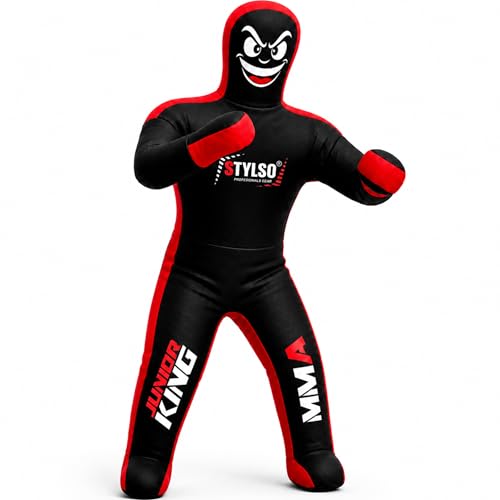


As an Amazon Associate we earn from qualifying purchases at no extra cost to you. Ratings are shown as listed on Amazon.
| Type | Typical finished height | Typical finished weight | Best suited to | Main trade-off |
|---|---|---|---|---|
| Compact or youth | About 3–4 ft | About 10–25 lb | Small spaces, lighter drilling, younger or smaller practitioners | Short limbs and low mass can make adult takedown and leg-lock positioning less realistic |
| Adult, lightweight | About 5–6 ft | About 25–45 lb | Floor transitions, positional sequences, easier carrying and storage | May slide or tip during forceful entries and stand-up drills |
| Adult, medium-to-heavy | About 5–6 ft | About 45–80 lb | More resistance during takedown finishes, passing, and top-control drills | Harder to move, store, and reposition; heavy filling can strain seams if poorly packed |
| Unfilled shell | About 5–6 ft, depending on model | Varies; often sold without a finished weight | Buyers who want to choose the fill and adjust weight | Requires filling time, supplies, and careful packing to avoid lumps |
Height alone is not enough to judge fit. Compare the dummy’s torso, arm, and leg lengths with a training partner of the size you commonly grapple with. A tall but narrow dummy may still feel unlike a real opponent during body-lock or guard drills.
Choose by the training you actually do
- For takedowns and stand-up-to-ground transitions: Look for a full-size dummy with a firm, evenly filled torso and enough finished weight to stay put. A lighter dummy can still help rehearse movement, but it will not provide much resistance to being lifted, driven, or turned.
- For submissions and positional sequences: Prioritize jointed or flexible limbs that can be placed into useful positions and remain there. Check that the arms and legs are long enough to practice your usual entries without forcing awkward angles.
- For solo drilling in a small home: Choose a lighter model with manageable limb bulk and a cover that can be wiped clean. Check the storage footprint when the arms and legs are extended, not only the packaged dimensions.
- For frequent or hard use: Give construction priority over extra features. Reinforced seams at the neck, shoulders, hips, and crotch and a closure that stays shut matter more than a high advertised weight.
If you train several times a week, a mid-weight adult dummy is often a sensible compromise: substantial enough for controlled floor work, but easier to reposition than a very heavy filled model. For occasional technique rehearsal, a lighter dummy may be more practical. Neither replaces live training; a dummy cannot react, grip, or provide the unpredictability of a partner.
Fill material: weight, feel, and mess
Some dummies arrive filled; others are sold as shells. Common fill materials include fabric scraps, foam, and shredded textile. The fill affects not just total weight but also how the dummy bends, settles, and holds its shape.
- Fabric or textile fill is widely used and can provide a dense, flexible body. Pack it evenly, since loose pockets can create hollow areas and lumpy limbs.
- Foam fill can keep the dummy relatively light and resilient. Depending on the construction, it may offer less mass for takedown resistance than densely packed textile.
- Mixed fill can balance weight and flexibility, but the finished result depends on how the materials are distributed and contained.
Do not assume a bag of fill has the same weight or volume as the finished dummy’s advertised capacity. Follow the maker’s instructions, add material gradually, and weigh the completed dummy. Keep the torso denser than the extremities if the design allows; overpacking hands and feet can make limbs stiff and harder to position.
What to inspect before buying
Limb positioning
For BJJ, a dummy should let you rehearse recognizable shapes—such as a bent arm, a tucked elbow, or a leg positioned for a guard or submission sequence. Flexible limbs are useful only if they hold a position under light movement. A completely limp arm may fall away from the torso; a rigid one may prevent realistic transitions. Look for clear descriptions of articulated construction, limb flexibility, and whether the model is designed for grappling rather than striking.
Stitching and closure
Repeated pulling concentrates stress around the shoulder seams, hips, neck, and crotch. Look for reinforced stitching at these junctions and a closure that is protected from direct contact during drills. Zippers can be convenient for filling, but exposed teeth or a weak flap may snag or fail. On a filled dummy, inspect the shell for stretched seams, loose threads, and gaps after the first few sessions.
Cover and cleanability
A tough synthetic cover is generally easier to wipe down than absorbent fabric, but surface material alone does not guarantee durability. Check whether the maker gives cleaning instructions, and avoid soaking a filled dummy unless the instructions specifically allow it. Let a wipedown dummy dry fully before storing it; trapped moisture can cause odor and damage some fills.
Keep it durable: setup and ownership
- Confirm the floor and training space. Clear hard objects and give yourself room to move around the dummy. Use a mat or suitable training surface to limit abrasion and protect the floor.
- Fill in small batches. Distribute material through the torso and limbs instead of forcing all the fill into one area. This reduces lumps and unnecessary stress on seams.
- Check the balance. Sit or lay the dummy in common drilling positions. If it always rolls or collapses to one side, redistribute the fill before adding more weight.
- Inspect high-stress areas regularly. Check seams, closures, and attachment points after training. Repair small seam damage early with an appropriate repair method rather than continuing to pull on a split.
- Store it dry and out of prolonged heat or sun. This helps protect the cover and reduces the chance of moisture or odor building up in the fill.
Common causes of early wear include dragging the dummy across rough floors, overfilling it, grabbing the same seam during every drill, and leaving it damp in a closed bag. Heavy dummies also take more effort to move; plan a safe way to lift and store one before choosing the highest weight available.
A simple decision matrix
| Your situation | Practical starting choice | Why |
|---|---|---|
| Beginner, limited space, occasional practice | Adult lightweight or compact model, with flexible limbs | Easier to handle and store while learning basic positioning |
| Experienced practitioner, regular submission drilling | Full-size model with position-holding limbs and reinforced seams | Supports more varied setups and repeated transitions |
| Stand-up drills and forceful takedown finishes | Heavier adult model with a dense, balanced torso | Less likely to shift than a lightly filled dummy |
| Unsure about preferred weight or fill | Unfilled shell with clear filling instructions | Lets you adjust the finished weight, though it takes extra setup |
Bottom line
For most adult BJJ practitioners, the best grappling dummy is a full-size model with flexible, positionable limbs, reinforced stress-point stitching, and a finished weight suited to the drills you plan to do. Choose lighter for portability and solo movement practice; choose heavier for more stable takedown and top-control work. Before buying, verify finished weight, limb dimensions, fill status, seam construction, and cleaning guidance—the details that determine whether the dummy fits your training and holds up over time.