Key takeaways
- Choose a compact steerable scooter for smooth indoor routes and limited storage, an all-terrain model for frequent outdoor travel, and a folding design when transport is central to your recovery. Across all three, prioritize a properly sized knee pad, a stable steering column, a usable…
The best knee scooters for comfortable lower-leg recovery are a stable steerable model for everyday indoor use, an all-terrain model for uneven outdoor surfaces, or a compact folding model when storage and transport matter most.
A knee scooter can reduce the need to put weight through an injured foot or lower leg, but it is not suitable for every injury or user. Follow your clinician’s weight-bearing instructions, and ask a physical therapist or other qualified professional to check your fit and walking technique if you are unsure.
Our top picks
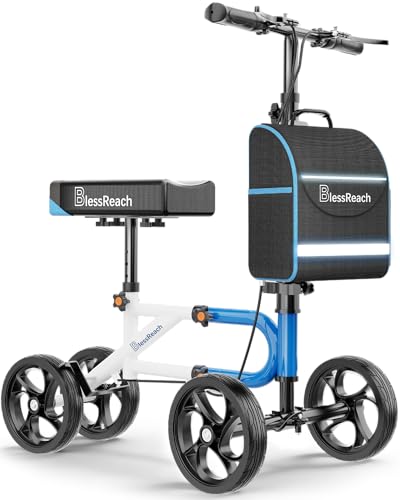


As an Amazon Associate we earn from qualifying purchases at no extra cost to you. Ratings are shown as listed on Amazon.
Best knee scooters by recovery situation
| Recovery situation | Best choice | Specifications to prioritize | Why it fits |
|---|---|---|---|
| Mostly indoors, limited budget | Basic steerable knee scooter | 7–8 inch wheels, 300 lb capacity, adjustable knee pad | Small turning circle and lower purchase cost |
| Regular outdoor use | All-terrain knee scooter | 10–12 inch pneumatic or large solid tires, hand brake, 350 lb capacity | More control over cracks, ramps, and rough paving |
| Small home, car travel, or air travel | Folding knee scooter | Folded length under 40 inches and weight near 20–25 lb | More manageable in a closet, trunk, or elevator |
| First-time scooter user | Four-wheel steerable model with dual brakes | Wide wheelbase, responsive steering, locking hand brakes | Predictable handling is easier to learn than a narrow design |
| Frequent or extended daily use | Reinforced all-terrain or premium steerable model | Replaceable pad, sealed bearings, 350 lb or higher capacity | Better long-term comfort and fewer service issues |
What separates the best knee scooters from merely adequate ones?
Knee-pad dimensions and shape
The knee pad is the main contact point, so its dimensions matter more than cosmetic features. Look for a pad approximately 7–9 inches long and 6–8 inches wide, with enough contoured padding to support the shin without concentrating pressure at the kneecap. A deep channel can help keep the leg centered, while a flat pad may accommodate a wider range of leg shapes.
Measure the lower leg from the floor to the bend behind the knee while wearing the shoe you expect to use. The scooter’s published knee-pad height should cover that measurement, but leave adjustment room rather than operating at the very top or bottom of the range. If your leg is unusually short or long, prioritize a model with independently adjustable knee-pad height and angle.
The pad cover is often one of the first components to wear. Check whether it is removable and replaceable, and clean it with mild soap rather than soaking the foam. A towel or thin sleeve can reduce skin irritation, but it should not make the leg unstable.
Steering stability and turning radius
Four wheels do not automatically make a scooter stable. A broad front axle, firm steering column, and low center of gravity usually matter more. Excessive play in the handlebar can make the scooter wander, while a very narrow frame may feel twitchy when turning.
For homes, a turning radius of about 30–40 inches is practical around kitchen islands, bathroom entrances, and furniture. All-terrain designs with larger wheels often need 40–50 inches or more. Measure the narrowest doorway and the space in front of the toilet or sink; a scooter that fits through a doorway may still be awkward to turn once inside.
Steer slowly and make wide turns on unfamiliar surfaces. Do not use the handlebar to lift the front of the scooter over a curb unless the manufacturer specifically permits it. A curb cut or ramp is safer and places less force on the steering assembly.
Braking and parking control
Hand-operated drum or cable brakes are useful for slowing on slopes and holding the scooter while you sit down. A parking lock is equally important: it should keep the scooter from rolling while you transfer onto the pad or reach for an object.
Test both brake levers before every outing. The scooter should slow without the lever touching the handlebar. Cable brakes can stretch over time, and exposed cables may collect dirt. If the brake feels soft, rubs continuously, or fails to hold on a gentle incline, stop using the scooter until it is adjusted or serviced.
Height adjustment and fit
With your recovering knee centered on the pad, your hips should be level rather than tilted sharply to one side. The handlebar should generally reach near wrist height when you stand upright with relaxed shoulders. Too-low handlebars encourage hunching; too-high handlebars reduce steering control.
After adjustment, lock every quick-release lever and tighten any clamp that uses a knob or bolt. Marking the correct settings with removable tape can make daily setup faster. Recheck them after folding and unfolding because a partially engaged clamp can slip under load.
Head-to-head: compact versus all-terrain scooters
A compact steerable scooter with 7–8 inch wheels is usually the better indoor choice. It is easier to turn, lighter to lift, and less likely to catch on furniture. Models such as compact offerings from KneeRover and Drive Medical are commonly designed around this use case, although exact dimensions and capacities vary by model.
An all-terrain scooter, including models such as the KneeRover All Terrain, uses larger wheels and a longer wheelbase. That design handles pavement joints, grass, gravel, and rough sidewalks better, but it is heavier and needs more room to turn. Pneumatic tires absorb more vibration but can lose air or puncture; solid tires eliminate inflation but transmit more impact through the frame and pad.
| Feature | Compact indoor design | All-terrain design |
|---|---|---|
| Typical wheel size | 7–8 inches | 10–12 inches |
| Typical product weight | 20–25 lb | 25–35 lb |
| Typical turning radius | 30–40 inches | 40–50 inches |
| Common load capacity | 250–300 lb | 300–350 lb or more |
| Best surfaces | Flooring, smooth pavement, short ramps | Cracked sidewalks, compact gravel, grass, rough pavement |
| Main compromise | Less forgiving over obstacles | More weight, space, and rolling resistance |
Folding size, transport, and storage
“Folding” can mean the handlebar folds, the steering column telescopes, or the frame separates into sections. Compare the folded dimensions, not just the word folding in the title. A useful target for car transport is a folded length under 40 inches, folded height under 15 inches, and weight near 20–25 lb. Larger all-terrain models may exceed those figures.
Check whether you can lift the folded scooter safely with one hand or whether you need assistance. A removable basket can reduce bulk, but do not use a front basket to carry a heavy load: added weight can affect steering and braking. Keep frequently used items in a backpack or waist bag instead.
Setup checklist before the first outing
- Set the knee-pad height so your hip remains level and your leg is supported from below the knee.
- Adjust the handlebar until your shoulders are relaxed and your elbows are slightly bent.
- Center the recovering leg in the pad and check that the other foot can push and step safely.
- Engage the parking lock, then confirm every clamp is fully closed.
- Squeeze both brakes and roll a short distance on a clear, level surface.
- Practice stopping, reversing, and turning before using ramps, door thresholds, or crowded paths.
Never carry a passenger, ride down stairs, or exceed the stated weight limit. Wet floors, loose rugs, sand, and steep slopes deserve particular caution. If the scooter pulls to one side, a wheel wobbles, or the frame develops a clicking sound, discontinue use until the problem is identified.
Ownership costs and parts that wear first
Basic knee scooters commonly occupy a general market range of about $100–$200, while premium or all-terrain designs often fall around $200–$400 or more. If you expect a six-week recovery and use the scooter five days per week, that is approximately 30 use-days. A $180 scooter therefore costs about $6 per use-day before resale or rental savings. A more expensive model can make sense when outdoor stability prevents the need for a second mobility aid.
Expect the knee-pad cover, brake cables, tires, wheel bearings, and quick-release hardware to need the most attention. Wipe mud and moisture from the wheels, keep bearings free of hair and grit, and inspect tire pressure weekly when using pneumatic tires. Do not apply oil to a brake cable or bearing unless the manufacturer permits it; lubricant can migrate onto braking surfaces.
Bottom line
Choose a compact steerable scooter for smooth indoor routes and limited storage, an all-terrain model for frequent outdoor travel, and a folding design when transport is central to your recovery. Across all three, prioritize a properly sized knee pad, a stable steering column, a usable parking brake, secure height adjustment, and a turning radius that matches your home. The most expensive specification is less important than a safe fit and predictable control.